Cambridge IGCSE Mathematics (0580) · Direct and inverse proportion (Extended) · Quick revision
Direct and inverse cube-root proportion (Extended)
Methods
| Step | What to do |
|---|---|
| Use the cube-root factor | Write . Use the cube root of the known input before dividing the output by it to find the constant. |
| Find the product and reverse | Write . Multiply the known output by the cube root to get k. If y is supplied, first find , then cube. |
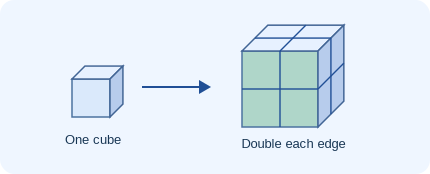
| Check scale and direction | A factor of on x gives a direct cube-root factor of and an inverse cube-root factor of . |
Worked line
Check yourself
For , find when .
Answer