Cambridge IGCSE Mathematics (0580) · Direct and inverse proportion (Extended) · Quick revision
Inverse proportion to a square or cube (Extended)
Methods
| Step | What to do |
|---|---|
| Write the inverse power | Use for an inverse square and for an inverse cube. Multiply the known output by the relevant power of the known input to find k. |
| Transform then invert | For unshifted powers, doubling the input divides inverse-square output by 4 and inverse-cube output by 8. When recovering , isolate the whole denominator and undo the power. |
| Check the transformed product | Check or across known pairs. With , the fixed product is . |
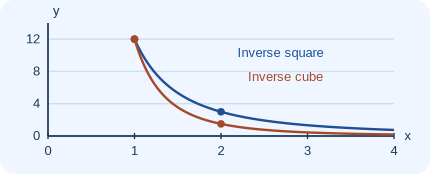
Worked line
Check yourself
For , find when .
Answer