Maths4UBETA

Maths4U · Learning together

Recovered curves, regions and accumulated quantities

← Coefficients as sequence data

Section 1 of 5 · Core · about 7 min

What must I recover before finding an area or volume?

A gradient function gives how the height changes; it does not give the height itself. Integrate first, include the constant, and use the supplied point or level condition to determine it. Keep the original domain of the curve.

Worked example

Recover the curve that will define the region

A curve has gradient dydx=2x−4\frac{\mathrm{d}y}{\mathrm{d}x}=2x-4 and passes through (0,5)(0,5). Find its equation and its least height.

  1. y=∫(2x−4) dx=x2−4x+C.y=\int(2x-4)\,\mathrm{d}x=x^2-4x+C.
  2. The point supplies a height condition:

    5=0−0+C⟹C=5.5=0-0+C\Longrightarrow C=5.
  3. y=x2−4x+5=(x−2)2+1.y=x^2-4x+5=(x-2)^2+1.
  4. The least height is 11, attained at x=2x=2. In particular, the whole curve lies above the xx-axis.

  5. Check both original facts: differentiating gives 2x−42x-4, and at x=0x=0 the height is 55.

Your turn

A curve satisfies h′(x)=3x2−2h^{\prime}(x)=3x^2-2 and h(1)=4h(1)=4. Write h(x)=x3−2x+Ch(x)=x^3-2x+C. Find CC, then find h(2)h(2).

Enter an exact number, for example 3/2 or 2-sqrt(3).

Enter an exact number, for example 3/2 or 2-sqrt(3).

Section 2 of 5 · Core · about 8 min

Which curves and bounds define the required region?

Sketch and label the region after recovering the curve. Use the stated vertical boundaries, or solve the boundary equations simultaneously to find their intersections. Retain only points allowed by the original domains.

Worked example

Use the recovered curve to find a bounded area

Coordinates are in centimetres. Find the area enclosed by the recovered curve y=x2−4x+5y=x^2-4x+5 and the horizontal line y=5y=5.

  1. Find where the two boundaries meet:

    x2−4x+5=5⟹x(x−4)=0⟹x=0,4.x^2-4x+5=5\Longrightarrow x(x-4)=0\Longrightarrow x=0,4.
  2. Between them, the vertical strip height is

    5−(x2−4x+5)=4x−x2=x(4−x)≥0.5-(x^2-4x+5)=4x-x^2=x(4-x)\ge0.

    The line is the upper boundary.

  3. A=∫04(4x−x2) dx.A=\int_0^4(4x-x^2)\,\mathrm{d}x.
  4. A=[2x2−x33]04=32−643=323 cm2.A=\left[2x^2-\frac{x^3}{3}\right]_0^4=32-\frac{64}{3}=\frac{32}{3}\,\mathrm{cm}^2.
  5. The limits came from curve-line intersections, not from setting the derivative to zero. The derivative zero at x=2x=2 locates the curve minimum, not a boundary of this region.

Your turn

Coordinates are in centimetres. Find the intersection inputs and the area enclosed by y=x2−2x+2y=x^2-2x+2 and y=2y=2.

Give the complete set: {1, 4} for separate values, (1, 5] for an interval, U for union or empty for no real solutions. Use sqrt(...) for exact roots.

Enter the value on its own or write area = … . Fractions and exact square roots are accepted.

Section 3 of 5 · Core · about 9 min

How does rotating the region change the integral?

A vertical strip rotated about the xx-axis forms a disk or washer. Radii are nonnegative distances to the axis. If the strip lies on one side of the axis, use the larger distance as the outer radius and the smaller distance as the inner radius.

The recovered region and one perpendicular washer compare a vertical difference of heights with a difference of squared distances to the axis.

  1. Integrate f′(x)=2x−4f'(x)=2x-4 and use f(0)=5f(0)=5 to get f(x)=(x−2)2+1f(x)=(x-2)^2+1.
  2. The strip has height 5−f(x)5-f(x). Rotating it about the horizontal axis gives radii R=5R=5 and r=f(x)r=f(x). At x=2x=2, the washer area is π(52−12)=24π cm2\pi(5^2-1^2)=24\pi\,\mathrm{cm}^2.
  3. A=∫04[5−f(x)] dx=323 cm2.A=\int_0^4[5-f(x)]\,\mathrm{d}x=\frac{32}{3}\,\mathrm{cm}^2.V=π∫04[25−f(x)2] dx=1088π15 cm3.V=\pi\int_0^4[25-f(x)^2]\,\mathrm{d}x=\frac{1088\pi}{15}\,\mathrm{cm}^3.

For f(x)=(x−2)2+1f(x)=(x-2)^2+1 below y=5y=5, the area strip has height 5−f(x)5-f(x). Its rotation has washer area π(25−f(x)2)\pi\bigl(25-f(x)^2\bigr).

Worked example

The same region gives a washer integral after rotation

Coordinates are in centimetres. Rotate the region between y=5y=5 and y=x2−4x+5y=x^2-4x+5, for 0≤x≤40\le x\le4, through one full turn about the xx-axis. Find the volume.

  1. Both boundaries are positive, and the region has a hole after rotation. Its radii are

    R=5,r=x2−4x+5.R=5,\qquad r=x^2-4x+5.
  2. V=π∫04[25−(x2−4x+5)2] dx.V=\pi\int_0^4\left[25-(x^2-4x+5)^2\right]\,\mathrm{d}x.
  3. Square the whole inner radius before subtracting:

    25−(x2−4x+5)2=−x4+8x3−26x2+40x.25-(x^2-4x+5)^2=-x^4+8x^3-26x^2+40x.
  4. V=π[−x55+2x4−26x33+20x2]04=1088π15 cm3.V=\pi\left[-\frac{x^5}{5}+2x^4-\frac{26x^3}{3}+20x^2\right]_0^4=\frac{1088\pi}{15}\,\mathrm{cm}^3.
  5. A quick slice check at x=2x=2 gives R=5R=5, r=1r=1 and area 24π24\pi. Squaring the gap instead would give 16π16\pi, which is a different cross-section.

Your turn

Coordinates are in centimetres. The region between y=2y=2 and y=x2−2x+2y=x^2-2x+2, for 0≤x≤20\le x\le2, is rotated about the xx-axis. Find the washer area at x=1x=1 and the volume of the whole solid.

Enter an exact number, for example 3/2 or 2-sqrt(3).

Enter an exact number, for example 3/2 or 2-sqrt(3).

For rotation about the yy-axis, use horizontal strips: express the distances as functions of yy, integrate with respect to yy, and use the corresponding yy-bounds. The same disk and washer reasoning applies.

Section 4 of 5 · Core · about 9 min

Does greatest volume mean greatest rate of growth?

For a continuous cross-sectional area S(x)≥0S(x)\ge0, define the volume accumulated from the fixed start aa to a variable boundary kk:

V(k)=∫akS(x) dx.V(k)=\int_a^k S(x)\,\mathrm{d}x.

After integrating in xx, the result is a function of kk. Differentiating that expression gives

V′(k)=S(k).V^{\prime}(k)=S(k).

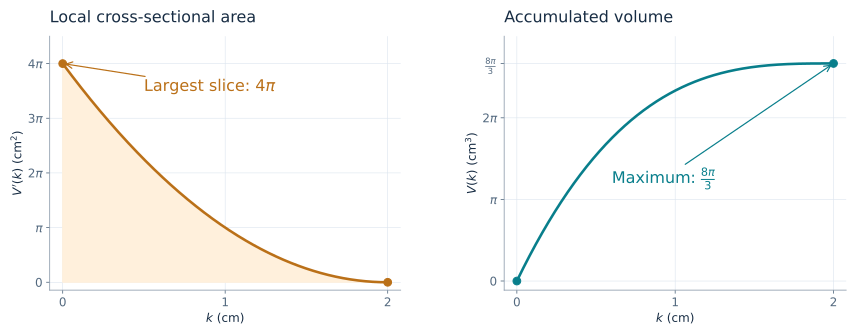
A decreasing cross-sectional area is compared with the increasing accumulated volume of a tapering solid.

  1. From r(x)=2−xr(x)=2-x and 0≤x≤20\le x\le2, integrate the disc areas up to kk.
  2. V(k)=π∫0k(2−x)2 dx=π(4k−2k2+k33).V(k)=\pi\int_0^k(2-x)^2\,\mathrm{d}x=\pi\left(4k-2k^2+\frac{k^3}{3}\right).
  3. Each slice below k=2k=2 adds volume because V′(k)=π(2−k)2>0V'(k)=\pi(2-k)^2>0. With V(0)=0V(0)=0, the maximum accumulated volume is V(2)=8π3V(2)=\frac{8\pi}{3}. The largest slice is at k=0k=0.

For radius 2−x2-x, the spatial growth V′(k)=π(2−k)2V^{\prime}(k)=\pi(2-k)^2 is greatest at the start. The accumulated volume is greatest at the end, where V(2)=8π3V(2)=\frac{8\pi}{3}.

Worked example

Greatest accumulated volume is different from greatest growth

A solid has disk radius 2−x2-x centimetres for 0≤x≤20\le x\le2, with xx in centimetres. Let V(k)V(k) be its volume between x=0x=0 and x=kx=k, where 0≤k≤20\le k\le2. Find V(k)V(k), its greatest value, and where volume grows fastest per unit increase in kk.

  1. V(k)=π∫0k(2−x)2 dx=π(4k−2k2+k33).V(k)=\pi\int_0^k(2-x)^2\,\mathrm{d}x=\pi\left(4k-2k^2+\frac{k^3}{3}\right).
  2. V′(k)=π(2−k)2.V^{\prime}(k)=\pi(2-k)^2.

    This is cross-sectional area in square centimetres, or equivalently volume per centimetre of added length.

  3. The derivative is positive for 0≤k<20\le k<2, so volume increases to the final endpoint:

    Vmax⁡=V(2)=8π3 cm3.V_{\max}=V(2)=\frac{8\pi}{3}\,\mathrm{cm}^3.
  4. The spatial growth π(2−k)2\pi(2-k)^2 decreases over this interval. Its greatest value is 4π cm24\pi\,\mathrm{cm}^2 at k=0k=0, interpreted from the allowed right-hand side.

  5. At k=2k=2, the accumulated volume is greatest even though the final cross-sectional area is zero. The two questions maximise different functions.

A time rate needs a further relationship. If the boundary moves according to k=k(t)k=k(t), use the chain rule at the same instant:

dVdt=dVdkdkdt.\frac{\mathrm{d}V}{\mathrm{d}t}=\frac{\mathrm{d}V}{\mathrm{d}k}\frac{\mathrm{d}k}{\mathrm{d}t}.

Without the boundary speed, a spatial derivative alone does not determine volume per second.

Your turn

A solid has disk radius 3−2x3-2x centimetres for 0≤x≤320\le x\le\frac{3}{2}, where xx is measured in centimetres. Let V(k)V(k) be its volume from x=0x=0 to x=kx=k. Find the value of kk giving the greatest volume, and dVdk\frac{\mathrm{d}V}{\mathrm{d}k} at k=1k=1. If a moving boundary has dkdt=14 cm s−1\frac{\mathrm{d}k}{\mathrm{d}t}=\frac{1}{4}\,\mathrm{cm\,s^{-1}} at that instant, find dVdt\frac{\mathrm{d}V}{\mathrm{d}t}.

Enter an exact number, for example 3/2 or 2-sqrt(3).

Enter an exact number, for example 3/2 or 2-sqrt(3).

Enter an exact number, for example 3/2 or 2-sqrt(3).

Section 5 of 5 · Further applications · about 9 min

How do I recover an amount from a changing rate?

Let q(t)q(t) be the signed net rate and Q(t)Q(t) the amount present. If separate inflow and outflow rates are given, first form inflow minus outflow in matching units.

Worked example

Recover an amount from a signed rate

A tank initially contains 77 litres. Its net rate is 6−2t6-2t litres per minute for 0≤t≤50\le t\le5, with time tt in minutes. Find the final amount, the net change and the greatest amount during this interval.

  1. Integrate the rate and include the initial amount:

    Q(t)=7+∫0t(6−2s) ds=7+6t−t2.Q(t)=7+\int_0^t(6-2s)\,\mathrm{d}s=7+6t-t^2.
  2. Q(5)=7+30−25=12 L.Q(5)=7+30-25=12\,\mathrm{L}.

    The net change is 12−7=5 L12-7=5\,\mathrm{L}, not the final amount.

  3. Q′(t)=6−2t=0⟹t=3.Q^{\prime}(t)=6-2t=0\Longrightarrow t=3.

    The amount increases before this time and decreases afterwards.

  4. Compare the allowed stationary time with both endpoints:

    Q(0)=7,Q(3)=16,Q(5)=12.Q(0)=7,\qquad Q(3)=16,\qquad Q(5)=12.
  5. The greatest amount is 16 L16\,\mathrm{L} at t=3 mint=3\,\mathrm{min}. The highest net rate instead occurs at t=0t=0, where it is 6 L min−16\,\mathrm{L\,min^{-1}}. The amount remains positive throughout the modelled interval.

If the question asks for total increase, integrate the net rate only over intervals where it is positive. Net change also includes the negative-rate intervals. These are changes in the amount present; separate gross inflow and outflow totals cannot be recovered from their difference alone.

Your turn

A tank initially contains 33 litres. Its net rate of change is 4−t4-t litres per minute for 0≤t≤60\le t\le6, with tt in minutes. Find the amount at t=6t=6, the greatest amount, the time at which it occurs and the total increase over intervals when the amount is rising.

Enter an exact number, for example 3/2 or 2-sqrt(3).

Enter an exact number, for example 3/2 or 2-sqrt(3).

Enter an exact number, for example 3/2 or 2-sqrt(3).

Enter an exact number, for example 3/2 or 2-sqrt(3).

Practise this topic

Extra practice from this lesson

Recover the ordinate before finding the region

A curve has y′=6x−6y^{\prime}=6x-6 and passes through (0,4)(0,4). Write it as y=3x2−6x+Cy=3x^2-6x+C. Find CC, its stationary point and the area enclosed by the curve and y=4y=4.

Enter the value on its own or write c = … . Fractions and exact square roots are accepted.

Enter a point as (1, 2) or x = 1, y = 2. Separate complete pairs with commas or semicolons.

Enter the value on its own or write area = … . Fractions and exact square roots are accepted.

Separate signed integral and total area

For f(x)=x2−1f(x)=x^2-1 on [−2,2][-2,2], find ∫−22f(x) dx\int_{-2}^{2}f(x)\,dx and the total area between the curve and the xx-axis.

Enter an exact number, for example 3/2 or 2-sqrt(3).

Enter the value on its own or write area = … . Fractions and exact square roots are accepted.

Use two distances from the rotation axis

The region between y=3y=3 and y=x+1y=x+1, for 0≤x≤20\le x\le2, is rotated about the xx-axis. Find its volume.

Enter an exact number, for example 3/2 or 2-sqrt(3).

Largest cross-section and largest volume

A solid has disk radius 4x−x2\sqrt{4x-x^2} cm at position xx, measured in cm, for 0≤x≤40\le x\le4. Its volume up to position kk is V(k)=π∫0k(4x−x2) dxV(k)=\pi\int_0^k(4x-x^2)\,dx. Find the position and area of the largest disk, and the position and value of the greatest accumulated volume.

Enter an exact number, for example 3/2 or 2-sqrt(3).

Enter an exact number, for example 3/2 or 2-sqrt(3).

Enter an exact number, for example 3/2 or 2-sqrt(3).

Enter an exact number, for example 3/2 or 2-sqrt(3).

The final amount need not be the greatest amount

A tank contains 44 L at t=0t=0. Its net inflow rate is 9−3t9-3t L/min for 0≤t≤50\le t\le5, with tt in minutes. Find the net change over five minutes, the final amount, and the greatest amount and when it occurs.

Enter an exact number, for example 3/2 or 2-sqrt(3).

Enter an exact number, for example 3/2 or 2-sqrt(3).

Enter an exact number, for example 3/2 or 2-sqrt(3).

Enter an exact number, for example 3/2 or 2-sqrt(3).

Exam-style practice

One recovered region, three different calculations 8 marks

A curve has y′=2x−2y^{\prime}=2x-2 and passes through (0,3)(0,3). The region enclosed by this curve and y=3y=3 is rotated about the xx-axis. Find the enclosed area, the resulting volume, and the position and area of the largest washer cross-section.

Hint

Recover the curve first. The plane region uses the separation; the solid uses the difference of squared distances from the axis.

Worked solution
  1. y=x2−2x+C,C=3,y=(x−1)2+2.y=x^2-2x+C,\qquad C=3,\qquad y=(x-1)^2+2.
  2. y=3⟹x(x−2)=0⟹x=0,2.y=3\Longrightarrow x(x-2)=0\Longrightarrow x=0,2.
  3. A=∫02(2x−x2) dx=[x2−x33]02=43.A=\int_0^2(2x-x^2)\,dx=\left[x^2-\frac{x^3}{3}\right]_0^2=\frac{4}{3}.
  4. Throughout this region the outer radius is 33, and the inner radius is the positive curve ordinate.

  5. V=π∫02(9−(x2−2x+3)2) dx=π∫02(−x4+4x3−10x2+12x) dx.V=\pi\int_0^2\left(9-(x^2-2x+3)^2\right)\,dx=\pi\int_0^2(-x^4+4x^3-10x^2+12x)\,dx.
  6. V=π[−x55+x4−10x33+6x2]02=104π15.V=\pi\left[-\frac{x^5}{5}+x^4-\frac{10x^3}{3}+6x^2\right]_0^2=\frac{104\pi}{15}.
  7. The washer area is π(9−y2)\pi(9-y^2). Since y≥2>0y\ge2>0, it is greatest where yy is smallest: at x=1x=1, where y=2y=2.

  8. Awasher,max=π(9−4)=5π.A_{\mathrm{washer,max}}=\pi(9-4)=5\pi.
  9. The plane area and cross-sectional area have square units; volume has cubic units. They describe different geometric objects.

Marking guidance
  • 1 mark: recover the curve and its constant.
  • 1 mark: obtain both intersections and the correct upper boundary.
  • 1 mark: form and evaluate the enclosed-area integral.
  • 1 mark: identify the washer radii.
  • 1 mark: expand the volume integrand correctly.
  • 1 mark: obtain the exact volume.
  • 1 mark: justify the largest washer position using the positive minimum inner radius.
  • 1 mark: obtain the largest washer area and distinguish units.
A local peak is not the global greatest amount 9 marks

A container has 88 L at t=0t=0. Its net inflow rate is 3t2−12t+93t^2-12t+9 L/min on 0≤t≤50\le t\le5. Find the final amount, the greatest amount and its time, the least amount and every time it occurs, and the total increase accumulated over the intervals when the net rate is positive.

Hint

Integrate with the initial condition, find where the net rate is zero, then compare all candidates and both endpoints. The last part asks only for intervals with positive net rate.

Worked solution
  1. Q(t)=8+∫0t(3s2−12s+9) ds=t3−6t2+9t+8.Q(t)=8+\int_0^t(3s^2-12s+9)\,ds=t^3-6t^2+9t+8.
  2. Q′(t)=3(t−1)(t−3).Q^{\prime}(t)=3(t-1)(t-3).
  3. The amount increases on (0,1)(0,1), decreases on (1,3)(1,3), then increases on (3,5)(3,5).

  4. Q(0)=8,Q(1)=12,Q(3)=8,Q(5)=28.Q(0)=8,\quad Q(1)=12,\quad Q(3)=8,\quad Q(5)=28.
  5. The final amount is 2828 L. The greatest amount is also 2828 L, at t=5t=5 min. The least amount is 88 L at both t=0t=0 and t=3t=3 min. The local peak at t=1t=1 is not the global greatest amount.

  6. Total increase=∫01Q′(t) dt+∫35Q′(t) dt=(12−8)+(28−8)=24 L.\text{Total increase}=\int_0^1Q^{\prime}(t)\,dt+\int_3^5Q^{\prime}(t)\,dt=(12-8)+(28-8)=24\ \text{L}.
  7. The amount falls by 44 L between the two stationary times. Thus the signed net change is 24−4=2024-4=20 L, which agrees with Q(5)−Q(0)Q(5)-Q(0). The positive-part integral measures total increase during net-inflow periods; a net-rate model alone does not identify separate gross inflow and outflow.

Marking guidance
  • 1 mark: integrate the rate and include the initial amount.
  • 1 mark: find both zero-rate times.
  • 1 mark: establish the three derivative signs.
  • 1 mark: evaluate the amount at both stationary times and both endpoints.
  • 1 mark: report the final amount and global greatest amount with its time.
  • 1 mark: report the global least amount and both times.
  • 1 mark: choose precisely the two intervals with positive net rate.
  • 1 mark: obtain their total increase.
  • 1 mark: distinguish total increase, net change and separate gross flows.