Maths4U · Learning together
Distinct objects, factorials and position restrictions
Notes
Objective
Choose an ordered sample space, then handle leading zeroes, blocks, distances and relative order without double-counting.
Before you start
Work with exact integer counts and identify what makes two outcomes different. Probability applications also use the conditional sample space from the preceding chapter. All arrangements here are in a line or in labelled rows; circular arrangements are excluded.
Key ideas
The product rule counts a staged construction
Multiply the number of choices at each stage when each permitted partial construction has the stated number of continuations. Add disjoint cases when that number depends on an earlier choice. Mutually exclusive cases are not multiplied together.
Factorials and ordered selections
For non-negative integers, n! multiplies 1 through n, with 0!=1. For r distinct objects chosen and placed in order from n distinct objects,
Without repetition, the choices decrease after each position. If repetitions are allowed, the same count may remain available.
Leading zero and end conditions interact
A number cannot start with zero. For an even number with distinct digits, split the last digit into zero and non-zero even cases: they leave different numbers of non-zero first choices.
Blocks, exact separation and relative order
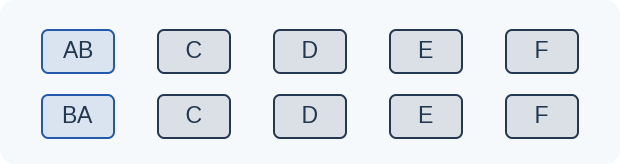
For two named objects together, treat them as one unit, arrange the units and restore their two internal orders. For exactly g objects between them, their positions differ by g+1. A relative order such as A before B is not an adjacency requirement.
Method
- Decide whether order, object identity and group labels matter.
- Choose a disjoint case split or a staged construction.
- Count each allowed outcome once and restore internal orders if needed.
- Check restrictions, impossible cases and any overcounting factor.
- For a probability, use the same kind of equally likely outcome in numerator and denominator.
Common mistakes
- Do not use combinations when the order matters.
- Handle zero separately when forming numbers.
- A block has internal orders only for distinguishable members.
- Exactly g objects between two names differs from a minimum gap.
Worked examples
A choice and an ordered programme differ
Three of six different talks are selected. How many selections are possible, and how many ordered three-talk programmes?
Follow the solutionEach selection gives 3!=6 different programmes. Selecting a set does not assign its order.
An even last digit changes the first choices
Form a four-digit number from 0 to 5 without repeating a digit. Count all such numbers and the even ones.
Follow the solutionThere are five non-zero first choices, then five, four and three choices.
For even numbers split on the final digit.
The even count is 156. Using five first choices in the second case would reuse its non-zero final digit.
A named pair is a block with two orders
Six different people, including A and B, stand in a line. Find the counts with A and B adjacent and with them apart.
Follow the solutionThe five units are the pair-block and the four other people. The factor 2 restores AB and BA.
Relative order does not require consecutive places
Six different objects include A, B and C. How many linear orders have A before B before C?
Follow the solutionEvery choice of their three positions has exactly one allowed order of A, B, C. Fill the other three positions freely.
Equivalently, one of the equally frequent relative orders is allowed, so the count is .