Maths4U · Learning together
Repeated symbols, blocks and gap methods
Notes
Objective
Count distinct visible patterns and use gaps to separate identical objects or enforce exactly one adjacent pair.
Before you start
Work with exact integer counts and identify what makes two outcomes different. Probability applications also use the conditional sample space from the preceding chapter. All arrangements here are in a line or in labelled rows; circular arrangements are excluded.
Key ideas
Identical symbols do not acquire hidden labels
If n symbols have repeated multiplicities a,b,…, the number of distinct full patterns is
Swapping two identical A tiles does not create a new pattern. Physical tile selections may require a different model; the final lesson makes that distinction explicit.
Apply restrictions after deciding what is identical
If an A must be first, remove one A and recount the remaining multiplicities. A block AA has only one internal pattern; a block AB of distinct symbols has two if either order is allowed.
Arrange the ordinary objects, then choose gaps
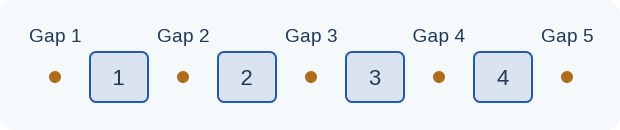
n distinct ordinary objects leave n+1 gaps, including both ends. Place at most one identical special object in each chosen gap to prevent adjacency. If the ends must be ordinary, use only the n−1 internal gaps.
Exactly one adjacent pair is a separate event
With three identical red counters, a pair and a single red must occupy distinct gaps of the ordinary objects. Their gap roles differ, even though the red counters do not. Do not include a triple or count the same pair twice. If two pair-events overlap, remove their common arrangements with the correct multiplicity.
Method
- Decide whether order, object identity and group labels matter.
- Choose a disjoint case split or a staged construction.
- Count each allowed outcome once and restore internal orders if needed.
- Check restrictions, impossible cases and any overcounting factor.
- For a probability, use the same kind of equally likely outcome in numerator and denominator.
Common mistakes
- Do not label identical tiles and then forget to remove overcounting.
- Remove a fixed symbol before applying the repeated-factor denominator.
- The end gaps count unless the ends are restricted.
- Exactly one adjacent pair excludes both no pair and a triple.
Worked examples
Fix a repeated symbol, then recount
Arrange A,A,A,B,B,C in a line. Count all distinct patterns and those beginning with A.
Follow the solutionAfter fixing the first A, two As remain. Dividing the remaining patterns by 3! would remove too many orders.
Two pair-events overlap
Arrange A,A,B,B,C,D. Find the counts with both AA and BB together, with exactly one pair together, and the latter probability given at least one pair is together in a uniform random pattern.
Follow the solutionAA together gives ; BB together also gives 60. Both together gives . Let E mean exactly one pair together and H mean at least one pair together.
Separate two identical counters with ordinary objects
Arrange four different numbered counters and two identical red counters. Count arrangements with the reds separated and with the reds adjacent.
Follow the solutionArrange the numbered counters in ways. There are five gaps for two separated reds.
The counts sum to , the total number of patterns.
A pair and a single need different gaps
Arrange three different ordinary counters and three identical red counters. Count no adjacent reds, exactly one red pair with the third red separate, and all three reds together.
Follow the solutionIn the middle case choose the pair-gap, then a different single-gap. The three cases total .