Maths4UBETA

Changing the subject of a simple formula

Make one letter the subject using inverse operations where the subject appears once.

Try the quick check →
Lesson 3 of 8

Section 1 of 3 · Core · about 7 min

What does the subject mean?

The subject is the letter isolated on one side. Changing the subject expresses the same relationship in a different order.
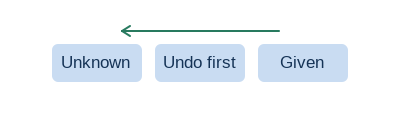
Two operations shown in reverse order, with arrows from right to left.

Start from the given result and work back through the operations.

Worked example

Make x the subject

Make xx the subject of p=5x+4p=5x+4.

  1. Subtract 44 from both sides, giving p−4=5xp-4=5x.

  2. Divide both sides by 55 and write the formula with xx alone on the left.

  3. The answer is x=p−45x=\frac{p-4}{5}.

Your turn

Make xx the subject of p=7x+2p=7x+2.

Enter a single fraction such as (2x+1)/(x−3). You can also separate the numerator and denominator with a semicolon.

Worked example

Make x the subject

Make xx the subject of p=9x+8p=9x+8.

Try it on paper first.

  1. Subtract 88 from both sides, giving p−8=9xp-8=9x.

  2. Divide both sides by 99 and write the formula with xx alone on the left.

  3. The answer is x=p−89x=\frac{p-8}{9}.

Your turn

Make xx the subject of p=3x+5p=3x+5.

Enter a single fraction such as (2x+1)/(x−3). You can also separate the numerator and denominator with a semicolon.

Section 2 of 3 · Core · about 7 min

How can I remove a denominator?

Multiply both sides by the denominator. Then continue to undo operations until the intended letter is alone.

Worked example

Make x the subject

Make xx the subject of p=6x5p=\frac{6x}{5}.

  1. Multiply both sides by 55 to remove the denominator.

  2. Divide both sides by 66 and write the formula with xx alone on the left.

  3. The answer is x=5p6x=\frac{5p}{6}.

Your turn

Make xx the subject of p=8x3p=\frac{8x}{3}.

Enter a single fraction such as (2x+1)/(x−3). You can also separate the numerator and denominator with a semicolon.

Worked example

Make x the subject

Make xx the subject of p=3x9p=\frac{3x}{9}.

Try it on paper first.

  1. Multiply both sides by 99 to remove the denominator.

  2. Divide both sides by 33 and write the formula with xx alone on the left.

  3. The answer is x=9p3x=\frac{9p}{3}.

Your turn

Make xx the subject of p=4x6p=\frac{4x}{6}.

Enter a single fraction such as (2x+1)/(x−3). You can also separate the numerator and denominator with a semicolon.

Section 3 of 3 · Core · about 7 min

How can I check the new rule?

Choose simple numbers to check one example in both versions. The formula should reproduce the same relationship.

Worked example

Rearrange and use a simple formula

The value of qq is given by q=8+6aq=8+6a. Write a formula giving aa in terms of qq.

  1. Subtract 88 from each side before dividing.

  2. Divide the resulting expression by 66.

  3. The answer is a=q−86a=\frac{q-8}{6}.

Your turn

The value of qq is given by q=10+4aq=10+4a. Write a formula giving aa in terms of qq.

Enter a single fraction such as (2x+1)/(x−3). You can also separate the numerator and denominator with a semicolon.

Worked example

Rearrange and use a simple formula

The value of qq is given by q=5+10aq=5+10a. Write a formula giving aa in terms of qq.

Try it on paper first.

  1. Subtract 55 from each side before dividing.

  2. Divide the resulting expression by 1010.

  3. The answer is a=q−510a=\frac{q-5}{10}.

Your turn

The value of qq is given by q=6+7aq=6+7a. Write a formula giving aa in terms of qq.

Enter a single fraction such as (2x+1)/(x−3). You can also separate the numerator and denominator with a semicolon.

Worked examples

Practise the method

Core practice

Question 1 of 5

0 / 5 checked in this collection

Question list

Core practice

Fresh variants

Exam-style

Make x the subject

1 mark

Make xx the subject of p=5x+10p=5x+10.

Enter a single fraction such as (2x+1)/(x−3). You can also separate the numerator and denominator with a semicolon.

Full answer-format guide

Exact numbers: 3/2, sqrt(5), 2-sqrt(3), pi/6, 3*pi/2. Sets: {1,4}. Intervals: (3,5]; a round bracket excludes the endpoint. Infinity: inf; union: U; no solutions: empty. Separate coordinate pairs or triples with semicolons. Expressions: 2x^2+3x-1; equations: x^2=3x+1 or the polynomial equal to zero. Factors: x-1 ; x+2. Parameter fraction: numerator ; denominator. List integer answers individually.

Review the method

Progress stays in this browser. Create an account to save it or sign in.

Extra practice from this lesson

Make xx the subject of p=9x+11p=9x+11.

Enter a single fraction such as (2x+1)/(x−3). You can also separate the numerator and denominator with a semicolon.

Make xx the subject of p=3x+12p=3x+12.

Enter a single fraction such as (2x+1)/(x−3). You can also separate the numerator and denominator with a semicolon.

Make xx the subject of p=5x3p=\frac{5x}{3}.

Enter a single fraction such as (2x+1)/(x−3). You can also separate the numerator and denominator with a semicolon.

Make xx the subject of p=6x4p=\frac{6x}{4}.

Enter a single fraction such as (2x+1)/(x−3). You can also separate the numerator and denominator with a semicolon.

The value of qq is given by q=9+6aq=9+6a. Write a formula giving aa in terms of qq.

Enter a single fraction such as (2x+1)/(x−3). You can also separate the numerator and denominator with a semicolon.

The value of qq is given by q=10+7aq=10+7a. Write a formula giving aa in terms of qq.

Enter a single fraction such as (2x+1)/(x−3). You can also separate the numerator and denominator with a semicolon.

Apply it · original exam-style problems

Show your working on paper and compare it with the worked solution and marking guidance.

Come back to what needs practice

Quick revision sheet (A4)

Your review plan starts after your first check.