Maths4UBETA

Angles at points, on lines and in shapes

Choose the correct sum or equality and give geometrical reasons for unknown angles.

Try the quick check →
Lesson 10 of 15

Section 1 of 3 · Core · about 8 min

Is this a straight line or a full turn?

All the angles around a point make a complete turn of 360∘360^\circ. Angles that fill one side of a straight line make a half-turn of 180∘180^\circ.

Worked example

Apply the correct line or point angle fact

The horizontal line is straight. Find x.
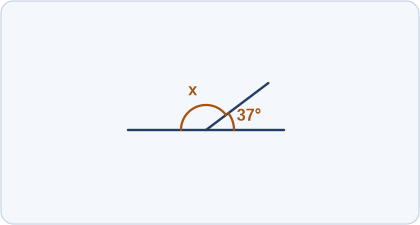
A ray divides the angle above a straight line into two marked parts.

  1. Angles on a straight line sum to 180°.

  2. 180∘−37∘=143∘180^\circ-37^\circ=143^\circ.

Your turn

The horizontal line is straight. Find x.

A ray divides the angle above a straight line into two marked parts.

Enter the angle in degrees.

Worked example

Apply the correct line or point angle fact

The angles shown make one full turn. Find the reflex angle x.
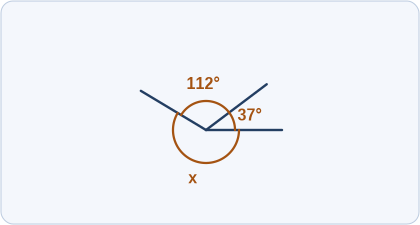
Three rays meet at a point. One of the three marked angles is reflex.

Try it on paper first.

  1. Angles around a point sum to 360°.

  2. 360∘−37∘−112∘=211∘360^\circ-37^\circ-112^\circ=211^\circ.

Your turn

The angles shown make one full turn. Find the reflex angle x.

Three rays meet at a point. One of the three marked angles is reflex.

Enter the angle in degrees.

Section 2 of 3 · Core · about 8 min

When are angles equal instead of supplementary?

When two straight lines cross, opposite angles have equal size. Adjacent angles on the same straight line are supplementary.

Two straight lines cross. The marked angles are vertically opposite.

The two equal angles lie across the intersection of the straight lines.

Worked example

Apply the correct line or point angle fact

The two intersecting lines are straight. Find x.
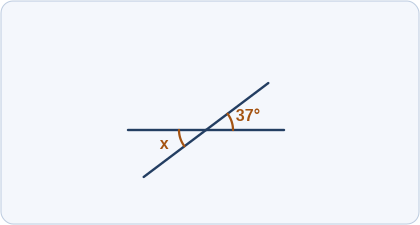
Two straight lines cross. The marked angles are vertically opposite.

  1. Vertically opposite angles are equal.

  2. x=37∘x=37^\circ.

Your turn

The two intersecting lines are straight. Find x.

Two straight lines cross. The marked angles are vertically opposite.

Enter the angle in degrees.

Worked example

Use the angle sum of a triangle

In triangle ABC, ∠BAC\angle BAC is 37∘37^\circ and ∠ABC\angle ABC is 53∘53^\circ. Find ∠BCA\angle BCA.

Try it on paper first.

  1. The three interior angles of a triangle sum to 180°.

  2. 180∘−37∘−53∘=90∘180^\circ-37^\circ-53^\circ=90^\circ.

Your turn

In triangle ABC, ∠BAC\angle BAC is 48∘48^\circ and ∠ABC\angle ABC is 54∘54^\circ. Find ∠BCA\angle BCA.

Enter the angle in degrees.

Section 3 of 3 · Core · about 8 min

How do equal sides and diagonals help?

Two equal sides of an isosceles triangle face equal angles. Mark the equal sides and then check which vertices lie opposite them.

Worked example

Find a base angle in an isosceles triangle

Triangle ABC has AB = AC and ∠BAC\angle BAC = 36∘36^\circ. Find ∠ABC\angle ABC.

  1. The base angles opposite the two equal sides are equal.

  2. Subtract 36∘36^\circ from 180∘180^\circ and share the result equally to obtain 72∘72^\circ.

Your turn

Triangle ABC has AB = AC and ∠BAC\angle BAC = 42∘42^\circ. Find ∠ABC\angle ABC.

Enter the angle in degrees.

Worked example

Find the fourth angle of a quadrilateral

Three interior angles of quadrilateral ABCD are 76∘76^\circ, 92∘92^\circ and 113∘113^\circ. Find the remaining interior angle.

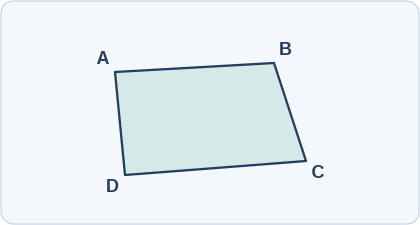
A labelled quadrilateral with vertices A, B, C, D in order.

Try it on paper first.

  1. The interior angles of a quadrilateral sum to 360°.

  2. Subtract the three given angles from 360∘360^\circ to obtain 79∘79^\circ.

Your turn

Three interior angles of quadrilateral ABCD are 77∘77^\circ, 93∘93^\circ and 114∘114^\circ. Find the remaining interior angle.

A labelled quadrilateral with vertices A, B, C, D in order.

Enter the angle in degrees.

Worked examples

Practise the method

Core practice

Question 1 of 5

0 / 5 checked in this collection

Question list

Core practice

Fresh variants

Exam-style

Apply the correct line or point angle fact

1 mark

The horizontal line is straight. Find x.
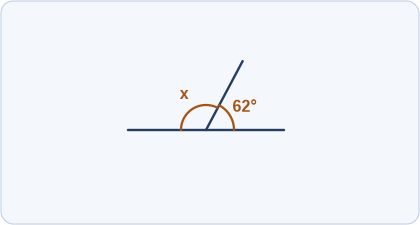
A ray divides the angle above a straight line into two marked parts.

Enter the angle in degrees.

Full answer-format guide

Exact numbers: 3/2, sqrt(5), 2-sqrt(3), pi/6, 3*pi/2. Sets: {1,4}. Intervals: (3,5]; a round bracket excludes the endpoint. Infinity: inf; union: U; no solutions: empty. Separate coordinate pairs or triples with semicolons. Expressions: 2x^2+3x-1; equations: x^2=3x+1 or the polynomial equal to zero. Factors: x-1 ; x+2. Parameter fraction: numerator ; denominator. List integer answers individually.

Review the method

Progress stays in this browser. Create an account to save it or sign in.

Extra practice from this lesson

Apply the correct line or point angle fact

The horizontal line is straight. Find x.

A ray divides the angle above a straight line into two marked parts.

Enter the angle in degrees.

Apply the correct line or point angle fact

The angles shown make one full turn. Find the reflex angle x.

Three rays meet at a point. One of the three marked angles is reflex.

Enter the angle in degrees.

Apply the correct line or point angle fact

The two intersecting lines are straight. Find x.

Two straight lines cross. The marked angles are vertically opposite.

Enter the angle in degrees.

Use the angle sum of a triangle

In triangle ABC, ∠BAC\angle BAC is 58∘58^\circ and ∠ABC\angle ABC is 55∘55^\circ. Find ∠BCA\angle BCA.

Enter the angle in degrees.

Find a base angle in an isosceles triangle

Triangle ABC has AB = AC and ∠BAC\angle BAC = 48∘48^\circ. Find ∠ABC\angle ABC.

Enter the angle in degrees.

Find the fourth angle of a quadrilateral

Three interior angles of quadrilateral ABCD are 78∘78^\circ, 94∘94^\circ and 115∘115^\circ. Find the remaining interior angle.

A labelled quadrilateral with vertices A, B, C, D in order.

Enter the angle in degrees.

Apply it · original exam-style problems

Show your working on paper and compare it with the worked solution and marking guidance.

Come back to what needs practice

Quick revision sheet (A4)

Your review plan starts after your first check.