Maths4UBETA

Extended: conditional probability from trees

Read a given starting branch and work backwards from a known outcome by comparing complete path probabilities.

Try the quick check →
Lesson 9 of 9

Section 1 of 3 · Extension · about 6 min

What if I already know the first branch?

Practise the method

Ignore the branch leading to the other node. Read the second-stage proportion from the given group.

Worked example

Use the given event to select the relevant tree branches

A selector chooses bag A with probability 16\frac{1}{6} and bag B otherwise. Bag A contains 2 copper tiles out of 17. Bag B contains 18 copper tiles out of 22. Once a bag is chosen, a tile is drawn at random from it. It is known that bag A was chosen. Find the probability that the tile is copper. Give an exact fraction or decimal.

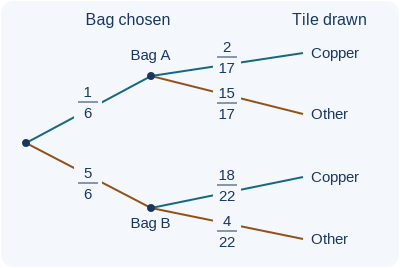
First stage, Bag A: 1 out of 6, Bag B: 5 out of 6. After Bag A, Copper: missing probability, Other: 15 out of 17. After Bag B, Copper: 18 out of 22, Other: 4 out of 22.

  1. First stage, Bag A: 1 out of 6, Bag B: 5 out of 6. After Bag A, Copper: 2 out of 17, Other: 15 out of 17. After Bag B, Copper: 18 out of 22, Other: 4 out of 22.

  2. Keep the branch for bag A. Within that branch there are 2 copper tiles out of 17 in total.

  3. The probability written on that outgoing branch gives the required chance.

  4. The answer is 217\frac{2}{17}.

Your turn

A selector chooses bag A with probability 27\frac{2}{7} and bag B otherwise. Bag A contains 15 copper tiles out of 18. Bag B contains 4 copper tiles out of 23. Once a bag is chosen, a tile is drawn at random from it. It is known that bag A was chosen. Find the probability that the tile is copper. Give your answer as an exact fraction.

First stage, Bag A: 2 out of 7, Bag B: 5 out of 7. After Bag A, Copper: missing probability, Other: 3 out of 18. After Bag B, Copper: 4 out of 23, Other: 19 out of 23.

Enter a probability such as 1/4, 0.25 or 25%.

Worked example

Use the given event to select the relevant tree branches

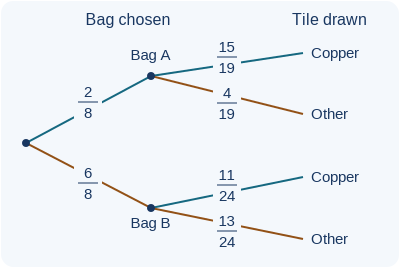
A selector chooses bag A with probability 14\frac{1}{4} and bag B otherwise. Bag A contains 15 copper tiles out of 19. Bag B contains 11 copper tiles out of 24. Once a bag is chosen, a tile is drawn at random from it. Find the probability the drawn tile is copper. Give an exact fraction or decimal.

First stage, Bag A: 2 out of 8, Bag B: 6 out of 8. After Bag A, Copper: 15 out of 19, Other: 4 out of 19. After Bag B, Copper: 11 out of 24, Other: 13 out of 24.

Try it on paper first.

  1. A copper tile can come from either bag. Multiply the chance of choosing each bag by its own copper probability.

  2. The path probabilities are 1576\frac{15}{76} and 1132\frac{11}{32}. Add those two distinct ways to reach copper.

  3. The answer is 329608\frac{329}{608}.

Your turn

A selector chooses bag A with probability 89\frac{8}{9} and bag B otherwise. Bag A contains 17 copper tiles out of 20. Bag B contains 20 copper tiles out of 25. Once a bag is chosen, a tile is drawn at random from it. Find the probability the drawn tile is copper. Give your answer as an exact fraction.

First stage, Bag A: 8 out of 9, Bag B: 1 out of 9. After Bag A, Copper: 17 out of 20, Other: 3 out of 20. After Bag B, Copper: 20 out of 25, Other: 5 out of 25.

Enter a probability such as 1/4, 0.25 or 25%.

Section 2 of 3 · Extension · about 7 min

How do I work backwards from the outcome?

Practise the method

Multiply along the retained paths. Divide the relevant path probability by the sum of the retained path probabilities.

Worked example

Use the given event to select the relevant tree branches

A selector chooses bag A with probability 817\frac{8}{17} and bag B otherwise. Bag A contains 7 copper tiles out of 11. Bag B contains 6 copper tiles out of 14. Once a bag is chosen, a tile is drawn at random from it. It is known that the tile is copper. Find the probability the selector chose bag A. Give an exact fraction or decimal.

First stage, Bag A: 8 out of 17, Bag B: 9 out of 17. After Bag A, Copper: 7 out of 11, Other: 4 out of 11. After Bag B, Copper: 6 out of 14, Other: 8 out of 14.

  1. The two ways to reach copper are bag A then copper and bag B then copper. Their probabilities are 56187\frac{56}{187} and 27119\frac{27}{119}.

  2. Only copper outcomes are still possible. The total weight of those two paths is 6891309\frac{689}{1309}. Divide the bag A copper path's weight by that total.

  3. The answer is 392689\frac{392}{689}.

Your turn

A selector chooses bag A with probability 15\frac{1}{5} and bag B otherwise. Bag A contains 4 copper tiles out of 12. Bag B contains 3 copper tiles out of 15. Once a bag is chosen, a tile is drawn at random from it. It is known that the tile is copper. Find the probability the selector chose bag A. Give your answer as an exact fraction.

First stage, Bag A: 1 out of 5, Bag B: 4 out of 5. After Bag A, Copper: 4 out of 12, Other: 8 out of 12. After Bag B, Copper: 3 out of 15, Other: 12 out of 15.

Enter a probability such as 1/4, 0.25 or 25%.

Worked example

Use the given event to select the relevant tree branches

A selector chooses bag A with probability 23\frac{2}{3} and bag B otherwise. Bag A contains 7 copper tiles out of 13. Bag B contains 4 copper tiles out of 16. Once a bag is chosen, a tile is drawn at random from it. The drawn tile is not copper. Find the probability the selector chose bag B. Give an exact fraction or decimal.

First stage, Bag A: 4 out of 6, Bag B: 2 out of 6. After Bag A, Copper: 7 out of 13, Other: 6 out of 13. After Bag B, Copper: 4 out of 16, Other: 12 out of 16.

Try it on paper first.

  1. The not-copper paths from bags A and B have probabilities 413\frac{4}{13} and 14\frac{1}{4}.

  2. Use the combined weight 2952\frac{29}{52} of the two not-copper paths as the denominator. Only the second of the paths begins in bag B.

  3. The answer is 1329\frac{13}{29}.

Your turn

A selector chooses bag A with probability 37\frac{3}{7} and bag B otherwise. Bag A contains 4 copper tiles out of 14. Bag B contains 9 copper tiles out of 17. Once a bag is chosen, a tile is drawn at random from it. The drawn tile is not copper. Find the probability the selector chose bag B. Give your answer as an exact fraction.

First stage, Bag A: 3 out of 7, Bag B: 4 out of 7. After Bag A, Copper: 4 out of 14, Other: 10 out of 14. After Bag B, Copper: 9 out of 17, Other: 8 out of 17.

Enter a probability such as 1/4, 0.25 or 25%.

Section 3 of 3 · Extension · about 7 min

How do I tell a joint event from a condition?

Practise the method

For a joint event use the full path's probability. If a final event is known, use its total probability as the new denominator.

Worked example

Use the given event to select the relevant tree branches

A selector chooses bag A with probability 115\frac{1}{15} and bag B otherwise. Bag A contains 4 copper tiles out of 22. Bag B contains 17 copper tiles out of 25. Once a bag is chosen, a tile is drawn at random from it. The drawn tile is not copper. Find the probability the selector chose bag B. Give an exact fraction or decimal.

First stage, Bag A: 1 out of 15, Bag B: 14 out of 15. After Bag A, Copper: 4 out of 22, Other: 18 out of 22. After Bag B, Copper: 17 out of 25, Other: 8 out of 25.

  1. The not-copper paths from bags A and B have probabilities 355\frac{3}{55} and 112375\frac{112}{375}.

  2. Use the combined weight 14574125\frac{1457}{4125} of the two not-copper paths as the denominator. Only the second of the paths begins in bag B.

  3. The answer is 12321457\frac{1232}{1457}.

Your turn

A selector chooses bag A with probability 916\frac{9}{16} and bag B otherwise. Bag A contains 5 copper tiles out of 6. Bag B contains 6 copper tiles out of 7. Once a bag is chosen, a tile is drawn at random from it. The drawn tile is not copper. Find the probability the selector chose bag B. Give an exact fraction or decimal.

First stage, Bag A: 9 out of 16, Bag B: 7 out of 16. After Bag A, Copper: 5 out of 6, Other: 1 out of 6. After Bag B, Copper: 6 out of 7, Other: 1 out of 7.

Use a fraction, a percentage or a decimal rounded to at least 3 significant figures.

Worked example

Use the given event to select the relevant tree branches

A selector chooses bag A with probability 517\frac{5}{17} and bag B otherwise. Bag A contains 6 copper tiles out of 7. Bag B contains 7 copper tiles out of 8. Once a bag is chosen, a tile is drawn at random from it. It is known that the tile is copper. Find the probability the selector chose bag A. Give an exact fraction or decimal.

First stage, Bag A: 5 out of 17, Bag B: 12 out of 17. After Bag A, Copper: 6 out of 7, Other: 1 out of 7. After Bag B, Copper: 7 out of 8, Other: 1 out of 8.

Try it on paper first.

  1. The two ways to reach copper are bag A then copper and bag B then copper. Their probabilities are 30119\frac{30}{119} and 2134\frac{21}{34}.

  2. Only copper outcomes are still possible. The total weight of those two paths is 207238\frac{207}{238}. Divide the bag A copper path's weight by that total.

  3. The answer is 2069\frac{20}{69}.

Your turn

A selector chooses bag A with probability 25\frac{2}{5} and bag B otherwise. Bag A contains 3 copper tiles out of 8. Bag B contains 4 copper tiles out of 9. Once a bag is chosen, a tile is drawn at random from it. It is known that the tile is copper. Find the probability the selector chose bag A. Give an exact fraction or decimal.

First stage, Bag A: 2 out of 5, Bag B: 3 out of 5. After Bag A, Copper: 3 out of 8, Other: 5 out of 8. After Bag B, Copper: 4 out of 9, Other: 5 out of 9.

Use a fraction, a percentage or a decimal rounded to at least 3 significant figures.

Worked examples

Practise the method

Core practice

Question 1 of 5

0 / 5 checked in this collection

Question list

Core practice

Fresh variants

Exam-style

Use the given event to select the relevant tree branches

1 mark

A selector chooses bag A with probability 513\frac{5}{13} and bag B otherwise. Bag A contains 6 copper tiles out of 8. Bag B contains 9 copper tiles out of 17. Once a bag is chosen, a tile is drawn at random from it. It is known that bag A was chosen. Find the probability that the tile is copper. Give an exact fraction or decimal.

First stage, Bag A: 5 out of 13, Bag B: 8 out of 13. After Bag A, Copper: missing probability, Other: 2 out of 8. After Bag B, Copper: 9 out of 17, Other: 8 out of 17.

Use a fraction, a percentage or a decimal rounded to at least 3 significant figures.

Full answer-format guide

Exact numbers: 3/2, sqrt(5), 2-sqrt(3), pi/6, 3*pi/2. Sets: {1,4}. Intervals: (3,5]; a round bracket excludes the endpoint. Infinity: inf; union: U; no solutions: empty. Separate coordinate pairs or triples with semicolons. Expressions: 2x^2+3x-1; equations: x^2=3x+1 or the polynomial equal to zero. Factors: x-1 ; x+2. Parameter fraction: numerator ; denominator. List integer answers individually.

Review the method

Progress stays in this browser. Create an account to save it or sign in.

Extra practice from this lesson

Use the given event to select the relevant tree branches

A selector chooses bag A with probability 611\frac{6}{11} and bag B otherwise. Bag A contains 7 copper tiles out of 22. Bag B contains 3 copper tiles out of 8. Once a bag is chosen, a tile is drawn at random from it. It is known that bag A was chosen. Find the probability that the tile is copper. Give your answer as an exact fraction.

First stage, Bag A: 6 out of 11, Bag B: 5 out of 11. After Bag A, Copper: missing probability, Other: 15 out of 22. After Bag B, Copper: 3 out of 8, Other: 5 out of 8.

Enter a probability such as 1/4, 0.25 or 25%.

Use the given event to select the relevant tree branches

A selector chooses bag A with probability 57\frac{5}{7} and bag B otherwise. Bag A contains 4 copper tiles out of 8. Bag B contains 7 copper tiles out of 11. Once a bag is chosen, a tile is drawn at random from it. Find the probability the drawn tile is copper. Give your answer as an exact fraction.

First stage, Bag A: 10 out of 14, Bag B: 4 out of 14. After Bag A, Copper: 4 out of 8, Other: 4 out of 8. After Bag B, Copper: 7 out of 11, Other: 4 out of 11.

Enter a probability such as 1/4, 0.25 or 25%.

Use the given event to select the relevant tree branches

A selector chooses bag A with probability 59\frac{5}{9} and bag B otherwise. Bag A contains 10 copper tiles out of 16. Bag B contains 15 copper tiles out of 19. Once a bag is chosen, a tile is drawn at random from it. It is known that the tile is copper. Find the probability the selector chose bag A. Give your answer as an exact fraction.

First stage, Bag A: 5 out of 9, Bag B: 4 out of 9. After Bag A, Copper: 10 out of 16, Other: 6 out of 16. After Bag B, Copper: 15 out of 19, Other: 4 out of 19.

Enter a probability such as 1/4, 0.25 or 25%.

Use the given event to select the relevant tree branches

A selector chooses bag A with probability 112\frac{1}{12} and bag B otherwise. Bag A contains 15 copper tiles out of 19. Bag B contains 18 copper tiles out of 22. Once a bag is chosen, a tile is drawn at random from it. The drawn tile is not copper. Find the probability the selector chose bag B. Give your answer as an exact fraction.

First stage, Bag A: 1 out of 12, Bag B: 11 out of 12. After Bag A, Copper: 15 out of 19, Other: 4 out of 19. After Bag B, Copper: 18 out of 22, Other: 4 out of 22.

Enter a probability such as 1/4, 0.25 or 25%.

Use the given event to select the relevant tree branches

A selector chooses bag A with probability 47\frac{4}{7} and bag B otherwise. Bag A contains 9 copper tiles out of 10. Bag B contains 10 copper tiles out of 11. Once a bag is chosen, a tile is drawn at random from it. The drawn tile is not copper. Find the probability the selector chose bag B. Give your answer as an exact fraction.

First stage, Bag A: 4 out of 7, Bag B: 3 out of 7. After Bag A, Copper: 9 out of 10, Other: 1 out of 10. After Bag B, Copper: 10 out of 11, Other: 1 out of 11.

Enter a probability such as 1/4, 0.25 or 25%.

Use the given event to select the relevant tree branches

A selector chooses bag A with probability 710\frac{7}{10} and bag B otherwise. Bag A contains 2 copper tiles out of 13. Bag B contains 3 copper tiles out of 14. Once a bag is chosen, a tile is drawn at random from it. It is known that the tile is copper. Find the probability the selector chose bag A. Give your answer as an exact fraction.

First stage, Bag A: 7 out of 10, Bag B: 3 out of 10. After Bag A, Copper: 2 out of 13, Other: 11 out of 13. After Bag B, Copper: 3 out of 14, Other: 11 out of 14.

Enter a probability such as 1/4, 0.25 or 25%.

Apply it · original exam-style problems

Show your working on paper and compare it with the worked solution and marking guidance.

Come back to what needs practice

Quick revision sheet (A4)

Your review plan starts after your first check.