Cambridge IGCSE Mathematics (0580) · Direct and inverse proportion (Extended) · Quick revision
Direct proportion to a square or cube (Extended)
Methods
| Step | What to do |
|---|---|
| Translate the named power | Write for direct proportion to the square and for the cube. First work out the power of the known input, then divide the known output by it. |
| Undo the same power | In a square model, first isolate and take the positive square root of . In a cube model, take the cube root after finding . If the problem specifies a bracket such as , take the root before subtracting 1. For unshifted powers, doubling x gives factors 4 and 8. |
| Keep the transformed ratio fixed | Use the ratio or for each pair. The constancy of the relevant ratio is the check. |
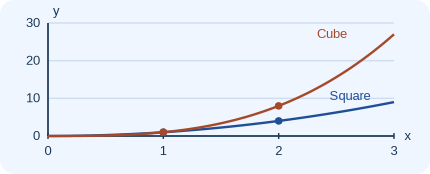
Worked line
Check yourself
The model is . Find the positive input when .
Answer