Maths4UBETA

Direct proportion to a square or cube (Extended)

Square or cube the input before using the constant, and reverse the transformation to find a positive input.

Try the quick check →
Lesson 3 of 6

Section 1 of 3 · Extension · about 7 min

What exactly gets squared or cubed?

Read the power in the relationship before using the pair. A comparable shape may scale by a power of its length.

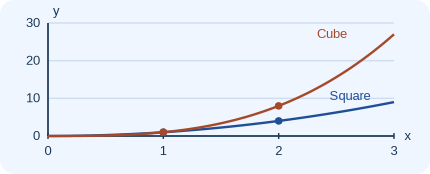
The square and cube curves agree at (1, 1). At x equals 2, the cube gives 8 and the square gives 4.

The cube curve rises faster after the common point at input 1.

Worked example

Find the constant of proportionality

yy is directly proportional to the square of xx. When x=2x=2, y=16y=16. Find the positive constant of proportionality kk in y=k x2y=k\,x^2.

  1. The symbols y∝x2y\propto x^2 mean y=k x2y=k\,x^2 for a fixed multiplier kk.

  2. Use x=2x=2 and y=16y=16. (2)2=4\left(2\right)^2=4.

  3. Divide yy by the transformed value of xx. k=164=4k=\frac{16}{4}=4.

  4. The model is y=4 x2y=4\,x^2.

Your turn

yy is directly proportional to the square of xx. When x=7x=7, y=6372y=\frac{637}{2}. Find the positive constant of proportionality kk in y=k x2y=k\,x^2.

Enter an exact value or round to 3 significant figures.

Worked example

Predict a new output

yy is directly proportional to the cube of xx. When x=5x=5, y=1500y=1500. Find yy when x=16x=16. Give an exact answer.

Try it on paper first.

  1. The symbols y∝x3y\propto x^3 mean y=k x3y=k\,x^3 for a fixed multiplier kk.

  2. Use x=5x=5 and y=1500y=1500. (5)3=125\left(5\right)^3=125.

  3. Divide yy by the transformed value of xx. k=1500125=12k=\frac{1500}{125}=12.

  4. y=12×(16)3=49152y=12\times \left(16\right)^3=49152.

  5. The exact output is 4915249152.

Your turn

yy is directly proportional to the cube of xx. When x=10x=10, y=19000y=19000. Find yy when x=12x=12. Give an exact answer.

Enter one number. Fractions and decimals are accepted.

Section 2 of 3 · Extension · about 8 min

How can I reverse the model or check a scale factor?

Before taking a root, isolate the expression in xx. Use the positive value of xx in the measurement contexts on this page.

Worked example

Work backwards to a new input

yy is directly proportional to the square of x+1x+1. Take x>−1x>-1. When x=11x=11, y=1440y=1440. Find the positive value of xx when y=1960y=1960. Give an exact answer.

  1. The symbols y∝(x+1)2y\propto \left(x+1\right)^2 mean y=k (x+1)2y=k\,\left(x+1\right)^2 for a fixed multiplier kk.

  2. Use x=11x=11 and y=1440y=1440. (11+1)2=144\left(11+1\right)^2=144.

  3. Divide yy by the transformed value of xx. k=1440144=10k=\frac{1440}{144}=10.

  4. Rearrange to isolate the transformed input. (x+1)2=196010=196\left(x+1\right)^2=\frac{1960}{10}=196.

  5. Undo the power or root to isolate x+1x+1, then undo its constant shift. x=13x=13.

Your turn

yy is directly proportional to the square of x+1x+1. Take x>−1x>-1. When x=3x=3, y=256y=256. Find the positive value of xx when y=576y=576. Give an exact answer.

Enter one number. Fractions and decimals are accepted.

Worked example

Use a scale factor to predict the change

yy is directly proportional to the cube of xx. The initial pair is x=2x=2 and y=40y=40. The value of xx is then multiplied by 77. By what factor is yy multiplied?

Try it on paper first.

  1. The factor applying to the transformed input is (7)3=343\left(7\right)^3=343.

  2. The transformed input is multiplied by a constant, so the same factor applies to the output.

  3. The resulting scale factor for yy is 343343.

Your turn

yy is directly proportional to the cube of xx. The initial pair is x=7x=7 and y=92614y=\frac{9261}{4}. The value of xx is then multiplied by 44. By what factor is yy multiplied?

Enter one number. Fractions and decimals are accepted.

Section 3 of 3 · Extension · about 9 min

How do I test a proposed equation against data?

A successful equation uses the right power of xx and the same numerical coefficient for all pairs.

Worked example

Recognise the correct equation

yy is directly proportional to the square of xx. When x=9x=9, y=15395y=\frac{1539}{5}. Which equation uses the right type of proportion and the value of kk from the pair?

A. y=195 x2y=\frac{19}{5}\,x^2   B. y=195 x2y=\frac{19}{5\,x^2}   C. y=x2+195y=x^2+\frac{19}{5}   D. y=245 x2y=\frac{24}{5}\,x^2

  1. The symbols y∝x2y\propto x^2 mean y=k x2y=k\,x^2 for a fixed multiplier kk.

  2. Use x=9x=9 and y=15395y=\frac{1539}{5}. (9)2=81\left(9\right)^2=81.

  3. Divide yy by the transformed value of xx. k=15395÷81=195k=\frac{1539}{5}\div 81=\frac{19}{5}.

  4. Substitute the value of kk into the matching model. y=195 x2y=\frac{19}{5}\,x^2.

Your turn

yy is directly proportional to the square of xx. When x=14x=14, y=1029y=1029. Which equation uses the right type of proportion and the value of kk from the pair?

Equation

Worked example

Use the constant to complete a table

yy is directly proportional to the cube of xx. Find the missing value of yy in the last row. Give an exact answer.

xxyy
12121209612096
111193179317
1313Missing value

Try it on paper first.

  1. The symbols y∝x3y\propto x^3 mean y=k x3y=k\,x^3 for a fixed multiplier kk.

  2. Use x=12x=12 and y=12096y=12096. (12)3=1728\left(12\right)^3=1728.

  3. Divide yy by the transformed value of xx. k=120961728=7k=\frac{12096}{1728}=7.

  4. The middle row gives the same constant. Use it again with the last input.

  5. y=7×(13)3=15379y=7\times \left(13\right)^3=15379.

Your turn

yy is directly proportional to the cube of xx. Find the missing value of yy in the last row. Give an exact answer.

xxyy
4410241024
5520002000
66Missing value

Enter one number. Fractions and decimals are accepted.

Worked examples

Practise the method

Core practice

Question 1 of 5

0 / 5 checked in this collection

Question list

Core practice

Fresh variants

Exam-style

Find the constant of proportionality

1 mark

yy is directly proportional to the square of xx. When x=2x=2, y=53y=53. Find the positive constant of proportionality kk in y=k x2y=k\,x^2.

Enter an exact value or round to 3 significant figures.

Full answer-format guide

Exact numbers: 3/2, sqrt(5), 2-sqrt(3), pi/6, 3*pi/2. Sets: {1,4}. Intervals: (3,5]; a round bracket excludes the endpoint. Infinity: inf; union: U; no solutions: empty. Separate coordinate pairs or triples with semicolons. Expressions: 2x^2+3x-1; equations: x^2=3x+1 or the polynomial equal to zero. Factors: x-1 ; x+2. Parameter fraction: numerator ; denominator. List integer answers individually.

Review the method

Progress stays in this browser. Create an account to save it or sign in.

Extra practice from this lesson

Find the constant of proportionality

yy is directly proportional to the square of xx. When x=12x=12, y=288y=288. Find the positive constant of proportionality kk in y=k x2y=k\,x^2.

Enter one number. Fractions and decimals are accepted.

Predict a new output

yy is directly proportional to the cube of xx. When x=2x=2, y=24y=24. Find yy when x=4x=4. Give an exact answer.

Enter one number. Fractions and decimals are accepted.

Work backwards to a new input

yy is directly proportional to the square of x+1x+1. Take x>−1x>-1. When x=8x=8, y=2754y=2754. Find the positive value of xx when y=9826y=9826. Give an exact answer.

Enter one number. Fractions and decimals are accepted.

Use a scale factor to predict the change

yy is directly proportional to the cube of xx. The initial pair is x=12x=12 and y=16704y=16704. The value of xx is then multiplied by 14\frac{1}{4}. By what factor is yy multiplied?

Enter an exact value or round to 3 significant figures.

Recognise the correct equation

yy is directly proportional to the square of xx. When x=6x=6, y=276y=276. Which equation uses the right type of proportion and the value of kk from the pair?

Equation

Use the constant to complete a table

yy is directly proportional to the cube of xx. Find the missing value of yy in the last row. Give an exact answer.

xxyy
99131225\frac{13122}{5}
1616737285\frac{73728}{5}
1313Missing value

Enter an exact value or round to 3 significant figures.

Apply it · original exam-style problems

Show your working on paper and compare it with the worked solution and marking guidance.

Come back to what needs practice

Quick revision sheet (A4)

Your review plan starts after your first check.