Maths4UBETA

Signed integrals and areas under curves

Find crossings, distinguish signed integral from area and add regions on opposite sides of the axis.

Try the quick check →
Lesson 10 of 11

Section 1 of 3 · Lesson · about 5 min

When does the definite integral equal an area?

Find the limits and decide the sign of the graph between them. The definite integral gives the area when the curve lies above the horizontal axis.
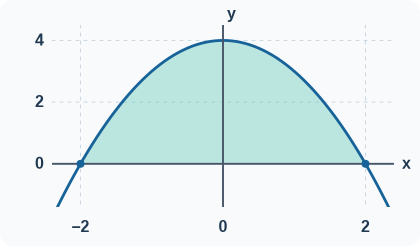
The whole region under a downward parabola from negative two to two lies above the axis.

The parabola y=4−x2y=4-x^2 has matching halves either side of x=0x=0. For the shaded region, integrate one half and double it.

Practise the method

Find the appropriate endpoints and check the sign of the integrand in the interval.

Find the given vertical bounds or the intersections with the x-axis. Test a point inside the region. If it is above the axis throughout, its height above the axis gives the integrand.

Worked example

Separate geometric area from a signed integral

A curve has equation y=(3−x)(10x+20)y=\left(3 - x\right) \left(10 x + 20\right).

Find the x-values where the curve meets the x-axis.

  1. Set (3−x)(10x+20)\left(3 - x\right) \left(10 x + 20\right) equal to zero and use the two linear factors.

  2. Answer: −2,3-2, 3.

  3. y plotted against x from −2 to 3.

Your turn

A curve has equation y=(−x−3)(9x+45)y=\left(- x - 3\right) \left(9 x + 45\right).

Find the x-values where the curve meets the x-axis.

Give every root, for example x = 1 or x = 4, or 1, 4. Use sqrt(...) for exact roots, or empty if there are none.

Worked example

Use symmetry for an area above the axis

Find the area between y=4−x2y=4-x^2 and the x-axis for −2≤x≤2-2\le x\le2.

Try it on paper first.

  1. The graph meets the axis at x=−2x=-2 and x=2x=2, and stays above the axis between them.

  2. The two halves are mirror images. The area is 2∫02(4−x2) dx2\int_0^2(4-x^2)\,\mathrm dx.

  3. The primitive is 4x−x334x-\frac{x^3}{3}. Subtract the value zero at x=0x=0 from 8−83=1638-\frac83=\frac{16}3 at x=2x=2.

  4. Doubling gives an area of 323\frac{32}3 square units.

Your turn

Find the area between y=2x+1y=2x+1 and the x-axis for 0≤x≤20\le x\le2.

The shaded region between the positive line and the x-axis from zero to two.

Enter one number. Fractions and decimals are accepted.

Section 2 of 3 · Lesson · about 5 min

Why can the definite integral be negative?

The integral gives a negative value when the curve stays below the axis. Change its sign to obtain the positive geometric area.
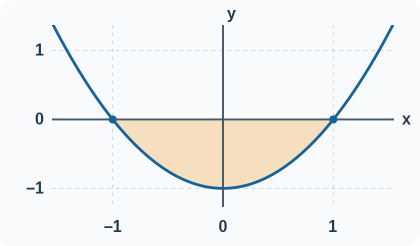
The portion of the upward parabola between its roots is below the horizontal axis.

For y=x2−1y=x^2-1, the axis is the upper boundary of the shaded region. The height of a strip is 1−x21-x^2.

Practise the method

Negate the signed integral for a region that stays below the axis.

Sketch the axis above the curve. Find the positive height by subtracting the curve from the axis. Equivalently, take the opposite of the signed integral.

Worked example

Separate geometric area from a signed integral

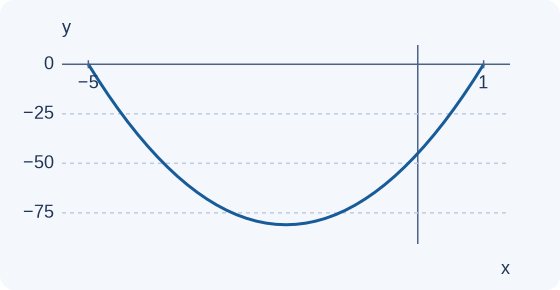
A curve has equation y=(1−x)(−9x−45)y=\left(1 - x\right) \left(- 9 x - 45\right).

Find the x-values where the curve meets the x-axis.

  1. Set (1−x)(−9x−45)\left(1 - x\right) \left(- 9 x - 45\right) equal to zero and use the two linear factors.

  2. Answer: −5,1-5, 1.

  3. y plotted against x from −5 to 1.

Your turn

A curve has equation y=(3−3x)(6−x)y=\left(3 - 3 x\right) \left(6 - x\right).

Find the x-values where the curve meets the x-axis.

Give every root, for example x = 1 or x = 4, or 1, 4. Use sqrt(...) for exact roots, or empty if there are none.

Worked example

Find the geometric area of a region below the axis

Find the area bounded by y=x2−1y=x^2-1 and the x-axis for −1≤x≤1-1\le x\le1.

Try it on paper first.

  1. On the interval, y≤0y\le0. A vertical strip has height 0−(x2−1)=1−x20-(x^2-1)=1-x^2.

  2. The area is [x−x33]−11\left[x-\frac{x^3}{3}\right]_{-1}^{1}.

  3. The upper evaluation is 23\frac23 and the lower evaluation is −23-\frac23. Hence the area is 43\frac43 square units.

Your turn

Find the area between y=x−4y=x-4 and the x-axis for 1≤x≤31\le x\le3.

The shaded region above a line and below the x-axis from one to three.

Enter one number. Fractions and decimals are accepted.

Section 3 of 3 · Lesson · about 5 min

How do you add areas across an axis crossing?

Split at each crossing inside the limits. Calculate each signed integral and add their magnitudes to find the total area.
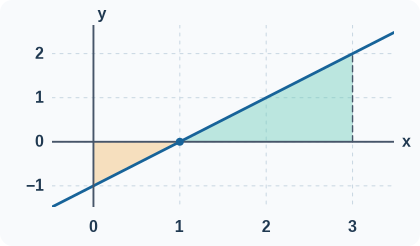
Two triangular regions meet where the line crosses the x-axis at one.

For y=x−1y=x-1, the first triangle has base 1 and height 1. The second has base 2 and height 2. Both areas are added.

Practise the method

Integrate separately on each side of the crossing, then add the geometric areas.

Determine the signs on the two intervals first. Find a positive area on each side and add them. The absolute value of the single signed integral gives the difference of the two areas.

Worked example

Separate geometric area from a signed integral

A curve has equation y=(−x−3)(7x+35)y=\left(- x - 3\right) \left(7 x + 35\right).

Find the x-values where the curve meets the x-axis.

  1. Set (−x−3)(7x+35)\left(- x - 3\right) \left(7 x + 35\right) equal to zero and use the two linear factors.

  2. Answer: −5,−3-5, -3.

  3. y plotted against x from −5 to −3.

Your turn

A curve has equation y=(4−x)(9x+9)y=\left(4 - x\right) \left(9 x + 9\right).

Find the x-values where the curve meets the x-axis.

Give every root, for example x = 1 or x = 4, or 1, 4. Use sqrt(...) for exact roots, or empty if there are none.

Worked example

Split the integral where the graph crosses the axis

Find the total area between y=x−1y=x-1 and the x-axis from x=0x=0 to x=3x=3.

Try it on paper first.

  1. The crossing is at x=1x=1. The curve is below the axis on [0,1][0,1] and above it on [1,3][1,3].

  2. Use heights 1−x1-x and x−1x-1 on the two intervals. The corresponding integrals are [x−x22]01=12\left[x-\frac{x^2}{2}\right]_0^1=\frac12 and [x22−x]13=2\left[\frac{x^2}{2}-x\right]_1^3=2.

  3. Add the two positive areas to obtain 52\frac52 square units. The shaded triangles in the diagram give the same result.

Your turn

Find the total area between y=2xy=2x and the x-axis for −1≤x≤2-1\le x\le2.

Two regions on either side of the x-axis between negative one and two.

Enter one number. Fractions and decimals are accepted.

Worked examples

Practise the method

Core practice

Question 1 of 5

0 / 5 checked in this collection

Question list

Core practice

Fresh variants

Exam-style

Use a signed integral to find geometric area

1 mark

The curve is y=−4x2−24x−32y=- 4 x^{2} - 24 x - 32.

Find the x-coordinates of the x-axis crossings. Show your algebra.

Give every root, for example x = 1 or x = 4, or 1, 4. Use sqrt(...) for exact roots, or empty if there are none.

Full answer-format guide

Exact numbers: 3/2, sqrt(5), 2-sqrt(3), pi/6, 3*pi/2. Sets: {1,4}. Intervals: (3,5]; a round bracket excludes the endpoint. Infinity: inf; union: U; no solutions: empty. Separate coordinate pairs or triples with semicolons. Expressions: 2x^2+3x-1; equations: x^2=3x+1 or the polynomial equal to zero. Factors: x-1 ; x+2. Parameter fraction: numerator ; denominator. List integer answers individually.

Review the method

Progress stays in this browser. Create an account to save it or sign in.

Extra practice from this lesson

Separate geometric area from a signed integral

A curve has equation y=(1−x)(5x+15)y=\left(1 - x\right) \left(5 x + 15\right).

Find the x-values where the curve meets the x-axis.

Give every root, for example x = 1 or x = 4, or 1, 4. Use sqrt(...) for exact roots, or empty if there are none.

Separate geometric area from a signed integral

A curve has equation y=(4−x)(7x−7)y=\left(4 - x\right) \left(7 x - 7\right).

Calculate the total area between the curve and the x-axis for 1≤x≤41\le x\le 4.

y plotted against x from 1 to 4.

Enter an exact value or round to 3 significant figures.

Separate geometric area from a signed integral

A curve has equation y=(3−x)(7−7x)y=\left(3 - x\right) \left(7 - 7 x\right).

Find the x-values where the curve meets the x-axis.

Give every root, for example x = 1 or x = 4, or 1, 4. Use sqrt(...) for exact roots, or empty if there are none.

Separate geometric area from a signed integral

A curve has equation y=(1−x)(−4x−12)y=\left(1 - x\right) \left(- 4 x - 12\right).

Calculate the total area between the curve and the x-axis for −3≤x≤1-3\le x\le 1.

y plotted against x from −3 to 1.

Enter an exact value or round to 3 significant figures.

Separate geometric area from a signed integral

A curve has equation y=(1−x)(11x+44)y=\left(1 - x\right) \left(11 x + 44\right).

Find the x-values where the curve meets the x-axis.

Give every root, for example x = 1 or x = 4, or 1, 4. Use sqrt(...) for exact roots, or empty if there are none.

Separate geometric area from a signed integral

A curve has equation y=(3−x)(x+3)y=\left(3 - x\right) \left(x + 3\right).

Calculate the total area between the curve and the x-axis for −5≤x≤3-5\le x\le 3.

y plotted against x from −5 to 3. The graph crosses the horizontal axis within the interval.

Enter an exact value or round to 3 significant figures.

Previous checkpoints

Separate geometric area from a signed integral

A curve has equation y=(3−x)(9x+9)y=\left(3 - x\right) \left(9 x + 9\right).

Calculate the total area between the curve and the x-axis for −1≤x≤3-1\le x\le 3.

y plotted against x from −1 to 3.

Enter one number. Fractions and decimals are accepted.

Separate geometric area from a signed integral

A curve has equation y=−x(−5x−20)y=- x \left(- 5 x - 20\right).

Calculate the total area between the curve and the x-axis for −4≤x≤0-4\le x\le 0.

y plotted against x from −4 to 0.

Enter an exact value or round to 3 significant figures.

Separate geometric area from a signed integral

A curve has equation y=−x(3x+12)y=- x \left(3 x + 12\right).

Calculate the total area between the curve and the x-axis for −5≤x≤0-5\le x\le 0.

y plotted against x from −5 to 0. The graph crosses the horizontal axis within the interval.

Enter one number. Fractions and decimals are accepted.

Apply it · original exam-style problems

Show your working on paper and compare it with the worked solution and marking guidance.

Come back to what needs practice

Quick revision sheet (A4)

Your review plan starts after your first check.