Maths4UBETA

Finding and using a straight-line model from data

Read transformed tables, recover original parameters and predict outputs.

Try the quick check →
Lesson 7 of 7

Section 1 of 3 · Lesson · about 8 min

Which numbers belong in the gradient formula?

Use two compatible pairs. Every row must refer to the same choices of X and Y.

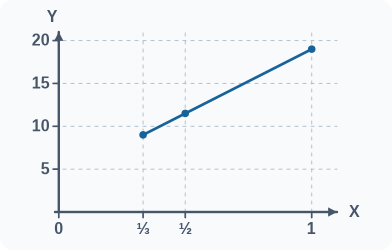
Three points on a straight line in transformed coordinates

The horizontal axis is X, the chosen expression in x. The vertical axis is Y, the chosen expression in y.

Worked example

A reciprocal calibration

The positive variables xx and yy satisfy an unknown relation. The table shows points on the straight line obtained using X=1xX=\frac{1}{x} and Y=y3Y=\sqrt[3]{y}.

XXYY
111919
12\frac{1}{2}232\frac{23}{2}
13\frac{1}{3}99

The three table points on a straight line. The horizontal axis is X and the vertical axis is Y.

  1. Find the gradient of the straight line.

    [2]
  2. Find an equation relating the original variables.

    [3]
  3. Use the relation to find the exact value of yy at x=15x=15.

    [2]
  1. (a) Use the rows (1,19)(1,19) and (13,9)\left(\frac13,9\right). The gradient is 19−91−13=1023=15\frac{19-9}{1-\frac13}=\frac{10}{\frac23}=15.

  2. (b) At X=1X=1, 19=15+c19=15+c, so c=4c=4. The model is y3=4+15x\sqrt[3]{y}=4+\frac{15}{x}.

  3. Cube both sides to get y=(4+15x)3y=\left(4+\frac{15}{x}\right)^3. The third row is consistent with the same straight line.

  4. (c) At x=15x=15, 15x=1\frac{15}{x}=1, so y=(4+1)3=125y=(4+1)^3=125.

Your turn

The positive variables xx and yy satisfy an unknown relation. The table shows points on the straight line obtained using X=1xX=\frac{1}{x} and Y=y3Y=\sqrt[3]{y}.

XXYY
112020
12\frac{1}{2}252\frac{25}{2}
13\frac{1}{3}1010

The three table points on a straight line. The horizontal axis is X and the vertical axis is Y.

Find the gradient of the straight line.

Enter one number. Fractions and decimals are accepted.

Worked example

Use two transformed readings to predict a third

The axes are X=1xX=\frac1x and Y=y3Y=\sqrt[3]{y}. The transformed line passes through (12,7)\left(\frac12,7\right) and (14,5)\left(\frac14,5\right). Find the original relation and predict yy at x=8x=8.

Try it on paper first.

  1. The gradient is 7−512−14=8\frac{7-5}{\frac12-\frac14}=8. Substituting (14,5)\left(\frac14,5\right) into Y=8X+cY=8X+c gives c=3c=3.

  2. Restore the original variables. y3=8x+3\sqrt[3]{y}=\frac8x+3, so y=(8x+3)3y=\left(\frac8x+3\right)^3.

  3. At x=8x=8 the transformed output is Y=4Y=4. Cubing gives y=64y=64.

Your turn

On the plot of Y=y3Y=\sqrt[3]y against X=1xX=\frac1x, the line has gradient 1212 and passes through (13,11)\left(\frac13,11\right). Find its vertical intercept as a number.

Enter one number. Fractions and decimals are accepted.

Section 2 of 3 · Lesson · about 8 min

What can a constant multiplying factor tell me?

Divide the later output by the earlier output. If there are hh steps between the inputs, the ratio is bhb^h. Growth gives a factor above 1, and decay gives a factor below 1.

Worked example

Recover a growth model when the first input is not zero

A model y=Abxy=Ab^x with positive constants passes through (1,10)(1,10) and (3,40)(3,40). Find bb and AA, then predict yy when x=4x=4.

  1. From x=1x=1 to x=3x=3 there are two steps. Dividing Ab3Ab^3 by AbAb gives b2=4010=4b^2=\frac{40}{10}=4.

  2. The base bb is positive, so b=2b=2. Using (1,10)(1,10), 10=A(21)10=A(2^1) gives A=5A=5.

  3. The model is y=5(2x)y=5(2^x). At x=4x=4, the predicted output is 5(16)=805(16)=80.

Your turn

The measurements in the table are modelled by y=Ab0xy=Ab_0^x with positive constants.

xxyy
001919
22171171
4415391539

Find the multiplying factor over one unit of x.

Enter one number. Fractions and decimals are accepted.

Worked example

Recover the one-step multiplier of a decay model

The readings (2,64)(2,64), (5,8)(5,8) and (8,1)(8,1) follow y=Abxy=Ab^x, with A>0A>0 and b>0b>0. Find bb, recover AA and use the model to predict yy at x=4x=4.

Try it on paper first.

  1. The inputs 2 and 5 differ by 3. Taking the later output divided by the earlier output gives b3=864=18b^3=\frac8{64}=\frac18, so b=12b=\frac12.

  2. The data give 64=A(12)264=A\left(\frac12\right)^2, so A=256A=256.

  3. The model gives y=256(12)4=16y=256\left(\frac12\right)^4=16 at x=4x=4. At x=8x=8, it also gives the observed value 11.

Your turn

A model y=Abxy=Ab^x has A>0A>0, b>0b>0, y=162y=162 at x=1x=1 and y=48y=48 at x=4x=4. Find the exact one-step multiplier bb.

Enter one number. Fractions and decimals are accepted.

Your turn

In a model y=Abxy=Ab^x with positive constants, y=16y=16 when x=2x=2 and y=36y=36 when x=4x=4. Find the one-step multiplier bb.

Enter an exact value or round to 3 significant figures.

Section 3 of 3 · Further practice · about 8 min

How do I use the original model to predict?

Move between the original input and the transformed graph in the right order. Start with xx, find XX, use the line to get YY, then undo the vertical transformation to get yy. A prediction beyond the measured X-values is an extrapolation.

Worked example

Predict an original value between measured inputs

The table shows readings on a graph with axes X=x2X=x^2 and Y=ln⁡yY=\ln y for x>0x>0 and y>0y>0.

XXYY
1133
4466
991111

Three measured points on a straight line in transformed X and Y coordinates.

Find an equation for yy in terms of xx, then find the exact value of yy at x=2x=\sqrt2.

  1. Use (1,3)(1,3) and (4,6)(4,6). The gradient is 6−34−1=1\frac{6-3}{4-1}=1. The next two rows give 11−69−4=1\frac{11-6}{9-4}=1 as a check.

  2. Substitute (1,3)(1,3) into Y=X+cY=X+c. Then 3=1+c3=1+c, so c=2c=2.

  3. Replace the transformed coordinates: ln⁡y=x2+2\ln y=x^2+2. Undo the log to obtain y=ex2+2y=e^{x^2+2}.

  4. At x=2x=\sqrt2, X=2X=2, so Y=4Y=4 and y=e4y=e^4. This is interpolation because X=2X=2 is between two measured values.

Your turn

The positive variables xx and yy satisfy an unknown relation. The table shows points on the straight line obtained using X=x2X=x^2 and Y=ln⁡yY=\ln y.

XXYY
111616
442525
994040

The three table points on a straight line. The horizontal axis is X and the vertical axis is Y.

Find the gradient of the straight line.

Enter one number. Fractions and decimals are accepted.

Worked example

Work backwards from the target output

The straight-line model is Y=2X+3Y=2X+3, where X=x2X=x^2, Y=ln⁡yY=\ln y, x>0x>0 and y>0y>0. Find the original input when y=e21y=e^{21}.

Try it on paper first.

  1. The target y=e21y=e^{21} gives Y=21Y=21. Solve 21=2X+321=2X+3 to get X=9X=9.

  2. Because X=x2X=x^2 and x>0x>0, the original input is 9=3\sqrt9=3.

  3. Substitution gives ln⁡y=2(32)+3=21\ln y=2(3^2)+3=21, as required.

Your turn

The line is Y=3X−2Y=3X-2, where X=x2X=x^2, Y=ln⁡yY=\ln y and x>0x>0. Find xx when y=e10y=e^{10}.

Enter one number. Fractions and decimals are accepted.

Your turn

For x>0x>0, the line on X=log⁡2xX=\log_2x and Y=log⁡2yY=\log_2y axes has equation Y=1−XY=1-X. Find the exact value of yy at x=4x=4.

Enter one number. Fractions and decimals are accepted.

Worked examples

Practise the method

Core practice

Question 1 of 5

0 / 5 checked in this collection

Question list

Core practice

Fresh variants

Exam-style

Fit and use a line in transformed coordinates

1 mark

For positive xx and yy, the table gives points on the line with axes X=1xX=\frac1x and Y=yY=\sqrt{y}. These are transformed coordinates.

XXYY
14\frac{1}{4}32\frac{3}{2}
12\frac{1}{2}22
1133

Find the gradient of the straight line.

Enter one number. Fractions and decimals are accepted.

Full answer-format guide

Exact numbers: 3/2, sqrt(5), 2-sqrt(3), pi/6, 3*pi/2. Sets: {1,4}. Intervals: (3,5]; a round bracket excludes the endpoint. Infinity: inf; union: U; no solutions: empty. Separate coordinate pairs or triples with semicolons. Expressions: 2x^2+3x-1; equations: x^2=3x+1 or the polynomial equal to zero. Factors: x-1 ; x+2. Parameter fraction: numerator ; denominator. List integer answers individually.

Review the method

Progress stays in this browser. Create an account to save it or sign in.

Extra practice from this lesson

On the plot of Y=y3Y=\sqrt[3]y against X=1xX=\frac1x, the data below lie on a straight line.

XXYY
14\frac1477
12\frac1266
1144

Find the gradient.

Enter one number. Fractions and decimals are accepted.

The table shows points on a straight line. Find qq.

XXYY
2233
6655
88qq

Enter one number. Fractions and decimals are accepted.

A model y=Abxy=Ab^x with b>0b>0 has y=16y=16 at x=0x=0 and y=25y=25 at x=2x=2. Find the exact value of bb.

Enter one number. Fractions and decimals are accepted.

A model y=Abxy=Ab^x, with A>0A>0 and b>0b>0, passes through (1,18)(1,18) and (3,8)(3,8). Find AA.

Enter one number. Fractions and decimals are accepted.

Here are readings on a straight-line graph with axes X=x2X=x^2 and Y=log⁡2yY=\log_2 y, with x>0x>0.

XXYY
1111
4444
9999

Find yy when x=3x=\sqrt3.

Enter one number. Fractions and decimals are accepted.

With axes X=xX=x and Y=log⁡3yY=\log_3 y, a decay model has equation Y=7−2XY=7-2X. Find the original input when y=13y=\frac13.

Enter one number. Fractions and decimals are accepted.

Previous checkpoints

The positive variables xx and yy satisfy an unknown relation. The table shows points on the straight line obtained using X=1xX=\frac{1}{x} and Y=y3Y=\sqrt[3]{y}.

XXYY
112222
12\frac{1}{2}292\frac{29}{2}
13\frac{1}{3}1212

The three table points on a straight line. The horizontal axis is X and the vertical axis is Y.

Find the gradient of the straight line.

Enter one number. Fractions and decimals are accepted.

The positive variables xx and yy satisfy an unknown relation. The table shows points on the straight line obtained using X=1xX=\frac{1}{x} and Y=y3Y=\sqrt[3]{y}.

XXYY
112828
12\frac{1}{2}412\frac{41}{2}
13\frac{1}{3}1818

Find the gradient of the straight line.

Enter one number. Fractions and decimals are accepted.

The positive variables xx and yy satisfy an unknown relation. The table shows points on the straight line obtained using X=1xX=\frac{1}{x} and Y=y3Y=\sqrt[3]{y}.

XXYY
112929
12\frac{1}{2}432\frac{43}{2}
13\frac{1}{3}1919

Find the gradient of the straight line.

Enter one number. Fractions and decimals are accepted.

The measurements in the table are modelled by y=Ab0xy=Ab_0^x with positive constants.

xxyy
002121
22189189
4417011701

Find the multiplying factor over one unit of x.

Enter one number. Fractions and decimals are accepted.

The measurements in the table are modelled by y=Ab0xy=Ab_0^x with positive constants.

xxyy
0088
22648648
445248852488

Find the multiplying factor over one unit of x.

Enter one number. Fractions and decimals are accepted.

The measurements in the table are modelled by y=Ab0xy=Ab_0^x with positive constants.

xxyy
0099
22729729
445904959049

Find the multiplying factor over one unit of x.

Enter one number. Fractions and decimals are accepted.

The positive variables xx and yy satisfy an unknown relation. The table shows points on the straight line obtained using X=x2X=x^2 and Y=ln⁡yY=\ln y.

XXYY
111818
442727
994242

The three table points on a straight line. The horizontal axis is X and the vertical axis is Y.

Find the gradient of the straight line.

Enter one number. Fractions and decimals are accepted.

The positive variables xx and yy satisfy an unknown relation. The table shows points on the straight line obtained using X=x2X=x^2 and Y=ln⁡yY=\ln y.

XXYY
1166
441818
993838

Find the gradient of the straight line.

Enter one number. Fractions and decimals are accepted.

The positive variables xx and yy satisfy an unknown relation. The table shows points on the straight line obtained using X=x2X=x^2 and Y=ln⁡yY=\ln y.

XXYY
1177
441919
993939

Find the gradient of the straight line.

Enter one number. Fractions and decimals are accepted.

Apply it · original exam-style problems

Show your working on paper and compare it with the worked solution and marking guidance.

Come back to what needs practice

Quick revision sheet (A4)

Your review plan starts after your first check.