Maths4UBETA

Plan and trial data collection

Choose data types and a sampling plan, then check for bias before collecting more data.

Try the quick check →
Lesson 1 of 4

Section 1 of 3 · Core · about 8 min

Choose information that answers the question

List what you will record and what counts as one observation.

Worked example

Choose the kind of data

A student plans a 6-day investigation. Their first variable is height of a sculpture.

  1. Choose the type of this variable. Options: A. Discrete. B. Categorical. C. None of these. D. Continuous.

    [2]
  2. Give one useful thing to check in a short trial of the collection method.

    [2]
  1. (a) Measured height can take any value in a range.

  2. Continuous

  3. (b) A short trial catches unclear definitions before the full investigation.

  4. Check that observers record the same variable in the same units.
Your turn

A student plans a 10-day investigation. Their first variable is type of book borrowed.

Choose the type of this variable.

Choose one answer

Worked example

Choose the kind of data

A student plans a 7-day investigation. Their first variable is number of late buses.

  1. Choose the type of this variable. Options: A. Discrete. B. Continuous. C. Categorical. D. None of these.

    [2]
  2. Give one useful thing to check in a short trial of the collection method.

    [2]

Try it on paper first.

  1. (a) A count takes separate whole-number values.

  2. Discrete

  3. (b) A short trial catches unclear definitions before the full investigation.

  4. Check that observers record the same variable in the same units.

Your turn

A student plans an 11-day investigation. Their first variable is height of a sculpture.

Choose the type of this variable.

Choose one answer

Section 2 of 3 · Core · about 8 min

Match your sample to the population

Identify the whole group you want to learn about.

Worked example

Sample a whole group fairly

For a school travel study, there are 28 names in the year. A student asks the first 3 learners to arrive at the bicycle shelter.

  1. Which new plan best reduces selection bias? Options: A. Use a random sample drawn from the full year list.. B. Ask more learners at the bicycle shelter.. C. Choose only learners who arrive earliest.. D. Send the question to the cycling club only..

    [2]
  2. Suggest a neutral question to ask.

    [2]
  1. (a) A bicycle-shelter sample can over-represent cyclists. Selecting from the full year can include all ways of travelling.

  2. Use a random sample drawn from the full year list.

  3. (b) Offer reasonable categories and allow an ‘other’ option if needed.

  4. How did you travel to school today?

Your turn

For a school travel study, there are 42 names in the year. A student asks the first 7 learners to arrive at the bicycle shelter.

Which new plan best reduces selection bias?

Choose one answer

Worked example

Sample a whole group fairly

For a school travel study, there are 30 names in the year. A student asks the first 4 learners to arrive at the bicycle shelter.

  1. Which new plan best reduces selection bias? Options: A. Send the question to the cycling club only.. B. Use a random sample drawn from the full year list.. C. Ask more learners at the bicycle shelter.. D. Choose only learners who arrive earliest..

    [2]
  2. Suggest a neutral question to ask.

    [2]

Try it on paper first.

  1. (a) A bicycle-shelter sample can over-represent cyclists. Selecting from the full year can include all ways of travelling.

  2. Use a random sample drawn from the full year list.

  3. (b) Offer reasonable categories and allow an ‘other’ option if needed.

  4. How did you travel to school today?

Your turn

For a school travel study, there are 44 names in the year. A student asks the first 8 learners to arrive at the bicycle shelter.

Which new plan best reduces selection bias?

Choose one answer

Section 3 of 3 · Core · about 8 min

Trial questions and follow-up ideas

Test the questions and the recording method with a small group first.

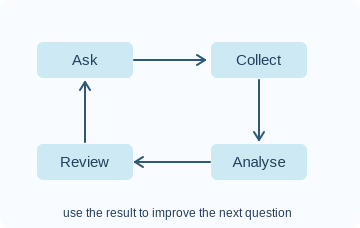
Four steps connected in a loop: ask, collect, analyse, review

Look back at the question and decide what to change or investigate next.

Worked example

Compare proportions from a trial

In a trial survey, 16 of 23 learners in one class chose music. In another class, 22 of 29 did.

  1. Give the proportion choosing music in the first class.

    [2]
  2. Suggest a second useful question about the same learners.

    [2]
  1. (a) Divide the count choosing music by all responses from the first class.

  2. 1623\frac{16}{23}

  3. (b) A related question could help explain the first pattern. Try both questions on a small group before a full survey.

  4. For example, ask whether music lessons outside school differ between classes.

Your turn

In a trial survey, 4 of 13 learners in one class chose music. In another class, 10 of 19 did.

Give the proportion choosing music in the first class.

Enter an exact value or round to 3 significant figures.

Worked example

Compare proportions from a trial

In a trial survey, 17 of 24 learners in one class chose music. In another class, 23 of 30 did.

  1. Give the proportion choosing music in the first class.

    [2]
  2. Suggest a second useful question about the same learners.

    [2]

Try it on paper first.

  1. (a) Divide the count choosing music by all responses from the first class.

  2. 1724\frac{17}{24}

  3. (b) A related question could help explain the first pattern. Try both questions on a small group before a full survey.

  4. For example, ask whether music lessons outside school differ between classes.

Your turn

In a trial survey, 5 of 14 learners in one class chose music. In another class, 11 of 20 did.

Give the proportion choosing music in the first class.

Enter an exact value or round to 3 significant figures.

Worked examples

Practise the method

Core practice

Question 1 of 12

0 / 12 checked in this collection

Question list

Core practice

Fresh variants

Exam-style

Choose the kind of data

1 mark

A student plans a 7-day investigation. Their first variable is type of book borrowed.

Choose the type of this variable.

Choose one answer

Choose one option. Explain your reasoning on paper.

Review the method

Progress stays in this browser. Create an account to save it or sign in.

Extra practice from this lesson

A student plans a 14-day investigation. Their first variable is number of late buses.

Choose the type of this variable.

Choose one answer

A student plans a 15-day investigation. Their first variable is type of book borrowed.

Choose the type of this variable.

Choose one answer

For a school travel study, there are 54 names in the year. A student asks the first 11 learners to arrive at the bicycle shelter.

Which new plan best reduces selection bias?

Choose one answer

For a school travel study, there are 56 names in the year. A student asks the first 12 learners to arrive at the bicycle shelter.

Which new plan best reduces selection bias?

Choose one answer

In a trial survey, 8 of 19 learners in one class chose music. In another class, 14 of 25 did.

Give the proportion choosing music in the first class.

Enter an exact value or round to 3 significant figures.

In a trial survey, 9 of 20 learners in one class chose music. In another class, 15 of 26 did.

Give the proportion choosing music in the first class.

Enter an exact value or round to 3 significant figures.

Apply it · original exam-style problems

Show your working on paper and compare it with the worked solution and marking guidance.

Come back to what needs practice

Quick revision sheet (A4)

Your review plan starts after your first check.