Maths4UBETA

Expected frequency and simulation

Build a simulation and compare theoretical probabilities with observed results.

Try the quick check →
Lesson 2 of 2

Section 1 of 3 · Core · about 8 min

Predict a count

Keep the probability and trial count separate.

Worked example

Predict the number of successes

A simulator gives a success probability of 511\frac{5}{11} in every trial. It runs 88 trials.

  1. Find the expected number of successes.

    [2]
  2. Explain whether every run has exactly this count.

    [1]
  1. (a) Multiply 88 by 511\frac{5}{11}. Divide by 11 to get 8, then multiply by 5.

  2. 4040

  3. (b) The expected frequency is a prediction, not a guarantee.

  4. The count can vary from one run to another.
Your turn

A simulator gives a success probability of 715\frac{7}{15} in every trial. It runs 120 trials.

Find the expected number of successes.

Enter the whole-number count.

Worked example

Predict the number of successes

A simulator gives a success probability of 12\frac{1}{2} in every trial. It runs 96 trials.

  1. Find the expected number of successes.

    [2]
  2. Explain whether every run has exactly this count.

    [1]

Try it on paper first.

  1. (a) Multiply 96 by 12\frac{1}{2}. Divide by 12 to get 8, then multiply by 6.

  2. 4848

  3. (b) The expected frequency is a prediction, not a guarantee.

  4. The count can vary from one run to another.

Your turn

A simulator gives a success probability of 12\frac{1}{2} in every trial. It runs 128 trials.

Find the expected number of successes.

Enter the whole-number count.

Section 2 of 3 · Core · about 8 min

Compare prediction and result

Calculate one expected count before looking at the count recorded.

Worked example

Compare observed and expected counts

A game has exact win probability 916\frac{9}{16}. In 128 plays, the player wins 75 times.

  1. Find the number of extra wins above the expected count.

    [2]
  2. Does this result alone prove the game is biased? Explain.

    [2]
  1. (a) The expected count is 128 × 916\frac{9}{16} = 72.

  2. Compare the observed count, 75, with the expectation.

  3. 33

  4. (b) Repeat the experiment more times and compare the rates.

  5. One result above expectation does not prove that the game is biased.

Your turn

A game has exact win probability 16\frac{1}{6}. In 96 plays, the player wins 18 times.

Find the number of extra wins above the expected count.

Enter the whole-number count.

Worked example

Compare observed and expected counts

A game has exact win probability 1017\frac{10}{17}. In 136 plays, the player wins 84 times.

  1. Find the number of extra wins above the expected count.

    [2]
  2. Does this result alone prove the game is biased? Explain.

    [2]

Try it on paper first.

  1. (a) The expected count is 136 × 1017\frac{10}{17} = 80.

  2. Compare the observed count, 84, with the expectation.

  3. 44

  4. (b) Repeat the experiment more times and compare the rates.

  5. One result above expectation does not prove that the game is biased.

Your turn

A game has exact win probability 313\frac{3}{13}. In 104 plays, the player wins 27 times.

Find the number of extra wins above the expected count.

Enter the whole-number count.

Section 3 of 3 · Core · about 8 min

Set rules for a fair simulation

Choose a random generator, label successes and record the result of each trial.

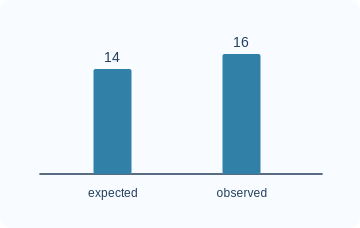
Bar chart of expected: 14, observed: 16

Example: 14 successes were predicted and 16 were observed. Compare counts only when the run size is the same.

Worked example

Design and check a simulation

A computer chooses integers from 1 to 13 with equal probabilities. A result up to 4 counts as a success. A short run of 104 trials gives 31 successes.

  1. Find the observed proportion of successes in this run.

    [2]
  2. Explain why repeating the process for 1040 trials can give a better comparison.

    [2]
  1. (a) Use the observed count, then divide by the total trial count.

  2. 31104\frac{31}{104}

  3. (b) Keep the same success rule, count all trials and compare the observed proportion with 413\frac{4}{13}.

  4. With many trials the observed proportion is typically more stable.

Your turn

A computer chooses integers from 1 to 17 with equal probabilities. A result up to 6 counts as a success. A short run of 136 trials gives 47 successes.

Find the observed proportion of successes in this run.

Enter an exact value or round to 3 significant figures.

Worked example

Design and check a simulation

A computer chooses integers from 1 to 14 with equal probabilities. A result up to 5 counts as a success. A short run of 112 trials gives 39 successes.

  1. Find the observed proportion of successes in this run.

    [2]
  2. Explain why repeating the process for 1120 trials can give a better comparison.

    [2]

Try it on paper first.

  1. (a) Use the observed count, then divide by the total trial count.

  2. 39112\frac{39}{112}

  3. (b) Keep the same success rule, count all trials and compare the observed proportion with 514\frac{5}{14}.

  4. With many trials the observed proportion is typically more stable.

Your turn

A computer chooses integers from 1 to 18 with equal probabilities. A result up to 7 counts as a success. A short run of 144 trials gives 55 successes.

Find the observed proportion of successes in this run.

Enter an exact value or round to 3 significant figures.

Worked examples

Practise the method

Core practice

Question 1 of 12

0 / 12 checked in this collection

Question list

Core practice

Fresh variants

Exam-style

Predict the number of successes

1 mark

A simulator gives a success probability of 723\frac{7}{23} in every trial. It runs 322 trials.

Find the expected number of successes.

Enter the whole-number count.

Full answer-format guide

Exact numbers: 3/2, sqrt(5), 2-sqrt(3), pi/6, 3*pi/2. Sets: {1,4}. Intervals: (3,5]; a round bracket excludes the endpoint. Infinity: inf; union: U; no solutions: empty. Separate coordinate pairs or triples with semicolons. Expressions: 2x^2+3x-1; equations: x^2=3x+1 or the polynomial equal to zero. Factors: x-1 ; x+2. Parameter fraction: numerator ; denominator. List integer answers individually.

Review the method

Progress stays in this browser. Create an account to save it or sign in.

Extra practice from this lesson

A simulator gives a success probability of 919\frac{9}{19} in every trial. It runs 152 trials.

Find the expected number of successes.

Enter the whole-number count.

A simulator gives a success probability of 12\frac{1}{2} in every trial. It runs 160 trials.

Find the expected number of successes.

Enter the whole-number count.

A game has exact win probability 14\frac{1}{4}. In 128 plays, the player wins 36 times.

Find the number of extra wins above the expected count.

Enter the whole-number count.

A game has exact win probability 517\frac{5}{17}. In 136 plays, the player wins 42 times.

Find the number of extra wins above the expected count.

Enter the whole-number count.

A computer chooses integers from 1 to 21 with equal probabilities. A result up to 8 counts as a success. A short run of 168 trials gives 63 successes.

Find the observed proportion of successes in this run.

Enter an exact value or round to 3 significant figures.

A computer chooses integers from 1 to 22 with equal probabilities. A result up to 9 counts as a success. A short run of 176 trials gives 71 successes.

Find the observed proportion of successes in this run.

Enter an exact value or round to 3 significant figures.

Apply it · original exam-style problems

Show your working on paper and compare it with the worked solution and marking guidance.

Come back to what needs practice

Quick revision sheet (A4)

Your review plan starts after your first check.