Maths4UBETA

Roots of unity, root polygons and parameter cases

Use the whole root set, with exclusions and multiplicities.

Try the quick check →
Lesson 4 of 5

Section 1 of 6 · Core · about 6 min

Why do the roots of unity form a regular polygon?

For n≥3n\ge3, the nn distinct solutions of zn=1z^n=1 are vertices of a regular polygon. For n=1n=1 or 22, there is one point or a pair of opposite points. The circle locates the vertices.
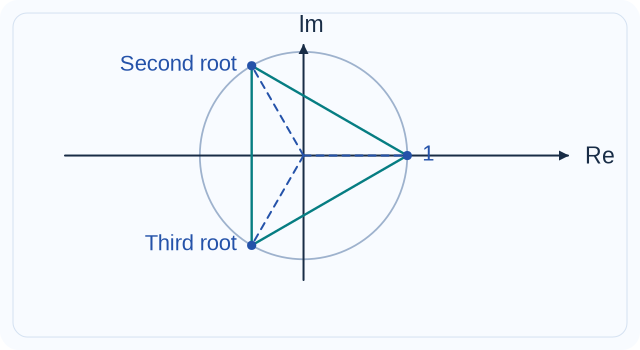
Three unit cube roots forming an equilateral triangle on an Argand diagram.

Each consecutive root is a rotation by 2π3\tfrac{2\pi}{3} about the origin.

Worked example

List the cube roots of unity

Consider all roots of z3=1z^{3}=1.

Give the complete set of coefficients of π\pi in the arguments, using [0,2π)[0,2\pi).

  1. All roots have modulus 11 and adjacent arguments differ by 2π3\frac{2 \pi}{3}.

  2. IndexArgument in [0,2π)[0,2\pi)
    0000
    112π3\frac{2 \pi}{3}
    224π3\frac{4 \pi}{3}

Worked example

Identify the complete square of unit roots

Consider all roots of z4=1z^{4}=1.

Give the complete set of coefficients of π\pi in the arguments, using [0,2π)[0,2\pi).

Try it on paper first.

  1. All roots have modulus 11 and adjacent arguments differ by π2\frac{\pi}{2}.

  2. IndexArgument in [0,2π)[0,2\pi)
    0000
    11π2\frac{\pi}{2}
    22π\pi
    333π2\frac{3 \pi}{2}

Your turn

Consider all roots of z5=1z^{5}=1.

Give the complete set of coefficients of π\pi in the arguments, using [0,2π)[0,2\pi).

Give the complete set: {1, 4} for separate values, (1, 5] for an interval, U for union or empty for no real solutions. Use sqrt(...) for exact roots.

Section 2 of 6 · Core · about 7 min

How do non-unit right-hand sides rotate and scale the roots?

First obtain one root. Multiplying it by each root of unity gives the complete set.
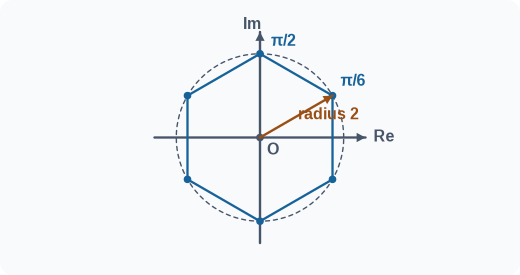
Six roots of negative sixty-four lie on a circle of radius two. The nearest positive argument is pi over six, and the next one is pi over two.
The six roots of z6=−64z^6=-64 start at π6\frac\pi6 and turn by π3\frac\pi3 at each step. Their radius is 646=2\sqrt[6]{64}=2.

Worked example

Find the circle for a rotated six-root set

Consider all roots of z6=64 eiπz^{6}=64\,\mathrm e^{i \pi}.

Give the radius of the root circle and the coefficient of π\pi in the angle between consecutive roots.

  1. All roots have modulus 22 and adjacent arguments differ by π3\frac{\pi}{3}.

  2. IndexArgument in [0,2π)[0,2\pi)
    00π6\frac{\pi}{6}
    11π2\frac{\pi}{2}
    225π6\frac{5 \pi}{6}
    337π6\frac{7 \pi}{6}
    443π2\frac{3 \pi}{2}
    5511π6\frac{11 \pi}{6}

Your turn

Consider z4=kz^4=k for real kk.

Give all real values of kk for which the root polygon has radius 22.

Give the complete set: {1, 4} for separate values, (1, 5] for an interval, U for union or empty for no real solutions. Use sqrt(...) for exact roots.

Section 3 of 6 · Core · about 7 min

How does the central angle determine a side length?

Join adjacent roots to the origin. Their triangle has two equal sides.
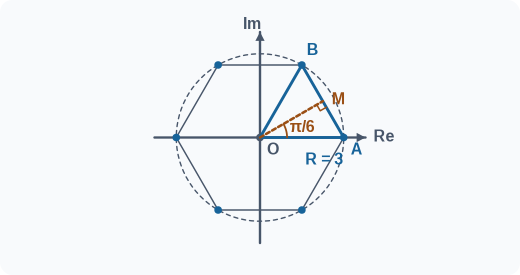
In a radius-three root hexagon, the triangle from the origin to two adjacent roots has central angle sixty degrees. The segment from the origin to the chord midpoint divides the central angle into two thirty-degree angles.
In right triangle OAMOAM, OA=3OA=3, ∠AOM=π6\angle AOM=\frac\pi6 and AM=3sin⁡π6AM=3\sin\frac\pi6. Double AMAM for the chord.

Worked example

Find the side of a root hexagon

Consider all roots of z6=729z^{6}=729.

Find the exact side length of the polygon formed by joining consecutive roots.

  1. All roots have modulus 33 and adjacent arguments differ by π3\frac{\pi}{3}.

  2. IndexArgument in [0,2π)[0,2\pi)
    0000
    11π3\frac{\pi}{3}
    222π3\frac{2 \pi}{3}
    33π\pi
    444π3\frac{4 \pi}{3}
    555π3\frac{5 \pi}{3}
  3. Bisect the central angle π3\frac{\pi}{3}. The chord is 2(3)sin⁡(π6)=32(3)\sin\left(\frac{\pi}{6}\right)=3.

Your turn

Consider all roots of z4=81 eiπz^{4}=81\,\mathrm e^{i \pi}.

Find the exact side length of the polygon formed by joining consecutive roots.

Enter an exact number, for example 3/2 or 2-sqrt(3).

Section 4 of 6 · Core · about 7 min

Why does the sum of all roots vanish?

The regular set of vectors balances around the origin. Equivalently, a geometric series of the distinct unit multipliers has zero sum.

Worked example

Use the zero sum and remove one vertex

Consider all roots of z4=1z^{4}=1.

From the sum, exclude the roots at π2\frac{\pi}{2} radians. Give the real and imaginary parts of the sum of the remaining roots.

  1. All roots have modulus 11 and adjacent arguments differ by π2\frac{\pi}{2}.

  2. IndexArgument in [0,2π)[0,2\pi)
    0000
    11π2\frac{\pi}{2}
    22π\pi
    333π2\frac{3 \pi}{2}
  3. The sum of every root is zero. Subtract the excluded roots from zero.

    The excluded sum is ii, so the required value is −i- i.

Your turn

Consider all roots of z4=1 eiπz^{4}=1\,\mathrm e^{i \pi}.

From the sum, exclude the roots at π4\frac{\pi}{4} radians. Give the real and imaginary parts of the sum of the remaining roots.

Enter an exact number, for example 3/2 or 2-sqrt(3).

Enter an exact number, for example 3/2 or 2-sqrt(3).

Section 5 of 6 · Core · about 7 min

How can I sum an incomplete set efficiently?

Identify which roots are excluded and subtract their sum from the total zero.
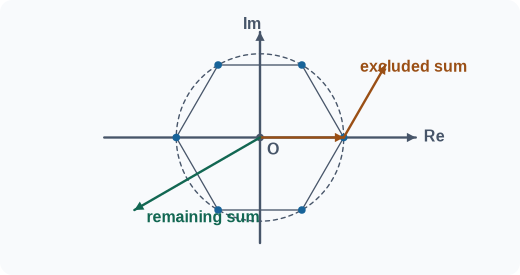
Two excluded roots from a radius-two hexagon are added head to tail. The opposite arrow from the origin gives the sum of the remaining four roots.
The excluded roots 22 and 1+i31+\mathrm i\sqrt3 sum to 3+i33+\mathrm i\sqrt3. The remaining roots sum to the opposite vector.

Worked example

Subtract two removed roots from zero

Consider all roots of z6=64z^{6}=64.

From the sum, exclude the roots at 00, π3\frac{\pi}{3} radians. Give the real and imaginary parts of the sum of the remaining roots.

  1. All roots have modulus 22 and adjacent arguments differ by π3\frac{\pi}{3}.

  2. IndexArgument in [0,2π)[0,2\pi)
    0000
    11π3\frac{\pi}{3}
    222π3\frac{2 \pi}{3}
    33π\pi
    444π3\frac{4 \pi}{3}
    555π3\frac{5 \pi}{3}
  3. The sum of every root is zero. Subtract the excluded roots from zero.

    The excluded sum is 3+3i3 + \sqrt{3} i, so the required value is −3−3i-3 - \sqrt{3} i.

Your turn

Consider all roots of z6=1z^{6}=1.

From the sum, exclude the roots at 00, π\pi radians. Give the real and imaginary parts of the sum of the remaining roots.

Enter an exact number, for example 3/2 or 2-sqrt(3).

Enter an exact number, for example 3/2 or 2-sqrt(3).

Section 6 of 6 · Core · about 6 min

How do I write all arguments in the requested interval?

Use the equal spacing from one root, then convert each value before writing the list.

Worked example

Move every representative into the requested interval

Write the arguments of all four roots of z4=−16z^4=-16 in the interval [−π,π)[-\pi,\pi).

  1. Use π\pi as one argument of −16-16. Dividing by four gives π4\frac\pi4. Advance by π2\frac\pi2 to get π4,3π4,5π4,7π4\frac\pi4,\frac{3\pi}4,\frac{5\pi}4,\frac{7\pi}4.

  2. The last two values are outside the interval. Subtract one full turn from each to obtain −3π4-\frac{3\pi}4 and −π4-\frac\pi4. Keep all four representatives.

Your turn

Consider all roots of z4=1 eiπz^{4}=1\,\mathrm e^{i \pi}.

Give the complete set of coefficients of π\pi in the arguments, using [0,2π)[0,2\pi).

Give the complete set: {1, 4} for separate values, (1, 5] for an interval, U for union or empty for no real solutions. Use sqrt(...) for exact roots.

Worked examples

Practise the method

Core practice

Question 1 of 4

0 / 4 checked in this collection

Question list

Core practice

Fresh variants

Exam-style

Every complex root in Cartesian form

1 mark

Find all roots of z4=−4z^4=-4. Give the complete set of coordinate pairs (Re z, Im z), separated by semicolons.

Enter a point as (1, 2) or x = 1, y = 2. Separate complete pairs with commas or semicolons.

Full answer-format guide

Exact numbers: 3/2, sqrt(5), 2-sqrt(3), pi/6, 3*pi/2. Sets: {1,4}. Intervals: (3,5]; a round bracket excludes the endpoint. Infinity: inf; union: U; no solutions: empty. Separate coordinate pairs or triples with semicolons. Expressions: 2x^2+3x-1; equations: x^2=3x+1 or the polynomial equal to zero. Factors: x-1 ; x+2. Parameter fraction: numerator ; denominator. List integer answers individually.

Review the method

Progress stays in this browser. Create an account to save it or sign in.

Extra practice from this lesson

Find the triangle side length for third roots

Consider all roots of z3=64z^{3}=64.

Find the exact side length of the polygon formed by joining consecutive roots.

Enter an exact number, for example 3/2 or 2-sqrt(3).

List roots on the fifth-root circle after rotation

Consider all roots of z5=1 eiπz^{5}=1\,\mathrm e^{i \pi}.

Give the complete set of coefficients of π\pi in the arguments, using [0,2π)[0,2\pi).

Give the complete set: {1, 4} for separate values, (1, 5] for an interval, U for union or empty for no real solutions. Use sqrt(...) for exact roots.

Sum a root set after removing the two real roots

Consider all roots of z8=1z^{8}=1.

From the sum, exclude the roots at 00, π\pi radians. Give the real and imaginary parts of the sum of the remaining roots.

Enter an exact number, for example 3/2 or 2-sqrt(3).

Enter an exact number, for example 3/2 or 2-sqrt(3).

Subtract two non-opposite cube roots

Consider all roots of z3=27z^{3}=27.

From the sum, exclude the roots at 00, 2π3\frac{2 \pi}{3} radians. Give the real and imaginary parts of the sum of the remaining roots.

Enter an exact number, for example 3/2 or 2-sqrt(3).

Enter an exact number, for example 3/2 or 2-sqrt(3).

Use a circle with twelve equally spaced points

Consider all roots of z12=1 eiπz^{12}=1\,\mathrm e^{i \pi}.

Give the radius of the root circle and the coefficient of π\pi in the angle between consecutive roots.

Enter the value on its own or write r = … . Fractions and exact square roots are accepted.

Enter an exact number, for example 3/2 or 2-sqrt(3).

Use the absence of real roots to find the sign

Consider z6=kz^6=k for real kk.

The roots have modulus 22 and none of the roots is real. Find kk.

Enter the value on its own or write k = … . Fractions and exact square roots are accepted.

Apply it · original exam-style problems

Show your working on paper and compare it with the worked solution and marking guidance.

Come back to what needs practice

Quick revision sheet (A4)

Your review plan starts after your first check.