Maths4UBETA

Density models and probability areas

Separate a curve height from probability, and use the complete support.

Try the quick check →
Lesson 1 of 5

Section 1 of 6 · Core · about 6 min

What part of a density graph represents probability?

A density is a height per unit of the variable. The probability of an interval is the area above it.

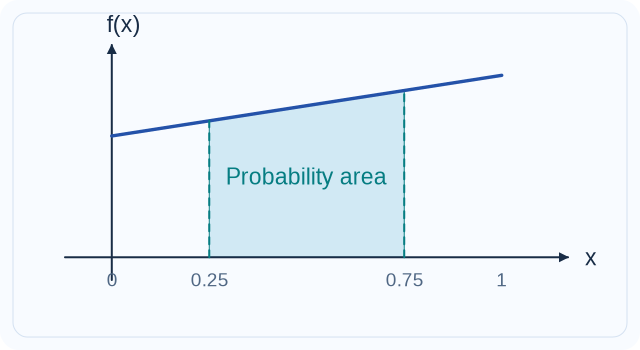
An increasing density from zero to one with a blue shaded interval between one quarter and three quarters.

The interval probability is the shaded area; the height at a single point contributes no area.

Worked example

Distinguish a density height from an area

The density is 2x5+45\frac{2 x}{5} + \frac{4}{5} for 0≤x≤10\le x\le1 and zero elsewhere.

Find the stated height at 14\frac{1}{4}, the point probability P(X=14)\mathrm P(X=\frac{1}{4}), and P(14≤X≤34)\mathrm P(\frac{1}{4}\le X\le\frac{3}{4}).

  1. Substituting into the density gives a height of 910\frac{9}{10}.

  2. Any single point has zero probability in a continuous distribution with a density.

  3. Integrate on the relevant support pieces to get ∫14342x5+45 dx=12\int_{\frac{1}{4}}^{\frac{3}{4}}\frac{2 x}{5} + \frac{4}{5}\,\mathrm dx=\frac{1}{2}.

Worked example

Distinguish a density height from an area

The density is 44 for 0≤x≤140\le x\le\frac{1}{4} and zero elsewhere.

Find the stated height at 116\frac{1}{16}, the point probability P(X=116)\mathrm P(X=\frac{1}{16}), and P(116≤X≤18)\mathrm P(\frac{1}{16}\le X\le\frac{1}{8}).

Try it on paper first.

  1. Substituting into the density gives a height of 44.

  2. Any single point has zero probability in a continuous distribution with a density.

  3. Integrate on the relevant support pieces to get ∫116184 dx=14\int_{\frac{1}{16}}^{\frac{1}{8}}4\,\mathrm dx=\frac{1}{4}.

Your turn

The density is 8x5+85\frac{8 x}{5} + \frac{8}{5} for 0≤x≤120\le x\le\frac{1}{2} and zero elsewhere.

Find the stated height at 18\frac{1}{8}, the point probability P(X=18)\mathrm P(X=\frac{1}{8}), and P(18≤X≤38)\mathrm P(\frac{1}{8}\le X\le\frac{3}{8}).

Enter an exact number, for example 3/2 or 2-sqrt(3).

Enter an exact number, for example 3/2 or 2-sqrt(3).

Enter an exact number, for example 3/2 or 2-sqrt(3).

Section 2 of 6 · Core · about 7 min

How do I choose the unknown scale?

Start with the entire area. Only after fixing the constant should you narrow the bounds to the event in question.

Worked example

Scale the full density before finding an interval probability

The proposed density has the following non-zero pieces: k(x+2)k(x + 2) on 0≤x<10\le x<1. It is zero elsewhere.

Find kk and P(14<X<34)\mathrm P(\frac{1}{4}<X<\frac{3}{4}) exactly.

  1. The unscaled area is ∫01x+2 dx=52\int_{0}^{1}x + 2\,\mathrm dx=\frac{5}{2}. The true area must be one.

  2. Thus k=25k=\frac{2}{5}. Substituting this makes all densities non-negative on their stated intervals.

  3. Use only the active pieces of the requested event. This gives ∫14342x5+45 dx=12\int_{\frac{1}{4}}^{\frac{3}{4}}\frac{2 x}{5} + \frac{4}{5}\,\mathrm dx=\frac{1}{2}.

Your turn

The proposed density has the following non-zero pieces: k(3−x)k(3 - x) on 0≤x<30\le x<3. It is zero elsewhere.

Find kk and P(1<X<2)\mathrm P(1<X<2) exactly.

Enter the value on its own or write k = … . Fractions and exact square roots are accepted.

Enter an exact number, for example 3/2 or 2-sqrt(3).

Section 3 of 6 · Core · about 7 min

When must I split an interval integral?

A piecewise model can have different equations on adjacent parts of one support. Use each equation only on its assigned interval.

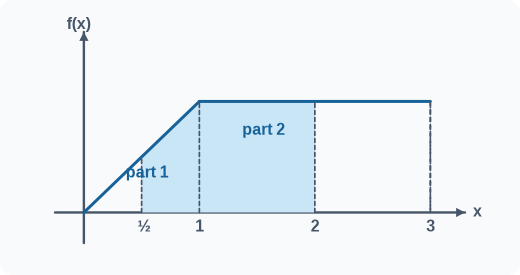
Density 2x/5 on zero to one, then height two fifths up to three. The event from one half to two is shaded and split at one.
Split 12<X≤2\frac12<X\le2 at x=1x=1. Each shaded part uses its own density rule.
Event positionIntegral choice
Inside one branchOne integral on that interval.
Across a joinClip and sum the separate integrals.
Inside a gapProbability zero.

Worked example

Split one event where the density rule changes

The density is 2x5\frac{2 x}{5} for 0≤x<10\le x<1; 25\frac{2}{5} for 1≤x<31\le x<3 and zero elsewhere.

Find P(12<X≤2)\mathrm P(\frac{1}{2}<X\le2) exactly.

  1. Clip the requested event to the support. At each change of formula start a separate integral.

  2. The contributing areas give ∫1212x5 dx+∫1225 dx=1120\int_{\frac{1}{2}}^{1}\frac{2 x}{5}\,\mathrm dx+\int_{1}^{2}\frac{2}{5}\,\mathrm dx=\frac{11}{20}.

Your turn

The proposed density has the following non-zero pieces: k(x+1)k(x + 1) on 0≤x<20\le x<2; k(1)k(1) on 2≤x<52\le x<5. It is zero elsewhere.

Find kk and P(1<X<3)\mathrm P(1<X<3) exactly.

Enter the value on its own or write k = … . Fractions and exact square roots are accepted.

Enter an exact number, for example 3/2 or 2-sqrt(3).

Section 4 of 6 · Core · about 6 min

What does a gap in the support contribute?

An event can include values that the model never produces. Those intervals contribute no area.

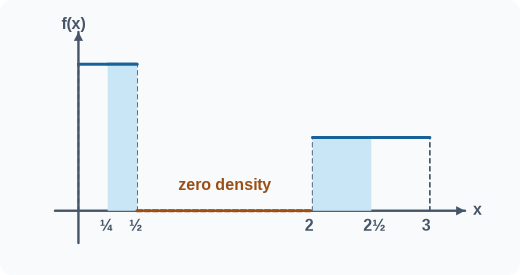
Two density rectangles on zero to one half and two to three. The middle interval has zero density. Only one quarter to one half and two to two and one half are shaded.
For 14<X≤52\frac14<X\le\frac52, integrate the two shaded pieces. The interval from 12\frac12 to 22 contributes zero.

Worked example

Skip the interval with zero density

The density is 11 for 0≤x<120\le x<\frac{1}{2}; 12\frac{1}{2} for 2≤x<32\le x<3 and zero elsewhere.

Find P(14<X≤52)\mathrm P(\frac{1}{4}<X\le\frac{5}{2}) exactly.

  1. Clip the requested event to the support. At each change of formula start a separate integral.

  2. The contributing areas give ∫14121 dx+∫25212 dx=12\int_{\frac{1}{4}}^{\frac{1}{2}}1\,\mathrm dx+\int_{2}^{\frac{5}{2}}\frac{1}{2}\,\mathrm dx=\frac{1}{2}.

Your turn

The density is 14\frac{1}{4} for −3≤x<−1-3\le x<-1; 14\frac{1}{4} for 2≤x<42\le x<4 and zero elsewhere.

Find P(−2<X≤3)\mathrm P(-2<X\le3) exactly.

Enter the value on its own or write p = … . Fractions and exact square roots are accepted.

Section 5 of 6 · Core · about 7 min

Does a signed integral of one prove a density is valid?

Check the sign on every interval before interpreting an integral as probability. A negative region can cancel part of a positive region in a signed integral.

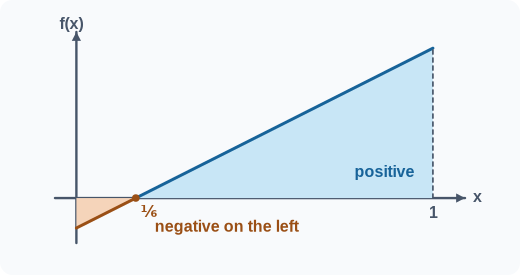
The proposed line starts at negative one half, crosses the axis at one sixth, and finishes at five halves. The left triangle is below the axis.
For 3x−123x-\frac12, the small triangle below the axis subtracts from the signed integral. It cannot represent probability.

Worked example

Reject a candidate even though its signed integral is one

Consider f(x)=3x−12f(x)=3x-\frac12 on [0,1][0,1], with zero elsewhere. Calculate its signed integral and decide whether it can represent a probability density.

  1. The candidate crosses the axis at x=16x=\frac16. It is negative on 0≤x<160\le x<\frac16, so it already fails the sign test.

  2. The signed integral is [32x2−12x]01=1\left[\frac32x^2-\frac12x\right]_0^1=1. On the sketch the triangle below the axis contributes −124-\frac1{24}, while the triangle above contributes 2524\frac{25}{24}.

  3. Both requirements must hold. The signed integral is one, but the candidate is invalid because it assigns a negative integral to some intervals.

Your turn

A proposed density is 2x2 x on 0≤x≤10\le x\le1 and zero elsewhere. Find the area under it on this interval. Then decide whether the model is a valid density.

Enter the value on its own or write area = … . Fractions and exact square roots are accepted.

Valid density

Section 6 of 6 · Extension · about 5 min

Can changing one endpoint alter a probability?

Including or excluding a single boundary point does not affect a probability. The statement still determines which height is assigned at that boundary.

Worked example

Check why an open endpoint has no probability mass

The density is 15\frac{1}{5} for −2≤x≤3-2\le x\le3 and zero elsewhere.

Find P(−2<X≤3)\mathrm P(-2<X\le3) exactly.

  1. Clip the requested event to the support. At each change of formula start a separate integral.

  2. The contributing areas give ∫−2315 dx=1\int_{-2}^{3}\frac{1}{5}\,\mathrm dx=1.

Your turn

The density is 11 for 0≤x<120\le x<\frac{1}{2}; 12\frac{1}{2} for 2≤x<32\le x<3 and zero elsewhere.

Find P(34<X≤32)\mathrm P(\frac{3}{4}<X\le\frac{3}{2}) exactly.

Enter the value on its own or write p = … . Fractions and exact square roots are accepted.

Worked examples

Practise the method

Core practice

Question 1 of 4

0 / 4 checked in this collection

Question list

Core practice

Fresh variants

Exam-style

Normalisation, an interval and a point

3 marks

The density is k(x+1)k(x+1) on [0,2][0,2], zero elsewhere. Give k, P(1/2<X<3/2)\mathrm P(1/2\lt X\lt3/2), and P(X=1)\mathrm P(X=1).

Enter the value on its own or write k = … . Fractions and exact square roots are accepted.

Enter an exact number, for example 3/2 or 2-sqrt(3).

Enter an exact number, for example 3/2 or 2-sqrt(3).

Full answer-format guide

Exact numbers: 3/2, sqrt(5), 2-sqrt(3), pi/6, 3*pi/2. Sets: {1,4}. Intervals: (3,5]; a round bracket excludes the endpoint. Infinity: inf; union: U; no solutions: empty. Separate coordinate pairs or triples with semicolons. Expressions: 2x^2+3x-1; equations: x^2=3x+1 or the polynomial equal to zero. Factors: x-1 ; x+2. Parameter fraction: numerator ; denominator. List integer answers individually.

Review the method

Progress stays in this browser. Create an account to save it or sign in.

Extra practice from this lesson

Distinguish a density height from an area

The density is x4\frac{x}{4} for 1≤x≤31\le x\le3 and zero elsewhere.

Find the stated height at 32\frac{3}{2}, the point probability P(X=32)\mathrm P(X=\frac{3}{2}), and P(32≤X≤52)\mathrm P(\frac{3}{2}\le X\le\frac{5}{2}).

Enter an exact number, for example 3/2 or 2-sqrt(3).

Enter an exact number, for example 3/2 or 2-sqrt(3).

Enter an exact number, for example 3/2 or 2-sqrt(3).

Scale the full density before finding an interval probability

The proposed density has the following non-zero pieces: k(x2)k(x^{2}) on 0≤x<20\le x<2. It is zero elsewhere.

Find kk and P(12<X<32)\mathrm P(\frac{1}{2}<X<\frac{3}{2}) exactly.

Enter the value on its own or write k = … . Fractions and exact square roots are accepted.

Enter an exact number, for example 3/2 or 2-sqrt(3).

Find the probability across the relevant branches

The density is 17\frac{1}{7} for 0≤x<30\le x<3; 27\frac{2}{7} for 3≤x<53\le x<5 and zero elsewhere.

Find P(2<X≤4)\mathrm P(2<X\le4) exactly.

Enter the value on its own or write p = … . Fractions and exact square roots are accepted.

Find the probability across the relevant branches

The density is 18\frac{1}{8} for 0≤x<20\le x<2; 14\frac{1}{4} for 4≤x<74\le x<7 and zero elsewhere.

Find P(1<X≤5)\mathrm P(1<X\le5) exactly.

Enter the value on its own or write p = … . Fractions and exact square roots are accepted.

Check the two density requirements

A proposed density is x+12x + \frac{1}{2} on −1≤x≤1-1\le x\le1 and zero elsewhere. Find the area under it on this interval. Then decide whether the model is a valid density.

Enter the value on its own or write area = … . Fractions and exact square roots are accepted.

Valid density

Find the probability across the relevant branches

The density is 16\frac{1}{6} for −3≤x≤3-3\le x\le3 and zero elsewhere.

Find P(−4<X≤−3)\mathrm P(-4<X\le-3) exactly.

Enter the value on its own or write p = … . Fractions and exact square roots are accepted.

Apply it · original exam-style problems

Show your working on paper and compare it with the worked solution and marking guidance.

Come back to what needs practice

Quick revision sheet (A4)

Your review plan starts after your first check.