Maths4UBETA

Work done by constant forces

Calculate signed work, identify zero work and use the correct displacement for a resistance or for weight.

Try the quick check →
Lesson 1 of 5

Section 1 of 5 · Core · about 6 min

Which force component does work?

Work describes the energy transferred by a force as its point of application moves. For a constant force and a straight displacement, resolve the force along the movement before multiplying by the distance.

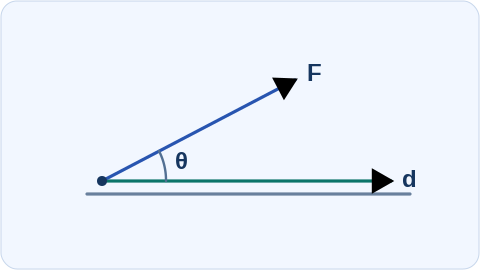
An angled pulling force F and a horizontal displacement d start at the same point. The angle between them is marked theta.

The work uses the component of FF along the displacement arrow. Here the indicated angle is the one used in Fdcos⁡θFd\cos\theta.

Worked example

Find signed work from an angle

The sample carriage moves 15 m15\,\mathrm m in a straight line. A constant force has magnitude 28 N28\,\mathrm N at angle 60∘60^\circ to the displacement. Find the signed work done by that force.

  1. The force component along the displacement is Fcos⁡θ=14F\cos\theta=14 newtons.

  2. Multiply the signed component by the distance. W=28×15×(12)=210W=28\times 15\times\left(\frac{1}{2}\right)=210.

  3. The force does 210 J210\,\mathrm J of work. This is positive because the force partly helps the motion.
Your turn

The sample carriage moves 9 m9\,\mathrm m in a straight line. A constant force has magnitude 36 N36\,\mathrm N at angle 30∘30^\circ to the displacement. Find the signed work done by that force.

Enter an exact value or round to 3 significant figures.

Section 2 of 5 · Core · about 6 min

When does a force do negative work?

When the force has a component back against the displacement, that component does negative work. This can occur even when another force keeps the body moving forwards.

Worked example

Find signed work from an angle

The sample carriage moves 5 m5\,\mathrm m in a straight line. A constant force has magnitude 32 N32\,\mathrm N at angle 120∘120^\circ to the displacement. Find the signed work done by that force.

  1. The force component along the displacement is Fcos⁡θ=−16F\cos\theta=-16 newtons.

  2. Multiply the signed component by the distance. W=32×5×(−12)=−80W=32\times 5\times\left(- \frac{1}{2}\right)=-80.

  3. The force does −80 J-80\,\mathrm J of work. This is negative because the force has a component opposing motion.

Your turn

The sample carriage moves 8 m8\,\mathrm m in a straight line. A constant force has magnitude 30 N30\,\mathrm N at angle θ\theta to the displacement. The cosine of this angle is −45- \frac{4}{5}. Find the signed work done by that force.

Enter an exact number, for example 3/2 or 2-sqrt(3).

Worked example

Find signed work from an angle

The measuring cart moves 22 m22\,\mathrm m in a straight line. A constant force has magnitude 14 N14\,\mathrm N at angle 180∘180^\circ to the displacement. Find the signed work done by that force.

Try it on paper first.

  1. The force component along the displacement is Fcos⁡θ=−14F\cos\theta=-14 newtons.

  2. Multiply the signed component by the distance. W=14×22×(−1)=−308W=14\times 22\times\left(-1\right)=-308.

  3. The force does −308 J-308\,\mathrm J of work. This is negative because the force has a component opposing motion.

Section 3 of 5 · Core · about 6 min

Can a force act and still do no work?

A force does zero work if its point of application stays still, or if it acts perpendicular to the displacement. A normal force on a fixed smooth track is an important example.

Worked example

Find signed work from an angle

The marker tray moves 8 m8\,\mathrm m in a straight line. A constant force has magnitude 54 N54\,\mathrm N at angle 90∘90^\circ to the displacement. Find the signed work done by that force.

  1. The force component along the displacement is Fcos⁡θ=0F\cos\theta=0 newtons.

  2. Multiply the signed component by the distance. W=54×8×(0)=0W=54\times 8\times\left(0\right)=0.

  3. The force does 0 J0\,\mathrm J of work. This is zero because there is no displacement along the force.

Your turn

The load remains stationary throughout an interval while a constant force of 75 N75\,\mathrm N acts on it. Find the signed work done by that force.

Enter an exact number, for example 3/2 or 2-sqrt(3).

Section 4 of 5 · Core · about 6 min

What does work done against resistance mean?

A resistance pointing back along the path does negative work. The phrase ‘work done against resistance’ asks for the corresponding positive amount of energy dissipated.

Worked example

Distinguish work by and against a resistance

A cart moves 22 m22\,\mathrm m against a constant resistance of 8 N8\,\mathrm N. Find the signed work done by resistance and the energy lost to resistance.

  1. The force points opposite to the displacement, so its own work is −Rd-Rd.

  2. The product of the two magnitudes is 176 J176\,\mathrm J.

  3. Resistance does −176 J-176\,\mathrm J of work. The amount of energy transferred away from mechanical energy is 176 J176\,\mathrm J.

Your turn

A transport sled moves 35 m35\,\mathrm m against a constant resistance of 16 N16\,\mathrm N. Find the signed work done by resistance and the energy lost to resistance.

Enter an exact number, for example 3/2 or 2-sqrt(3).

Enter an exact number, for example 3/2 or 2-sqrt(3).

Worked example

Distinguish work by and against a resistance

A instrument trolley moves 45 m45\,\mathrm m against a constant resistance of 112 N\frac{11}{2}\,\mathrm N. Find the work done against the resistance.

Try it on paper first.

  1. The force points opposite to the displacement, so its own work is −Rd-Rd.

  2. The product of the two magnitudes is 4952 J\frac{495}{2}\,\mathrm J.

  3. The work done against resistance is 4952 J\frac{495}{2}\,\mathrm J.

Section 5 of 5 · Core · about 6 min

Why does gravity use vertical displacement?

Weight points downwards. Its work depends on the signed vertical displacement Δh\Delta h, even when the route is longer than that displacement.

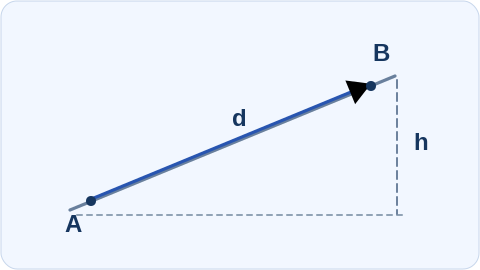
A sloped path from A to B shows an uphill arrow and a dashed vertical height marker to the right.

Use the vertical height change hh for work by weight. The path length dd is used for a force resisting motion along the ramp.

Worked example

Calculate work by weight on a slope

A particle, modelled as a instrument sled, has mass 14 kg14\,\mathrm{kg} moves 20 m20\,\mathrm m up a slope. The sine of the inclination is 35\frac{3}{5}. Take g=10 m s−2g=10\,\mathrm{m\,s^{-2}}. Give its signed height change (upwards positive) and the work done by gravity.

  1. Only vertical displacement enters the work done by the vertical weight. The vertical change is 12 m12\,\mathrm m.

  2. Gravity acts downwards, so signed work is Wg=−mg Δh=−1680W_g=-mg\,\Delta h=-1680 joules.

  3. The height change is 12 m12\,\mathrm m and work done by gravity is −1680 J-1680\,\mathrm J.

Your turn

A particle, modelled as a instrument sled, has mass 8 kg8\,\mathrm{kg} moves 13 m13\,\mathrm m down a slope. The sine of the inclination is 513\frac{5}{13}. Take g=10 m s−2g=10\,\mathrm{m\,s^{-2}}. Give its signed height change (upwards positive) and the work done by gravity.

Enter an exact number, for example 3/2 or 2-sqrt(3).

Enter an exact number, for example 3/2 or 2-sqrt(3).

Worked examples

Practise the method

Core practice

Question 1 of 4

0 / 4 checked in this collection

Question list

Core practice

Fresh variants

Exam-style

Find signed work from an angle

1 mark

The sample carriage moves 18 m18\,\mathrm m in a straight line. A constant force has magnitude 35 N35\,\mathrm N at angle 60∘60^\circ to the displacement. Find the signed work done by that force.

Enter an exact number, for example 3/2 or 2-sqrt(3).

Full answer-format guide

Exact numbers: 3/2, sqrt(5), 2-sqrt(3), pi/6, 3*pi/2. Sets: {1,4}. Intervals: (3,5]; a round bracket excludes the endpoint. Infinity: inf; union: U; no solutions: empty. Separate coordinate pairs or triples with semicolons. Expressions: 2x^2+3x-1; equations: x^2=3x+1 or the polynomial equal to zero. Factors: x-1 ; x+2. Parameter fraction: numerator ; denominator. List integer answers individually.

Review the method

Progress stays in this browser. Create an account to save it or sign in.

Extra practice from this lesson

Find signed work from an angle

The sample carriage moves 12 m12\,\mathrm m in a straight line. A constant force has magnitude 56 N56\,\mathrm N at angle θ\theta to the displacement. The cosine of this angle is 34\frac{3}{4}. Find the signed work done by that force.

Enter an exact number, for example 3/2 or 2-sqrt(3).

Find signed work from an angle

The sample carriage moves 10 m10\,\mathrm m in a straight line. A constant force has magnitude 44 N44\,\mathrm N at angle 135∘135^\circ to the displacement. Find the signed work done by that force.

Enter an exact value or round to 3 significant figures.

Find signed work from an angle

The sample carriage moves 20 m20\,\mathrm m in a straight line. A constant force has magnitude 32 N32\,\mathrm N at angle 90∘90^\circ to the displacement. Find the signed work done by that force.

Enter an exact number, for example 3/2 or 2-sqrt(3).

Distinguish work by and against a resistance

A cart moves 152 m\frac{15}{2}\,\mathrm m against a constant resistance of 14 N14\,\mathrm N. Find the signed work done by resistance and the energy lost to resistance.

Enter an exact number, for example 3/2 or 2-sqrt(3).

Enter an exact number, for example 3/2 or 2-sqrt(3).

Calculate work by weight on a slope

A particle, modelled as a instrument sled, has mass 16 kg16\,\mathrm{kg} moves 17 m17\,\mathrm m up a slope. The sine of the inclination is 817\frac{8}{17}. Take g=10 m s−2g=10\,\mathrm{m\,s^{-2}}. Give its signed height change (upwards positive) and the work done by gravity.

Enter an exact number, for example 3/2 or 2-sqrt(3).

Enter an exact value or round to 3 significant figures.

Apply it · original exam-style problems

Show your working on paper and compare it with the worked solution and marking guidance.

Come back to what needs practice

Quick revision sheet (A4)

Your review plan starts after your first check.