Worked example
Choose the increment and retain the requested terms
Use the terms through in to approximate .
Therefore using the specified quadratic approximation. Its exact error is found from the omitted terms below.
Match a numerical input, control omitted terms and connect coefficient models to complete parameter ranges.
Try the quick check →Section 1 of 5 · Core · about 7 min
A short binomial expansion estimates a numerical power by retaining only the requested terms. First equate the bracket’s base to the number you need. If the bracket is , solve ; do not substitute the target itself for .
Worked example
Use the terms through in to approximate .
Therefore using the specified quadratic approximation. Its exact error is found from the omitted terms below.
Worked example
Use a quadratic binomial approximation to estimate .
For , the quadratic polynomial is .
The omitted contribution is , so the exact value is . The outside factor multiplies the error as well as the retained terms.
Section 2 of 5 · Core · about 8 min
Let be the full finite expansion and its terms through degree . Define the signed remainder by . It is exactly the sum of the omitted terms.
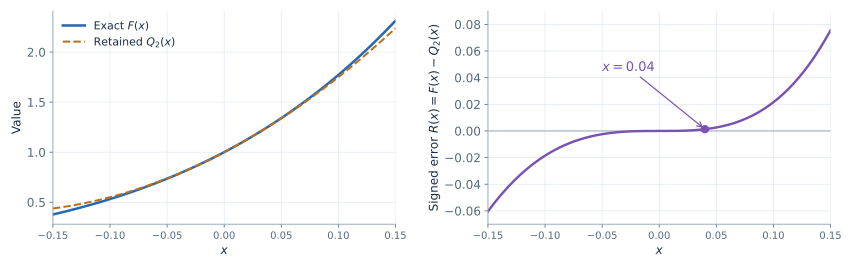
For and , subtract the retained terms.
At , and . The error is positive, so the approximation is an underestimate. For small negative inputs the error has the opposite sign.
At , the quadratic value for is ; the exact value is . The omitted polynomial gives their positive difference .
Worked example
Approximate by . At , find the signed remainder, absolute error and percentage error.
The signed remainder is , so is an overestimate. The absolute error is .
The percentage is rounded to three significant figures. Its denominator is the magnitude of the true value, not the approximation.
Section 3 of 5 · Core · about 10 min
For a whole input interval, bound each omitted term. If has positive integer powers and , the triangle inequality gives
This bound allows for all omitted terms, including mixed signs. On , nonnegative coefficients also tell you .
Worked example
For , bound the error when is approximated by .
Every term is nonnegative and increases as increases on this interval. Replace each power by its value at :
The exact upper bound is reached at . Thus the quadratic approximation is at most the true value, and its absolute error is less than throughout the interval.
Worked example
Approximate using a truncation of at . Find the least retained degree that gives absolute error below , and justify the correct answer to three decimal places.
Keeping degree two gives . Its exact remainder is
All contributions are positive at this input. Any earlier truncation omits still more positive terms, so it also fails the error requirement.
The least degree is , meaning four retained terms including the constant.
This whole interval lies between the rounding boundaries and , so the correct three-decimal-place value is .
The quadratic value would round to , despite its error being below half a thousandth. The true value crosses the midpoint ; an error threshold alone does not guarantee the same rounding.
To prove a truncation is the least sufficient one, show that it meets the strict error requirement and that all shorter choices fail. With positive omitted terms at a positive input, shorter truncations have larger errors. With mixed signs, compare the actual remainders; do not assume every added term reduces the absolute error.
Section 4 of 5 · Core · about 6 min
Plan backward from the final power. Multiplication by lowers each exponent by . To retain terms through degree after that shift, the inner expansion may need terms through degree .
Worked example
For , find the terms through in . Use its linear truncation at and find the exact omitted error.
Division by lowers powers by two, so the numerator must be expanded through degree four.
The exact value is . Expanding the numerator only through degree two would have kept just the constant after division and lost both needed higher terms.
Section 5 of 5 · Core · about 11 min
A coefficient extracted from a product may be a quadratic function of a parameter. First collect every contribution to the requested power. Then treat the resulting coefficient function as an algebra problem, preserving the parameter’s domain.
Write for the coefficient of in . The input used in the expansion and a model parameter such as have different roles.
Worked example
Let be the coefficient of in , where . Find the range of , then solve in the allowed domain.
The quadratic coefficient collects three contributions:
For , the square satisfies . Therefore
Only belongs to . Neither range endpoint is attained because the parameter interval excludes both endpoints.
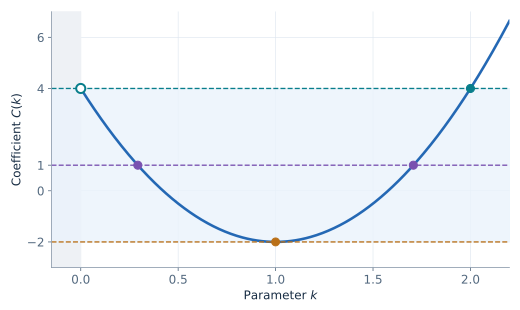
For with , count intersections only on the positive-parameter side.
| Level | Positive solutions |
|---|---|
| A repeated solution at . | |
| Two solutions . | |
| Only remains because is excluded. |
There are two distinct positive solutions exactly when .
For , a horizontal level meets the curve twice at positive precisely when . The lower boundary is a repeated root; at the upper boundary one root is zero.
Worked example
The coefficient of in is . Find the values of for which the coefficient equation has two distinct positive solutions for .
Two distinct real roots require , so .
The larger root is then positive. The smaller root must also be positive:
At , there is one repeated root . At , the roots are and . These boundaries fail “two distinct positive”, so both inequalities are strict.
Question 1 of 4
0 / 4 checked in this collection
Use the quadratic truncation of to estimate . Give the matching x and the quadratic estimate rounded to 3 decimal places.
Progress stays in this browser. Create an account to save it or sign in.
Show your working on paper and compare it with the worked solution and marking guidance.
Approximate by retaining the first terms in ascending powers of from , with . Find the lowest retained degree giving an absolute error less than . State the number of terms, the resulting approximation and its exact error.
Test the remainder after the cubic term and after the quartic term. At this positive input every omitted term is positive.
After degree three the error is
After degree four the error is
Earlier truncations omit these positive terms and additional positive terms, so they also fail. Degree four is therefore the lowest possible degree, giving five retained terms.
Let be the coefficient of in . Both linear coefficients inside the two brackets are strictly positive.
Show on paper that . Find the exact range of , state whether either endpoint is attained, and find every allowed for which .
The bracket conditions give . Extract all three quadratic contributions and complete the square in .
For , we have , so . Thus the exact range is
Every intermediate value is attained because this quadratic is continuous and strictly increasing on the interval. Neither endpoint is included.
Only lies between and . The positive-sign candidate violates the bracket conditions.
The coefficient of in is , where and are real.
Find the range of for which the coefficient equation has two distinct positive values of . Explain both excluded endpoints. Then find those two values when .
Extract the coefficient as . Its minimum controls distinct real roots. Use the smaller root from the completed-square form to check that both are positive.
Two distinct real solutions require . Write . The roots are . Both are positive exactly when the smaller one is positive:
At , the minimum is attained, but there is only the repeated solution . At , the roots are and , so one is not strictly positive. Both endpoints are excluded for the stated question.
For ,
Both values are positive and distinct.
Your review plan starts after your first check.