Pure Mathematics 1 (9709) · Coordinate Geometry · Quick revision
Distances, midpoints and diameter geometry
Difference for distance, average for midpoint
For and , use . The midpoint averages the two -coordinates and the two -coordinates separately.
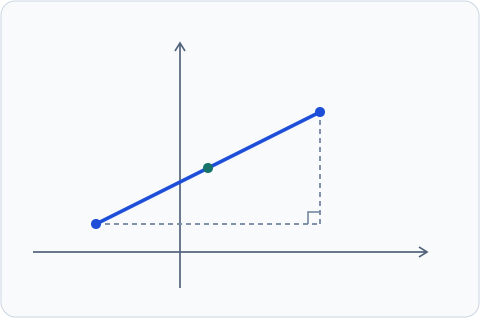
Work backwards from the midpoint
If is the midpoint, and . Repeat the same move from to , starting at .
Turn a condition into an equation
For equal distances, use . If is a diameter, the centre is its midpoint and .