Maths4UBETA

Distances, midpoints and diameter geometry

Use exact coordinates to find lengths, missing endpoints and geometric constraints.

Try the quick check →
Lesson 1 of 5

Section 1 of 5 · Core · about 5 min

How do coordinate changes give a length?

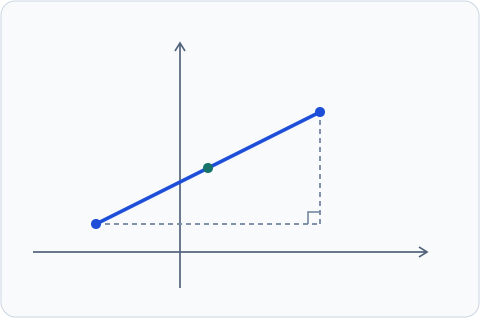
From A(−3,1)A(-3,1) to B(5,5)B(5,5), move 88 units right and 44 units up. These are the two perpendicular sides of a right-angled triangle. The segment ABAB is its hypotenuse.

A at (−3, 1) and B at (5, 5) form a right triangle with horizontal change 8 and vertical change 4. Their midpoint C is (1, 3).

Worked example

Use the two sides of the right triangle

Find the exact distance between A(−3,1)A(-3,1) and B(5,5)B(5,5).

  1. The coordinate changes from AA to BB are 5−(−3)=85-(-3)=8 and 5−1=45-1=4.

  2. Squaring and adding gives AB2=82+42=64+16=80AB^2=8^2+4^2=64+16=80.

  3. Take the non-negative square root. AB=80=45AB=\sqrt{80}=4\sqrt5.

Your turn

Find the length of the segment from P(−4,2)P(-4,2) to Q(2,−6)Q(2,-6).

Enter the value on its own or write PQ = … . Fractions and exact square roots are accepted.

Your turn

Find the exact length from P(−2,4)P(-2,4) to Q(1,−4)Q(1,-4). Give a surd.

Enter the value on its own or write PQ = … . Fractions and exact square roots are accepted.

Section 2 of 5 · Core · about 4 min

Where is the midpoint?

To reach the midpoint of ABAB, make half of each move from AA to BB. From (−3,1)(-3,1), move 44 right and 22 up to reach C(1,3)C(1,3).

Worked example

Average one coordinate at a time

Use the midpoint formula for A(−3,1)A(-3,1) and B(5,5)B(5,5).

  1. The average xx-coordinate is −3+52=1\frac{-3+5}{2}=1.

  2. The average yy-coordinate is 1+52=3\frac{1+5}{2}=3. So C=(1,3)C=(1,3).

  3. The move from AA to CC is (4,2)(4,2), and the move from CC to BB is also (4,2)(4,2).

Your turn

Find the midpoint of P(−6,1)P(-6,1) and Q(4,6)Q(4,6).

Enter a point as (1, 2) or x = 1, y = 2. Separate complete pairs with commas or semicolons.

Section 3 of 5 · Core · about 4 min

How can a midpoint locate the missing endpoint?

The move from AA to the midpoint CC is exactly the move from CC to BB. Knowing AA and CC therefore tells you the position of BB.

Worked example

Extend the same half of a segment

The midpoint of ABAB is C(1,3)C(1,3) and A=(−3,1)A=(-3,1). Find BB.

  1. From AA to CC, the change is 1−(−3)=41-(-3)=4 in xx and 3−1=23-1=2 in yy.

  2. Add the same changes to CC. This gives B=(1+4,3+2)=(5,5)B=(1+4,3+2)=(5,5).

  3. Check that the averages of the endpoint coordinates are 11 and 33.

Your turn

A segment starts at (3,−2)(3,-2) and has midpoint (−1,52)(-1,\tfrac52). Find the other endpoint.

Enter a point as (1, 2) or x = 1, y = 2. Separate complete pairs with commas or semicolons.

Section 4 of 5 · Core · about 6 min

How can equal distances locate a point?

A point PP lies on the yy-axis and is equally far from AA and BB. Write it as P(0,p)P(0,p). Now there is only one unknown coordinate.
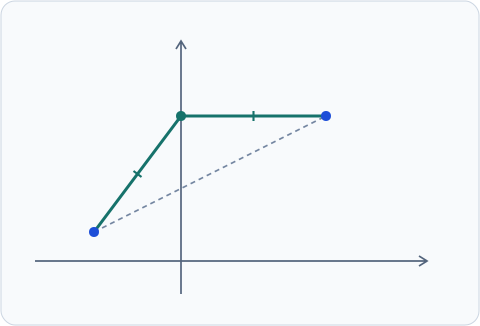
P (0, 5) is connected to A (−3, 1) and B (5, 5). PA and PB have the same length.

Worked example

Find an equidistant point on the y-axis

Find the point P(0,p)P(0,p) that is equally far from A(−3,1)A(-3,1) and B(5,5)B(5,5).

  1. Use PA2=PB2PA^2=PB^2. This gives 9+(p−1)2=25+(p−5)29+(p-1)^2=25+(p-5)^2.

  2. Expand to get p2−2p+10=p2−10p+50p^2-2p+10=p^2-10p+50. Hence 8p=408p=40 and p=5p=5.

  3. At P=(0,5)P=(0,5), the two squared distances are 9+16=259+16=25 and 25+0=2525+0=25.

Your turn

Find the point on the xx-axis equally far from D(−2,3)D(-2,3) and E(4,1)E(4,1).

Enter a point as (1, 2) or x = 1, y = 2. Separate complete pairs with commas or semicolons.

Section 5 of 5 · Core · about 5 min

How does a diameter determine a circle?

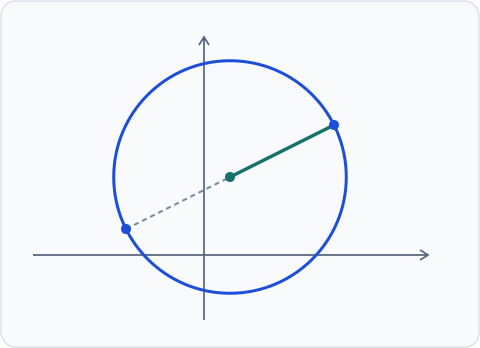
When ABAB is a diameter, the centre is its midpoint CC. The radius runs from CC to one endpoint.

The circle with diameter AB has centre C (1, 3). The radius CB is half the length of AB.

Worked example

Use the midpoint and half the diameter

A circle has diameter from A(−3,1)A(-3,1) to B(5,5)B(5,5). Find its centre and the square of its radius.

  1. The midpoint is (1,3)(1,3), so this is the centre.

  2. The diameter has squared length 8080, so r2=804=20r^2=\frac{80}{4}=20.

  3. Check using the changes from the centre to BB. They are 44 and 22. Thus 42+22=204^2+2^2=20, and r=25r=2\sqrt5.

Your turn

A circle has diameter from (−2,4)(-2,4) to (6,−2)(6,-2). Give its centre.

Enter a point as (1, 2) or x = 1, y = 2. Separate complete pairs with commas or semicolons.

Your turn

For the same diameter from (−2,4)(-2,4) to (6,−2)(6,-2), find r2r^2.

Enter an exact number, for example 3/2 or 2-sqrt(3).

Worked examples

Practise the method

Core practice

Question 1 of 4

0 / 4 checked in this collection

Question list

Core practice

Fresh variants

Exam-style

Exact length and midpoint

2 marks

Find the length and midpoint of A(−2, 1)\left( -2, \ 1\right) and B(4, 5)\left( 4, \ 5\right).

Enter the value on its own or write AB = … . Fractions and exact square roots are accepted.

Enter a point as (1, 2) or x = 1, y = 2. Separate complete pairs with commas or semicolons.

Full answer-format guide

Exact numbers: 3/2, sqrt(5), 2-sqrt(3), pi/6, 3*pi/2. Sets: {1,4}. Intervals: (3,5]; a round bracket excludes the endpoint. Infinity: inf; union: U; no solutions: empty. Separate coordinate pairs or triples with semicolons. Expressions: 2x^2+3x-1; equations: x^2=3x+1 or the polynomial equal to zero. Factors: x-1 ; x+2. Parameter fraction: numerator ; denominator. List integer answers individually.

Review the method

Progress stays in this browser. Create an account to save it or sign in.

Apply it · original exam-style problems

Show your working on paper and compare it with the worked solution and marking guidance.

Start after this lesson

Recover a centre from a diameter 5 marks

A circle has diameter ABAB, where A=(−5,2)A=(-5,2) and B=(3,8)B=(3,8).

  1. Find the length ABAB. [2]
  2. Find the centre of the circle. [2]
  3. Find the squared radius. [1]
Worked solution
  1. The coordinate changes are 88 and 66. Thus AB=82+62=10AB=\sqrt{8^2+6^2}=10. [2]
  2. The centre is the midpoint (−5+32,2+82)=(−1,5)\left(\frac{-5+3}{2},\frac{2+8}{2}\right)=(-1,5). [2]
  3. The radius is 55, so its square is 2525. [1]
Locate a point equidistant from two ends 5 marks

The point TT lies on the yy-axis and is equidistant from P(−3,2)P(-3,2) and Q(5,4)Q(5,4).

  1. Find the coordinates of TT. [3]
  2. Find the exact length TPTP. [2]
Worked solution
  1. Write T=(0,t)T=(0,t). Equate 9+(t−2)29+(t-2)^2 and 25+(t−4)225+(t-4)^2. After cancelling t2t^2, 4t=284t=28, so T=(0,7)T=(0,7). [3]
  2. TP=32+52=34TP=\sqrt{3^2+5^2}=\sqrt{34}. [2]
Mixed chapter practice

Try these after completing this chapter.

Review Parallel, perpendicular and exceptional lines and Straight-line equations, intercepts and intersections first.

Review Parallel, perpendicular and exceptional lines and Circle equations, centres and tangents first.

Review Parallel, perpendicular and exceptional lines first.

Review Parallel, perpendicular and exceptional lines and Circle equations, centres and tangents first.

Review Circle equations, centres and tangents and Line–circle intersections, chords and tangency first.

Review Circle equations, centres and tangents and Line–circle intersections, chords and tangency first.

Review Circle equations, centres and tangents and Line–circle intersections, chords and tangency first.

Review Circle equations, centres and tangents and Line–circle intersections, chords and tangency first.

Review Circle equations, centres and tangents first.

Review Parallel, perpendicular and exceptional lines and Circle equations, centres and tangents first.

Come back to what needs practice

Quick revision sheet (A4)

Your review plan starts after your first check.

Question bank and saved work