Pure Mathematics 1 (9709) · Functions · Quick revision
Graphs of functions and inverses
Reflect in the line
For a one–one function, gives . Swap the coordinates and reflect only the allowed part of the original graph. For example, becomes .
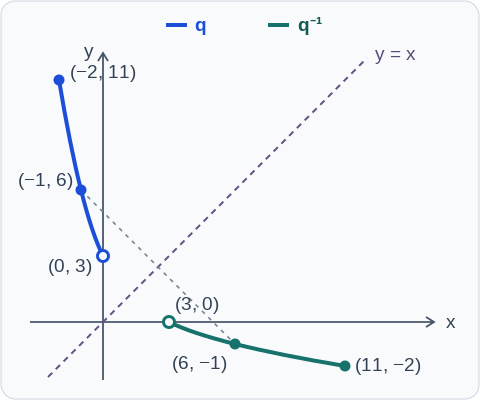
Reflect features with the graph
| Original feature | Inverse feature |
|---|---|
| Open or closed endpoint | Swap the coordinates. Keep the dot hollow or filled. |
| An included axis intercept | Swap the axes. Check that the original point was allowed. |
| Asymptote or | Swap vertical and horizontal. Keep . |
Find common points
For a strictly increasing function, solve and keep allowed roots. In general, equate and on their common domain. A decreasing graph can share points with its inverse away from the mirror.