Maths4UBETA

Graphs of functions and inverses

Reflect coordinates, endpoints and asymptotes, and distinguish fixed points from all intersections.

Try the quick check →
Lesson 4 of 5

Section 1 of 6 · Core · about 5 min

How does a point move on the inverse graph?

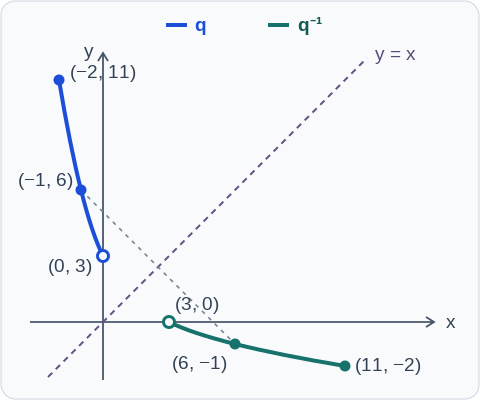
Take q(x)=(x−1)2+2q(x)=(x-1)^2+2 on [−2,0)[-2,0). Since q(−1)=6q(-1)=6, its inverse takes 66 back to −1-1. The point (−1,6)(-1,6) moves to (6,−1)(6,-1) across the dotted line y=xy=x.

The restricted graph of q and its inverse are mirror images in y = x. A guide connects (−1, 6) on q to (6, −1) on its inverse. The open endpoint (0, 3) maps to the open endpoint (3, 0).

Worked example

Swap an input and output on the sketch

Let q(x)=(x−1)2+2q(x)=(x-1)^2+2 on −2≤x<0-2\le x<0. Find the inverse point corresponding to the input −1-1.

  1. q(−1)=(−2)2+2=6q(-1)=(-2)^2+2=6, so (−1,6)(-1,6) is on the original graph.

  2. Reversing the function makes 66 the input and −1-1 the output. Plot (6,−1)(6,-1) on the inverse.

  3. The midpoint of these two points is (52,52)(\tfrac52,\tfrac52), on y=xy=x. The segment joining them is perpendicular to the mirror.
Your turn

A one–one function passes through (−3,2)(-3,2), (1,5)(1,5) and (4,9)(4,9). Give all three matching points on its inverse.

Enter a point as (1, 2) or x = 1, y = 2. Separate complete pairs with commas or semicolons.

Section 2 of 6 · Core · about 6 min

Which endpoints stay open?

Reflect the allowed arc of q(x)=(x−1)2+2q(x)=(x-1)^2+2 on −2≤x<0-2\le x<0. The point (−2,11)(-2,11) is included. The arc approaches (0,3)(0,3), which is excluded.

EndpointOn qqOn q−1q^{-1}
Closed(−2,11)(-2,11)(11,−2)(11,-2)
Open(0,3)(0,3)(3,0)(3,0)

Worked example

Reflect a closed end and an open end

Sketch the inverse of q(x)=(x−1)2+2q(x)=(x-1)^2+2 on [−2,0)[-2,0) by reflecting its endpoints. State the inverse domain and range.

  1. The filled endpoint (−2,11)(-2,11) reflects to a filled endpoint at (11,−2)(11,-2). The hollow endpoint (0,3)(0,3) reflects to a hollow endpoint at (3,0)(3,0).

  2. Read across the sketch for the inverse inputs, from 33 open to 1111 closed. The inverse domain is (3,11](3,11].

  3. Read up the sketch for the inverse outputs, from −2-2 closed to 00 open. The inverse range is [−2,0)[-2,0). Draw only the reflected arc between the two endpoints.

Your turn

Let r(x)=8−2xr(x)=8-2x for −1≤x<2-1\le x<2. Give the coordinates of the hollow endpoint on the inverse sketch.

Enter a point as (1, 2) or x = 1, y = 2. Separate complete pairs with commas or semicolons.

Your turn

For the same r(x)=8−2xr(x)=8-2x on −1≤x<2-1\le x<2, give the complete domain of r−1r^{-1}.

Use inequalities in x or interval notation. Join intervals with ‘or’ or ∪. Enter an isolated value on its own.

Section 3 of 6 · Core · about 6 min

Which intercepts are on the inverse graph?

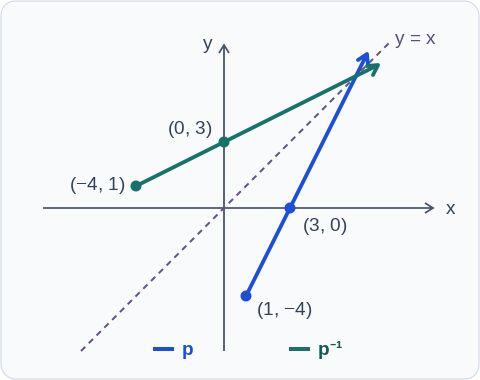
For p(x)=2x−6p(x)=2x-6 on x≥1x\ge1, the point (3,0)(3,0) belongs to the graph. It becomes the point (0,3)(0,3) on the inverse. The original graph stops before the yy-axis.

The restricted line p has x-intercept (3, 0). Its reflection in y = x has y-intercept (0, 3) and never meets the x-axis.

Worked example

Reflect an intercept that belongs to the domain

For p(x)=2x−6p(x)=2x-6, x≥1x\ge1, find the intercepts of the inverse graph.

  1. Solve 2x−6=02x-6=0. The input 33 is allowed, so (3,0)(3,0) reflects to the inverse's yy-intercept (0,3)(0,3).

  2. The original graph does not take input 00. Its inverse therefore never returns 00 and has no xx-intercept.

  3. Check the inverse rule p−1(x)=x+62p^{-1}(x)=\dfrac{x+6}{2} with x≥−4x\ge-4. The apparent zero at −6-6 is outside the inverse domain.

Your turn

Let u(x)=3x−12u(x)=3x-12 for x≥2x\ge2. Give the yy-intercept of u−1u^{-1} as a coordinate pair.

Enter a point as (1, 2) or x = 1, y = 2. Separate complete pairs with commas or semicolons.

Your turn

For that same u(x)=3x−12u(x)=3x-12 on x≥2x\ge2, give all xx-intercepts of u−1u^{-1}. Enter empty if there are none.

Enter a point as (1, 2) or x = 1, y = 2. Separate complete pairs with commas or semicolons.

Section 4 of 6 · Core · about 6 min

Where do the asymptotes go?

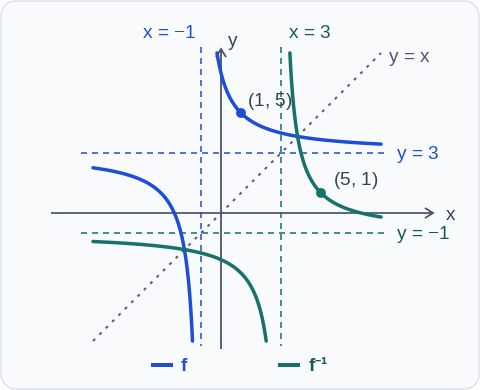
Set f(x)=3+4x+1f(x)=3+\dfrac4{x+1}, with x≠−1x\ne-1. The original graph approaches the lines x=−1x=-1 and y=3y=3. Reflect those lines in the same mirror as the curve.

The reciprocal function and its inverse are reflected in y = x. The original vertical asymptote x = −1 becomes y = −1. The original horizontal asymptote y = 3 becomes x = 3.

Worked example

Reflect both asymptotes and a marked point

For f(x)=3+4x+1f(x)=3+\dfrac4{x+1}, x≠−1x\ne-1, give the asymptotes of the inverse and reflect the point (1,5)(1,5).

  1. The original vertical line is x=−1x=-1, where its denominator is zero. The original horizontal line is y=3y=3, the limiting output as ∣x∣|x| grows.

  2. Reflect in y=xy=x. The inverse has vertical asymptote x=3x=3 and horizontal asymptote y=−1y=-1.

  3. The point (1,5)(1,5) becomes (5,1)(5,1). The inverse rule f−1(x)=−1+4x−3f^{-1}(x)=-1+\dfrac4{x-3} gives 11 at x=5x=5 and confirms the reflected asymptotes.

Your turn

Let h(x)=−2+5x−4h(x)=-2+\dfrac5{x-4} with x≠4x\ne4. Give the constant in the inverse's vertical asymptote, in the form x=x= a number.

Enter the value on its own or write x = … . Fractions and exact square roots are accepted.

Your turn

For the same h(x)=−2+5x−4h(x)=-2+\dfrac5{x-4}, give the constant in the inverse's horizontal asymptote, in the form y=y= a number.

Enter the value on its own or write y = … . Fractions and exact square roots are accepted.

Section 5 of 6 · Core · about 7 min

When is solving f(x) = x enough?

A fixed point is an input tt for which f(t)=tf(t)=t. The point (t,t)(t,t) stays put under reflection. For a strictly increasing function, this finds every common point with its inverse.

Worked example

Discard a fixed point at an open endpoint

Find every common point of y=f(x)y=f(x) and y=f−1(x)y=f^{-1}(x) for f(x)=2+(x−2)22f(x)=2+\dfrac{(x-2)^2}{2}, x>2x>2.

  1. On the right branch x>2x>2, the function is strictly increasing. Every common point therefore lies on y=xy=x.

  2. Set f(x)=xf(x)=x. With t=x−2t=x-2, this gives t2=2tt^2=2t, so t=0t=0 or t=2t=2. The candidate inputs are 22 and 44.

  3. The boundary 22 is excluded. The allowed input 44 gives f(4)=4f(4)=4, so (4,4)(4,4) is the only common point.

Your turn

Let g(x)=3+(x−3)24g(x)=3+\dfrac{(x-3)^2}{4} for x≥3x\ge3. Give every common point of y=g(x)y=g(x) and y=g−1(x)y=g^{-1}(x).

Enter a point as (1, 2) or x = 1, y = 2. Separate complete pairs with commas or semicolons.

Your turn

Now keep only x>3x>3 for g(x)=3+(x−3)24g(x)=3+\dfrac{(x-3)^2}{4}. Give all common points of the new graph and its inverse.

Enter a point as (1, 2) or x = 1, y = 2. Separate complete pairs with commas or semicolons.

Section 6 of 6 · Core · about 7 min

Can the graphs meet away from y = x?

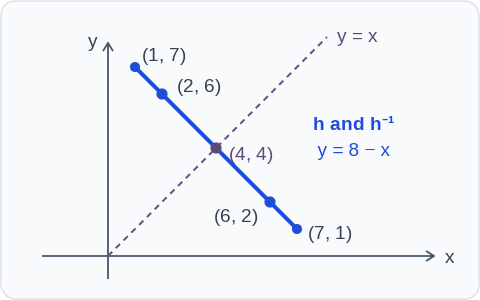
Let h(x)=8−xh(x)=8-x on [1,7][1,7]. The graph contains (2,6)(2,6) and (6,2)(6,2). Reflection swaps them, so both points are on the inverse too.

The line segment for h of x = 8 minus x coincides with its inverse. The off-diagonal points (2, 6) and (6, 2) reflect to one another. (4, 4) is on the mirror y = x.

Worked example

A segment that is its own reflection

Describe all common points of h(x)=8−xh(x)=8-x on [1,7][1,7] and its inverse. Which of them is on y=xy=x?

  1. From y=8−xy=8-x, rearrange to x=8−yx=8-y. The original outputs also run from 11 to 77, so the inverse has the same rule and the same domain.

  2. The two graphs coincide along the whole segment from (1,7)(1,7) to (7,1)(7,1). For example, (2,6)(2,6) and (6,2)(6,2) are both shared.

  3. On the mirror, 8−x=x8-x=x gives x=4x=4. The only shared point on y=xy=x is (4,4)(4,4).

Your turn

Let v(x)=10−xv(x)=10-x on [2,8][2,8]. Give the two points shared with its inverse whose xx-coordinates are 33 and 77.

Enter a point as (1, 2) or x = 1, y = 2. Separate complete pairs with commas or semicolons.

Your turn

For the same v(x)=10−xv(x)=10-x on [2,8][2,8], give the common point lying on y=xy=x.

Enter a point as (1, 2) or x = 1, y = 2. Separate complete pairs with commas or semicolons.

Worked example

Two decreasing graphs may meet once

Find all common points of r(x)=9−2xr(x)=9-2x and r−1(x)r^{-1}(x), both on the real numbers.

  1. Rearrange y=9−2xy=9-2x to find r−1(x)=9−x2r^{-1}(x)=\dfrac{9-x}{2}.

  2. Equate the two rules. From 9−2x=9−x29-2x=\dfrac{9-x}{2}, get 18−4x=9−x18-4x=9-x, so x=3x=3.

  3. At x=3x=3 both rules give 33. The only common point is (3,3)(3,3), on the mirror.

Your turn

Let p(x)=12−3xp(x)=12-3x for real xx. Solve for all common points of pp and its inverse.

Enter a point as (1, 2) or x = 1, y = 2. Separate complete pairs with commas or semicolons.

Worked examples

Practise the method

Core practice

Question 1 of 4

0 / 4 checked in this collection

Question list

Core practice

Fresh variants

Exam-style

Reflect every marked point

1 mark

The following marked points lie on a one–one function graph: (1,4)(1,4), (2,6)(2,6), (3,8)(3,8). Give all corresponding points on the inverse graph.

Enter a point as (1, 2) or x = 1, y = 2. Separate complete pairs with commas or semicolons.

Full answer-format guide

Exact numbers: 3/2, sqrt(5), 2-sqrt(3), pi/6, 3*pi/2. Sets: {1,4}. Intervals: (3,5]; a round bracket excludes the endpoint. Infinity: inf; union: U; no solutions: empty. Separate coordinate pairs or triples with semicolons. Expressions: 2x^2+3x-1; equations: x^2=3x+1 or the polynomial equal to zero. Factors: x-1 ; x+2. Parameter fraction: numerator ; denominator. List integer answers individually.

Review the method

Progress stays in this browser. Create an account to save it or sign in.

Apply it · original exam-style problems

Show your working on paper and compare it with the worked solution and marking guidance.

Start after this lesson

Mixed chapter practice

Try these after completing this chapter.

Review Translations, reflections and ordered stretches first.

Review Translations, reflections and ordered stretches first.

Review Translations, reflections and ordered stretches first.

Review Translations, reflections and ordered stretches first.

Review Translations, reflections and ordered stretches first.

Review Translations, reflections and ordered stretches first.

Come back to what needs practice

Quick revision sheet (A4)

Your review plan starts after your first check.

Question bank and saved work