Pure Mathematics 1 (9709) · Functions · Quick revision
Translations, reflections and ordered stretches
Follow an original point
| New graph | New point | Transformation |
|---|---|---|
| Horizontal translation by | ||
| Vertical translation by | ||
| Reflection in the -axis | ||
| Reflection in the -axis | ||
| , | Stretch parallel to -axis, factor | |
| , | Stretch parallel to -axis, factor |
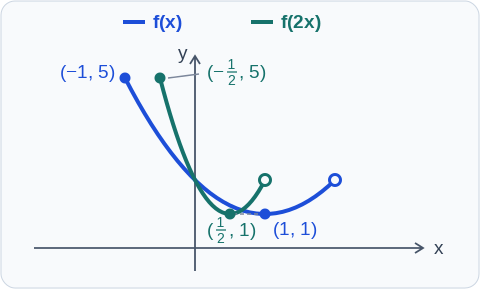
Combine the changes and check the bounds
For , with , solve and set . Factor the inside before reading the horizontal translation. A negative multiplier adds a reflection in the relevant axis.
Map the original domain using the input rule and the original range using the output rule. Carry open and closed endpoints. For two changes to the same coordinate, follow the order given.