Maths4UBETA

Translations, reflections and ordered stretches

Track coordinates and domains through horizontal and vertical changes in the correct order.

Try the quick check →
Lesson 5 of 5

Section 1 of 6 · Core · about 5 min

Which way does a translation move the graph?

Start with f(x)=(x−1)2+1f(x)=(x-1)^2+1 for −1≤x<2-1\le x<2. A translation two units right and three units down gives y=f(x−2)−3y=f(x-2)-3. Follow the vertex from (1,1)(1,1) to (3,−2)(3,-2).

The parabola translates two units right and three down. Its vertex moves from (1, 1) to (3, −2). Both endpoints follow the same translation.

Worked example

Move a vertex and keep the hollow end

Translate the restricted graph of f(x)=(x−1)2+1f(x)=(x-1)^2+1 two units right and three units down. Find its new equation, vertex and hollow endpoint.

  1. To move the curve right, the old input uu must be reached at x=u+2x=u+2. Use u=x−2u=x-2, then subtract 33 from the output.

  2. The new equation is y=f(x−2)−3=(x−3)2−2y=f(x-2)-3=(x-3)^2-2. Its vertex is (3,−2)(3,-2).

  3. The old hollow endpoint (2,2)(2,2) moves to (4,−1)(4,-1). The same vector (2−3)\binom{2}{-3} gives both moves.

Your turn

The point (2,−3)(2,-3) lies on y=p(x)y=p(x). Give the matching point on y=p(x+4)+2y=p(x+4)+2.

Enter a point as (1, 2) or x = 1, y = 2. Separate complete pairs with commas or semicolons.

Your turn

The graph of y=x2−2xy=x^2-2x moves three units left and four units up. Give the new expression for yy.

Enter an expression in x; use ^ for powers and / for fractions.

Section 2 of 6 · Core · about 5 min

Which coordinate changes under reflection?

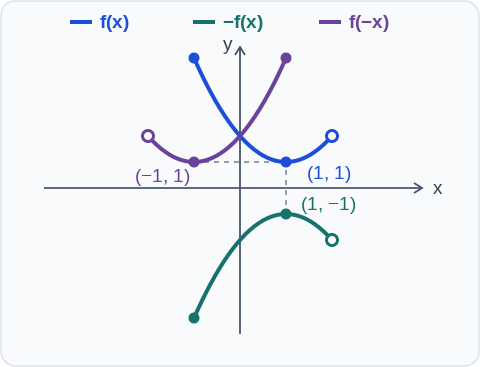
Find the vertex (1,1)(1,1) on the same parabola. The graph of y=−f(x)y=-f(x) takes it below the xx-axis. The graph of y=f(−x)y=f(-x) takes it across the yy-axis.

The vertex (1, 1) of f reflects to (1, −1) on −f(x) and to (−1, 1) on f(−x). Hollow endpoints stay hollow.

Worked example

Reflect one vertex in two axes

The original vertex is (1,1)(1,1) on y=f(x)y=f(x). Give its images on y=−f(x)y=-f(x) and y=f(−x)y=f(-x), and name both axes of reflection.

  1. On y=−f(x)y=-f(x), set x=1x=1 and get y=−1y=-1. The vertex (1,−1)(1,-1) is reflected in the xx-axis.

  2. On y=f(−x)y=f(-x), set −x=1-x=1 and get x=−1x=-1. The output stays 11. The vertex (−1,1)(-1,1) is reflected in the yy-axis.

  3. The original hollow endpoint is (2,2)(2,2). It stays hollow at (2,−2)(2,-2) on the first graph and at (−2,2)(-2,2) on the second.

Your turn

The point (−3,2)(-3,2) lies on y=p(x)y=p(x). Give the matching point on y=−p(x)y=-p(x).

Enter a point as (1, 2) or x = 1, y = 2. Separate complete pairs with commas or semicolons.

Your turn

The point (4,−2)(4,-2) lies on y=r(x)y=r(x). Give the matching point on y=r(−x)y=r(-x).

Enter a point as (1, 2) or x = 1, y = 2. Separate complete pairs with commas or semicolons.

Section 3 of 6 · Core · about 6 min

Why does doubling the input halve the horizontal distances?

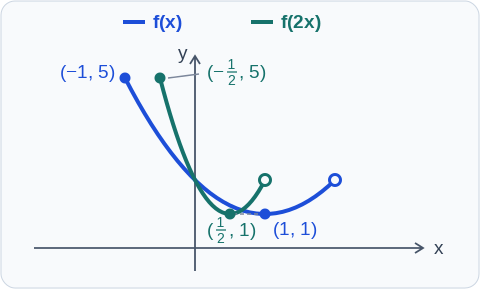
On y=f(2x)y=f(2x), the input 11 to ff is reached at x=12x=\tfrac12. The vertex moves from (1,1)(1,1) to (12,1)(\tfrac12,1). The entire graph becomes narrower.

The graph of f(2x) is half as wide as f(x). The marked vertices are (1, 1) and (one half, 1).

Worked example

Find the scale factor from a marked point

The left end of ff is (−1,5)(-1,5). Find its images on y=f(2x)y=f(2x) and y=2f(x)y=2f(x). Describe each stretch.

  1. For f(2x)f(2x), solve 2x=−12x=-1 and keep y=5y=5. The point (−12,5)(-\tfrac12,5) shows a stretch parallel to the xx-axis with factor 12\tfrac12.

  2. For 2f(x)2f(x), keep x=−1x=-1 and double 55. The point (−1,10)(-1,10) shows a stretch parallel to the yy-axis with factor 22.

  3. Both graphs keep the endpoint included. The first halves its horizontal distance from the yy-axis. The second doubles its vertical distance from the xx-axis.

Your turn

The point (−3,5)(-3,5) lies on y=p(x)y=p(x). Find its image on y=p(2x)y=p(2x).

Enter a point as (1, 2) or x = 1, y = 2. Separate complete pairs with commas or semicolons.

Your turn

Let p(x)=x2+1p(x)=x^2+1. Give the expression for y=−2p(x3)y=-2p(\frac{x}{3}).

Enter an expression in x; use ^ for powers and / for fractions.

Section 4 of 6 · Core · about 7 min

How do you track a point through several changes?

For y=2f(2x−6)−1y=2f(2x-6)-1, follow the marked vertex of ff at (1,1)(1,1). First find the new xx that feeds the old input 11 into ff. Then use the old output 11 to find the new yy.

Worked example

Use the old input and output separately

Find the image of (1,1)(1,1) on y=2f(2x−6)−1y=2f(2x-6)-1. Describe the horizontal changes in order.

  1. Set 2x−6=12x-6=1 so that ff receives its old input. This gives x=72x=\tfrac72.

  2. The output is 2(1)−1=12(1)-1=1. The new point is (72,1)(\tfrac72,1).

  3. Factor 2x−6=2(x−3)2x-6=2(x-3). Halve the old xx-coordinate, then add 33. The graph stretches parallel to the xx-axis with factor 12\tfrac12 before translating 33 units right.

Your turn

The point (6,−2)(6,-2) lies on y=p(x)y=p(x). Give its image on y=3p(2x+4)+1y=3p(2x+4)+1.

Enter a point as (1, 2) or x = 1, y = 2. Separate complete pairs with commas or semicolons.

Worked example

Track a maximum on a sine graph

Angles are in degrees. The point (90,1)(90,1) is a maximum on y=sin⁡xy=\sin x. Find the corresponding maximum on y=2sin⁡(x−30)+1y=2\sin(x-30)+1.

  1. Use the old input 90∘90^\circ: x−30=90x-30=90 gives x=120x=120.

  2. Double the original height and add one: 2(1)+1=32(1)+1=3. The positive multiplier keeps this point a maximum. Its image is (120,3)(120,3).

Your turn

Angles are in degrees. The sine graph has a maximum at (90,1)(90,1). Give the corresponding minimum on y=−3sin⁡(2x)+2y=-3\sin(2x)+2.

Enter a point as (1, 2) or x = 1, y = 2. Separate complete pairs with commas or semicolons.

Section 5 of 6 · Core · about 7 min

What happens to the ends of an interval?

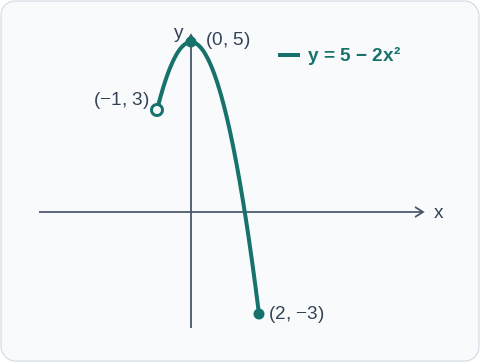
Take the original restricted ff and form g(x)=7−2f(1−x)g(x)=7-2f(1-x). Its graph is y=5−2x2y=5-2x^2 for −1<x≤2-1<x\le2. The hollow point is now on the left, and the original minimum becomes the new maximum.

The transformed graph has an open end at (−1, 3), a maximum at (0, 5), and a closed end at (2, −3).

Worked example

Carry both brackets through a reflection

The restricted ff has domain [−1,2)[-1,2) and range [1,5][1,5]. Find the domain and range of g(x)=7−2f(1−x)g(x)=7-2f(1-x).

  1. Require −1≤1−x<2-1\le1-x<2. Solving gives −1<x≤2-1<x\le2. The included old input −1-1 moves to 22, and the excluded boundary 22 moves to −1-1.

  2. The original outputs run from 11 to 55, inclusive. The rule v↦7−2vv\mapsto7-2v sends 11 to 55 and 55 to −3-3.

  3. So the domain is (−1,2](-1,2] and the range is [−3,5][-3,5]. The highest output is attained at the vertex.

Your turn

A function pp has domain (−2,5](-2,5] and range [1,4)[1,4). Set g(x)=6−3p(2−x)g(x)=6-3p(2-x). Give the domain of gg.

Use inequalities in x or interval notation. Join intervals with ‘or’ or ∪. Enter an isolated value on its own.

Your turn

For the same g(x)=6−3p(2−x)g(x)=6-3p(2-x), the range of pp is [1,4)[1,4). Give the range of gg.

Give the output range as an inequality or an interval. For example, y ≤ 4 is (−∞, 4]. You can type <= for ≤.

Section 6 of 6 · Core · about 6 min

Why can reversing two steps change the result?

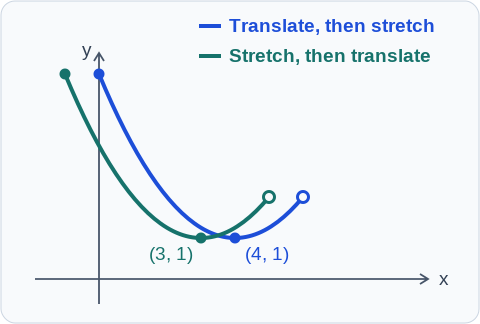
Start at the same vertex (1,1)(1,1). Move one unit right, then double its horizontal distance from the yy-axis. It finishes at (4,1)(4,1). Doubling the distance first and moving right afterwards sends it to (3,1)(3,1).

The two final curves have different vertices. Translate then stretch gives (4, 1). Stretch then translate gives (3, 1).

Worked example

Write both equations and compare the vertices

Translate y=f(x)y=f(x) right by one, then stretch parallel to the xx-axis by factor two. Write the final equation. Repeat with the order reversed.

  1. Translate first: x=2(u+1)x=2(u+1), so u=x2−1u=\frac{x}{2}-1. The equation is y=f(x2−1)y=f(\frac{x}{2}-1). The vertex at old input 11 finishes at x=4x=4.

  2. Stretch first: x=2u+1x=2u+1, so u=x−12u=\frac{x-1}{2}. The equation is y=f(x−12)y=f(\frac{x-1}{2}). The same vertex finishes at x=3x=3.

  3. A translation performed first is also scaled by the stretch. Compare the marked vertices on the two final graphs.

Your turn

Start with y=x2−1y=x^2-1. Translate two units left, then stretch parallel to the xx-axis with scale factor 33. Give the final expression for yy.

Enter an expression in x; use ^ for powers and / for fractions.

Your turn

Start again with y=x2−1y=x^2-1. Stretch parallel to the xx-axis with scale factor 33, then translate two units left. Give the final expression for yy.

Enter an expression in x; use ^ for powers and / for fractions.

Worked examples

Practise the method

Core practice

Question 1 of 4

0 / 4 checked in this collection

Question list

Core practice

Fresh variants

Exam-style

A point and a domain under a combined change

2 marks

The point (3,−1)(3,-1) lies on y=f(x), whose domain is [2,6)[2,6). Find its corresponding point and the domain of y=2f(3x−3)−4y=2f(3 x - 3)-4.

Enter a point as (1, 2) or x = 1, y = 2. Separate complete pairs with commas or semicolons.

Use inequalities in x or interval notation. Join intervals with ‘or’ or ∪. Enter an isolated value on its own.

Full answer-format guide

Exact numbers: 3/2, sqrt(5), 2-sqrt(3), pi/6, 3*pi/2. Sets: {1,4}. Intervals: (3,5]; a round bracket excludes the endpoint. Infinity: inf; union: U; no solutions: empty. Separate coordinate pairs or triples with semicolons. Expressions: 2x^2+3x-1; equations: x^2=3x+1 or the polynomial equal to zero. Factors: x-1 ; x+2. Parameter fraction: numerator ; denominator. List integer answers individually.

Review the method

Progress stays in this browser. Create an account to save it or sign in.

Apply it · original exam-style problems

Show your working on paper and compare it with the worked solution and marking guidance.

Come back to what needs practice

Quick revision sheet (A4)

Your review plan starts after your first check.

Question bank and saved work