Maths4UBETA

Power integration, definite integrals and improper endpoints

Reverse the power and chain rules, evaluate with the correct limits and test an unbounded endpoint using a limit.

Try the quick check →
Lesson 1 of 5

Section 1 of 5 · Core · about 7 min

How do I reverse differentiation?

An antiderivative FF of ff satisfies F′(x)=f(x)F^{\prime}(x)=f(x). An indefinite integral describes the family of these functions. The expression inside the integral is the integrand, and dx\mathrm{d}x names the variable of integration.

Worked example

Check an indefinite integral by differentiating

Find ∫(6x2−4x+3) dx\int(6x^2-4x+3)\,\mathrm{d}x.

  1. Integrate the three terms separately:

    ∫(6x2−4x+3) dx=6x33−4x22+3x+C.\int(6x^2-4x+3)\,\mathrm{d}x=\frac{6x^3}{3}-\frac{4x^2}{2}+3x+C.
  2. =2x3−2x2+3x+C.=2x^3-2x^2+3x+C.
  3. Differentiate the result:

    ddx(2x3−2x2+3x+C)=6x2−4x+3.\frac{\mathrm{d}}{\mathrm{d}x}\left(2x^3-2x^2+3x+C\right)=6x^2-4x+3.
  4. Every constant CC disappears on differentiation, so the indefinite integral is a family of functions.

Your turn

Write ∫(8x3−6x+7) dx\int(8x^3-6x+7)\,\mathrm{d}x as Ax4+Bx2+Dx+CAx^4+Bx^2+Dx+C. Find A,B,DA,B,D, where CC is an arbitrary constant.

Enter the value on its own or write A = … . Fractions and exact square roots are accepted.

Enter the value on its own or write B = … . Fractions and exact square roots are accepted.

Enter the value on its own or write D = … . Fractions and exact square roots are accepted.

Section 2 of 5 · Core · about 9 min

How do I rewrite roots and fractions without losing the domain?

Expand finite polynomial products when needed, or divide every numerator term by the denominator. Convert roots and reciprocals into rational powers, then use the same power rule. Do not integrate the numerator and denominator separately.

Worked example

Rewrite a quotient as separate powers

For x>0x>0, find ∫5x2+6x dx\int\frac{5x^2+6}{\sqrt{x}}\,\mathrm{d}x.

  1. Divide each numerator term by x12x^{\frac{1}{2}}:

    5x2+6x=5x32+6x−12.\frac{5x^2+6}{\sqrt{x}}=5x^{\frac{3}{2}}+6x^{-\frac{1}{2}}.
  2. ∫(5x32+6x−12) dx=552x52+612x12+C.\int\left(5x^{\frac{3}{2}}+6x^{-\frac{1}{2}}\right)\,\mathrm{d}x=\frac{5}{\frac{5}{2}}x^{\frac{5}{2}}+\frac{6}{\frac{1}{2}}x^{\frac{1}{2}}+C.
  3. =2x52+12x+C,x>0.=2x^{\frac{5}{2}}+12\sqrt{x}+C,\qquad x>0.
  4. The constant of integration does not change the original restriction from the denominator.

Your turn

Write an antiderivative of 2x2+3x\frac{2x^2+3}{\sqrt{x}} as Ax52+Bx12+CAx^{\frac{5}{2}}+Bx^{\frac{1}{2}}+C. Find A,BA,B and choose the original real domain.

Enter the value on its own or write A = … . Fractions and exact square roots are accepted.

Enter the value on its own or write B = … . Fractions and exact square roots are accepted.

Original domain

Worked example

Use real cube roots for negative inputs

Find an antiderivative of 4x34\sqrt[3]{x} valid for real inputs. Check its derivative at x=−8x=-8.

  1. ∫4x13 dx=443x43+C=3x43+C.\int4x^{\frac{1}{3}}\,\mathrm{d}x=\frac{4}{\frac{4}{3}}x^{\frac{4}{3}}+C=3x^{\frac{4}{3}}+C.
  2. Here x43x^{\frac{4}{3}} means (x3)4(\sqrt[3]{x})^4, using the real cube root. It is defined for negative as well as positive inputs.

  3. F′(x)=4x3,F′(−8)=4(−2)=−8.F^{\prime}(x)=4\sqrt[3]{x},\qquad F^{\prime}(-8)=4(-2)=-8.
  4. At zero, F(x)=3∣x∣43+CF(x)=3|x|^{\frac{4}{3}}+C also has derivative zero, matching the continuous integrand. The formula therefore works across the whole real line.

Algebraic cancellation does not restore a missing input. For example, x2−1x−1=x+1\frac{x^2-1}{x-1}=x+1 only when x≠1x\ne1. Its antiderivative is x22+x+C\frac{x^2}{2}+x+C on each interval separated by 11; the constants on those intervals may differ.

Section 3 of 5 · Core · about 8 min

How do I integrate a power of a linear expression?

Differentiating a power of ax+bax+b multiplies by aa. Reversing that process requires division by aa, as well as division by the new outer exponent.

  1. For the integral of (2x+3)3(2x+3)^3, try F(x)=K(2x+3)4+CF(x)=K(2x+3)^4+C.
  2. F′(x)=K⋅4(2x+3)3⋅2=8K(2x+3)3.F'(x)=K\cdot4(2x+3)^3\cdot2=8K(2x+3)^3.The outer derivative contributes 44 and the inner derivative contributes 22.
  3. Matching the integrand gives 8K=1  ⟹  K=188K=1\implies K=\frac18.∫(2x+3)3 dx=(2x+3)48+C.\int(2x+3)^3\,\mathrm{d}x=\frac{(2x+3)^4}{8}+C.

Differentiating (2x+3)48+C\frac{(2x+3)^4}{8}+C recovers (2x+3)3(2x+3)^3: the outer factor 44 and inner factor 22 cancel the denominator.

Worked example

Reverse both parts of the chain rule

Find ∫(2x+3)3 dx\int(2x+3)^3\,\mathrm{d}x without expanding.

  1. Increase the outer exponent to 44, divide by 44, then divide by the inner derivative 22:

    ∫(2x+3)3 dx=(2x+3)48+C.\int(2x+3)^3\,\mathrm{d}x=\frac{(2x+3)^4}{8}+C.
  2. Check by differentiating the proposed antiderivative:

    ddx((2x+3)48)=18⋅4(2x+3)3⋅2=(2x+3)3.\frac{\mathrm{d}}{\mathrm{d}x}\left(\frac{(2x+3)^4}{8}\right)=\frac{1}{8}\cdot4(2x+3)^3\cdot2=(2x+3)^3.
  3. Without the extra division by 22, the derivative would be twice the required integrand.

Your turn

For x≠5x\ne5, write ∫(5−x)−2 dx=A(5−x)p+C\int(5-x)^{-2}\,\mathrm{d}x=A(5-x)^p+C. Find A,pA,p.

Enter the value on its own or write A = … . Fractions and exact square roots are accepted.

Enter the value on its own or write p = … . Fractions and exact square roots are accepted.

If a=0a=0, first treat the integrand as the constant kbnkb^n. When that is a finite real number, its integral is kbnx+Ckb^n x+C. The nonconstant linear-power formula is unnecessary and would divide by zero.

Section 4 of 5 · Core · about 8 min

How do I evaluate a definite integral?

For a continuous integrand on a finite closed interval, find an antiderivative first and then subtract its lower-bound value from its upper-bound value. This gives a number, not an arbitrary family.

Worked example

A definite integral can be negative

Evaluate ∫−12(2x−3) dx\int_{-1}^{2}(2x-3)\,\mathrm{d}x.

  1. The integrand is continuous over the whole interval. An antiderivative is F(x)=x2−3xF(x)=x^2-3x.

  2. ∫−12(2x−3) dx=[x2−3x]−12.\int_{-1}^{2}(2x-3)\,\mathrm{d}x=\left[x^2-3x\right]_{-1}^{2}.
  3. F(2)=4−6=−2,F(−1)=1+3=4.F(2)=4-6=-2,\qquad F(-1)=1+3=4.
  4. F(2)−F(−1)=−2−4=−6.F(2)-F(-1)=-2-4=-6.
  5. This is signed accumulation, so a negative answer is possible. The constant cancels in (F(2)+C)−(F(−1)+C)(F(2)+C)-(F(-1)+C).

Your turn

Evaluate I=∫02(3x2−4x+1) dxI=\int_0^2(3x^2-4x+1)\,\mathrm{d}x, then the same integral with its bounds reversed.

Enter an exact number, for example 3/2 or 2-sqrt(3).

Enter an exact number, for example 3/2 or 2-sqrt(3).

When all relevant integrals exist, the following rules hold:

∫baf(x) dx=−∫abf(x) dx,∫aaf(x) dx=0.\int_b^a f(x)\,\mathrm{d}x=-\int_a^b f(x)\,\mathrm{d}x,\qquad\int_a^a f(x)\,\mathrm{d}x=0.∫acf(x) dx=∫abf(x) dx+∫bcf(x) dx.\int_a^c f(x)\,\mathrm{d}x=\int_a^b f(x)\,\mathrm{d}x+\int_b^c f(x)\,\mathrm{d}x.

You can also take constant factors outside an integral and add or subtract integrals term by term.

Section 5 of 5 · Core · about 15 min

What if a bound is infinite or the integrand is undefined?

An infinite interval or an unbounded integrand requires an improper integral. An excluded endpoint must also be checked by a limit. Replace the problematic endpoint by a valid finite value, evaluate there, and then approach the endpoint. A finite limit means the integral converges; otherwise it diverges.
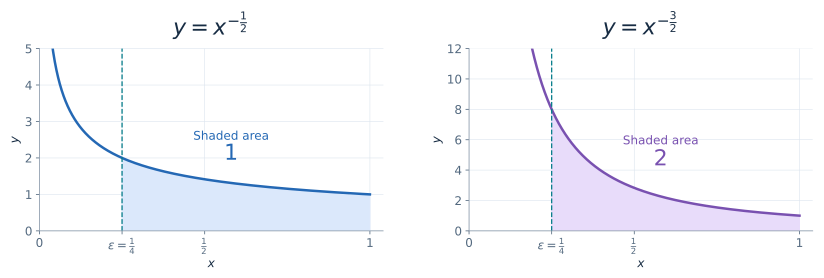
Two positive curves near zero compare a finite limiting accumulation with one that grows without bound.

Both curves rise without bound near zero. For ε>0\varepsilon>0, evaluate the two areas before letting ε→0+\varepsilon\to0^+. The plots use different vertical scales.

∫ε1x−1/2 dx=2(1−ε)⟶2.\int_\varepsilon^1 x^{-1/2}\,\mathrm{d}x=2(1-\sqrt\varepsilon)\longrightarrow2.∫ε1x−3/2 dx=2(1ε−1)⟶+∞.\int_\varepsilon^1 x^{-3/2}\,\mathrm{d}x=2\left(\frac{1}{\sqrt\varepsilon}-1\right)\longrightarrow+\infty.

Both curves become unbounded near zero. Yet ∫01x−12 dx=2\int_0^1x^{-\frac{1}{2}}\,\mathrm{d}x=2, while ∫01x−32 dx\int_0^1x^{-\frac{3}{2}}\,\mathrm{d}x diverges. The limit of the accumulated integral decides.

Worked example

Compare two powers at an improper lower endpoint

Determine whether ∫01x−12 dx\int_0^1x^{-\frac{1}{2}}\,\mathrm{d}x and ∫01x−32 dx\int_0^1x^{-\frac{3}{2}}\,\mathrm{d}x converge. Find any finite value.

  1. Neither integrand is defined at zero. Replace that endpoint by ε>0\varepsilon>0 before evaluating.

  2. ∫ε1x−12 dx=[2x]ε1=2−2ε⟶2.\int_{\varepsilon}^1x^{-\frac{1}{2}}\,\mathrm{d}x=\left[2\sqrt{x}\right]_{\varepsilon}^1=2-2\sqrt{\varepsilon}\longrightarrow2.
  3. The first improper integral converges to 22, even though the curve becomes unbounded near zero.

  4. ∫ε1x−32 dx=[−2x−12]ε1=2ε−12−2⟶+∞.\int_{\varepsilon}^1x^{-\frac{3}{2}}\,\mathrm{d}x=\left[-2x^{-\frac{1}{2}}\right]_{\varepsilon}^1=2\varepsilon^{-\frac{1}{2}}-2\longrightarrow+\infty.
  5. The second integral diverges: the limit is not finite. Infinity is not a number to substitute into an antiderivative.

Your turn

Find the improper integral ∫09x−12 dx\int_0^9x^{-\frac{1}{2}}\,\mathrm{d}x. Then decide whether ∫01x−43 dx\int_0^1x^{-\frac{4}{3}}\,\mathrm{d}x converges or diverges.

Enter an exact number, for example 3/2 or 2-sqrt(3).

Second integral

Worked example

Replace an infinite endpoint by a finite bound first

Evaluate ∫2∞3x−2 dx\int_2^{\infty}3x^{-2}\,\mathrm{d}x. If it is approximated by integrating only up to R≥2R\ge2, find the smallest integer RR that leaves a tail less than 0.10.1.

  1. ∫2R3x−2 dx=[−3x]2R=32−3R.\int_2^R3x^{-2}\,\mathrm{d}x=\left[-\frac{3}{x}\right]_2^R=\frac{3}{2}-\frac{3}{R}.
  2. lim⁡R→∞(32−3R)=32.\lim_{R\to\infty}\left(\frac{3}{2}-\frac{3}{R}\right)=\frac{3}{2}.
  3. The remaining tail is the difference from this finite total:

    ∫R∞3x−2 dx=3R.\int_R^{\infty}3x^{-2}\,\mathrm{d}x=\frac{3}{R}.
  4. 3R<0.1⟹R>30.\frac{3}{R}<0.1\Longrightarrow R>30.

    The smallest integer is 3131; R=30R=30 gives equality and fails the strict inequality.

  5. A different power need not converge at infinity. For example, ∫1Rx−12 dx=2R−2\int_1^R x^{-\frac{1}{2}}\,\mathrm{d}x=2\sqrt{R}-2 grows without bound.

Worked example

Never cancel two divergent contributions across a singularity

Does ∫−11x−3 dx\int_{-1}^{1}x^{-3}\,\mathrm{d}x exist as an improper integral?

  1. Zero is inside the interval and is excluded from the integrand. Split there and take the limits independently.

  2. lim⁡u→0−∫−1ux−3 dx=lim⁡u→0−(12−12u2)=−∞.\lim_{u\to0^-}\int_{-1}^{u}x^{-3}\,\mathrm{d}x=\lim_{u\to0^-}\left(\frac{1}{2}-\frac{1}{2u^2}\right)=-\infty.
  3. lim⁡v→0+∫v1x−3 dx=lim⁡v→0+(−12+12v2)=+∞.\lim_{v\to0^+}\int_v^1x^{-3}\,\mathrm{d}x=\lim_{v\to0^+}\left(-\frac{1}{2}+\frac{1}{2v^2}\right)=+\infty.
  4. Both one-sided integrals must have finite values for their sum to define the ordinary improper integral. They do not, so the integral diverges.

  5. Formal endpoint subtraction using −12x2-\frac{1}{2x^2} would give zero. That calculation crosses an interior singularity and is invalid; opposite divergences cannot be cancelled.

Your turn

Evaluate ∫−181(x3)2 dx\int_{-1}^{8}\frac{1}{(\sqrt[3]{x})^2}\,\mathrm{d}x as an improper integral. The cube root is the real cube root. Give the left contribution up to zero, the right contribution from zero and their sum.

Enter an exact number, for example 3/2 or 2-sqrt(3).

Enter an exact number, for example 3/2 or 2-sqrt(3).

Enter an exact number, for example 3/2 or 2-sqrt(3).

Worked examples

Practise the method

Core practice

Question 1 of 4

0 / 4 checked in this collection

Question list

Core practice

Fresh variants

Exam-style

A complete antiderivative with a specified constant

2 marks

Find F(x)F(x) such that F′(x)=6x2−4x+3F^{\prime}(x)=6 x^{2} - 4 x + 3 and F(0)=0F(0)=0. Then select why the unrestricted indefinite integral also needs a constant.

Enter an expression in x; use ^ for powers and / for fractions.

Why include C without the condition?

Choose one option. Explain your reasoning on paper.

Full answer-format guide

Exact numbers: 3/2, sqrt(5), 2-sqrt(3), pi/6, 3*pi/2. Sets: {1,4}. Intervals: (3,5]; a round bracket excludes the endpoint. Infinity: inf; union: U; no solutions: empty. Separate coordinate pairs or triples with semicolons. Expressions: 2x^2+3x-1; equations: x^2=3x+1 or the polynomial equal to zero. Factors: x-1 ; x+2. Parameter fraction: numerator ; denominator. List integer answers individually.

Review the method

Progress stays in this browser. Create an account to save it or sign in.

Extra practice from this lesson

Reverse each derivative and keep the constant

Write the general antiderivative of 12x2−6x+512x^2-6x+5 as Ax3+Bx2+Dx+CAx^3+Bx^2+Dx+C. Find A,B,DA,B,D. Explain on paper why the arbitrary constant is needed.

Enter the value on its own or write a = … . Fractions and exact square roots are accepted.

Enter the value on its own or write b = … . Fractions and exact square roots are accepted.

Enter the value on its own or write d = … . Fractions and exact square roots are accepted.

Rewrite a quotient before integrating

For x>0x>0, express ∫6x3+3xx2 dx\displaystyle\int\frac{6x^3+3\sqrt{x}}{x^2}\,\mathrm{d}x in the form Ax2+Bx−12+CAx^2+Bx^{-\frac{1}{2}}+C. Find A,BA,B.

Enter the value on its own or write a = … . Fractions and exact square roots are accepted.

Enter the value on its own or write b = … . Fractions and exact square roots are accepted.

Undo a negative inner multiplier

Find K,mK,m such that ∫5(3−2x)4 dx=K(3−2x)m+C\displaystyle\int5(3-2x)^4\,\mathrm{d}x=K(3-2x)^m+C.

Enter the value on its own or write k = … . Fractions and exact square roots are accepted.

Enter the value on its own or write m = … . Fractions and exact square roots are accepted.

Use brackets, reverse limits and join intervals

Let f(x)=3x2−4xf(x)=3x^2-4x. Find I=∫−21f(x) dxI=\displaystyle\int_{-2}^{1}f(x)\,\mathrm{d}x and J=∫1−2f(x) dxJ=\displaystyle\int_{1}^{-2}f(x)\,\mathrm{d}x. You are also given ∫13f(x) dx=10\displaystyle\int_1^3f(x)\,\mathrm{d}x=10. Use this to find K=∫−23f(x) dxK=\displaystyle\int_{-2}^{3}f(x)\,\mathrm{d}x.

Enter the value on its own or write i = … . Fractions and exact square roots are accepted.

Enter the value on its own or write j = … . Fractions and exact square roots are accepted.

Enter the value on its own or write k = … . Fractions and exact square roots are accepted.

Use the real cube root on negative inputs

Evaluate ∫−8−1x3 dx\displaystyle\int_{-8}^{-1}\sqrt[3]{x}\,\mathrm{d}x exactly. Interpret fractional powers through the real cube root.

Enter an exact number, for example 3/2 or 2-sqrt(3).

Check the assumptions before applying a formula

Answer each separate question.

(a) Find the coefficient of xx in ∫(0x+4)3 dx\displaystyle\int(0x+4)^3\,\mathrm{d}x.

(b) Does the power rule xn+1n+1\frac{x^{n+1}}{n+1} apply when n=−1n=-1?

(c) After simplifying x2−1x−1\frac{x^2-1}{x-1}, is the original excluded input restored?

Enter an exact number, for example 3/2 or 2-sqrt(3).

Power rule for part (b)
Domain in part (c)

Apply it · original exam-style problems

Show your working on paper and compare it with the worked solution and marking guidance.

Start after this lesson

Two unbounded integrands can behave differently 6 marks

Decide whether each improper integral has a finite value. For the first, give the exact value if it converges. Justify both conclusions using a lower endpoint ε>0\varepsilon>0 before taking a one-sided limit.

I=∫04x−12 dx,J=∫04x−32 dx.I=\int_0^4x^{-\frac{1}{2}}\,\mathrm{d}x,\qquad J=\int_0^4x^{-\frac{3}{2}}\,\mathrm{d}x.
Hint

Integrate on [ε,4][\varepsilon,4], where both functions are defined. Examine the lower-endpoint term as ε\varepsilon approaches zero from above.

Worked solution
  1. I=lim⁡ε→0+[2x]ε4=lim⁡ε→0+(4−2ε)=4.I=\lim_{\varepsilon\to0^+}\left[2\sqrt{x}\right]_{\varepsilon}^{4}=\lim_{\varepsilon\to0^+}(4-2\sqrt{\varepsilon})=4.
  2. The first integral converges even though the integrand becomes unbounded near zero.

  3. ∫ε4x−32 dx=[−2x−12]ε4=−1+2ε.\int_{\varepsilon}^{4}x^{-\frac{3}{2}}\,\mathrm{d}x=\left[-2x^{-\frac{1}{2}}\right]_{\varepsilon}^{4}=-1+\frac{2}{\sqrt{\varepsilon}}.
  4. As ε→0+\varepsilon\to0^+, the last expression grows without bound. Thus JJ diverges to positive infinity; infinity is not a finite integral value.

Marking guidance
  • 1 mark: replace the first zero endpoint by a positive lower bound and state the limit.
  • 1 mark: obtain the first antiderivative 2x2\sqrt{x}.
  • 1 mark: obtain the finite value and conclusion.
  • 1 mark: obtain the second antiderivative −2x−12-2x^{-\frac{1}{2}}.
  • 1 mark: evaluate the second truncated integral with the correct sign.
  • 1 mark: justify positive divergence from its lower-endpoint term.
An infinite interval can have a finite integral 6 marks

Evaluate I=∫1∞6x2 dx\displaystyle I=\int_1^{\infty}\frac{6}{x^2}\,\mathrm{d}x. For R≥1R\ge1, write the remaining tail T(R)=∫R∞6x2 dx\displaystyle T(R)=\int_R^{\infty}\frac{6}{x^2}\,\mathrm{d}x as kR\frac{k}{R}. Find kk, then find the least integer RR for which T(R)<0.05T(R)<0.05.

Hint

Use a finite upper bound MM, then take M→∞M\to\infty. The final inequality is strict.

Worked solution
  1. I=lim⁡M→∞[−6x]1M=lim⁡M→∞(6−6M)=6.I=\lim_{M\to\infty}\left[-\frac{6}{x}\right]_1^M=\lim_{M\to\infty}\left(6-\frac{6}{M}\right)=6.
  2. T(R)=lim⁡M→∞(−6M+6R)=6R.T(R)=\lim_{M\to\infty}\left(-\frac{6}{M}+\frac{6}{R}\right)=\frac{6}{R}.
  3. 6R<0.05⟺R>120(R>0).\frac{6}{R}<0.05\Longleftrightarrow R>120\qquad(R>0).
  4. The least integer is 121121. At R=120R=120, the tail equals 0.050.05 and does not satisfy the strict inequality.

Marking guidance
  • 1 mark: replace infinity by a finite upper bound and state a limit.
  • 1 mark: obtain the antiderivative −6x-\frac{6}{x}.
  • 1 mark: obtain the convergent total.
  • 1 mark: derive the tail 6R\frac{6}{R}.
  • 1 mark: solve the strict inequality correctly.
  • 1 mark: select the least allowed integer and exclude equality.
Do not cross a singularity using endpoint subtraction 6 marks

A student writes

∫−111x2 dx=[−1x]−11=−2.\int_{-1}^{1}\frac{1}{x^2}\,\mathrm{d}x=\left[-\frac{1}{x}\right]_{-1}^{1}=-2.

Identify the singular input. For ε>0\varepsilon>0, express the left and right truncated integrals in the form Aε+B\frac{A}{\varepsilon}+B and Dε+E\frac{D}{\varepsilon}+E. Decide whether the original improper integral converges.

Hint

Split at zero. Use intervals [−1,−ε][-1,-\varepsilon] and [ε,1][\varepsilon,1], and evaluate each separately.

Worked solution
  1. The integrand is undefined at x=0x=0, inside the interval. The ordinary endpoint-subtraction argument does not apply across this singularity.

  2. ∫−1−ε1x2 dx=[−1x]−1−ε=1ε−1.\int_{-1}^{-\varepsilon}\frac{1}{x^2}\,\mathrm{d}x=\left[-\frac{1}{x}\right]_{-1}^{-\varepsilon}=\frac{1}{\varepsilon}-1.
  3. ∫ε11x2 dx=[−1x]ε1=1ε−1.\int_{\varepsilon}^{1}\frac{1}{x^2}\,\mathrm{d}x=\left[-\frac{1}{x}\right]_{\varepsilon}^{1}=\frac{1}{\varepsilon}-1.
  4. Each expression tends to positive infinity as its endpoint approaches zero from the relevant side. An improper integral across an interior singularity converges only if both one-sided integrals converge separately. Here they do not, so there is no finite integral value.

  5. The integrand is positive wherever defined. That also flags the student’s negative result as impossible, but the split limit calculation supplies the proof of divergence.

Marking guidance
  • 1 mark: identify the internal singularity and explain why ordinary endpoint subtraction is invalid.
  • 1 mark: split into two appropriate one-sided integrals.
  • 1 mark: evaluate the left truncated integral.
  • 1 mark: evaluate the right truncated integral.
  • 1 mark: justify divergence of each one-sided limit.
  • 1 mark: state the resulting divergence of the full improper integral.

Come back to what needs practice

Quick revision sheet (A4)

Your review plan starts after your first check.

Question bank and saved work