Maths4UBETA

Arithmetic conditions, parameters and linked progressions

Translate equal differences into an equation, retain constant cases and check any extra restrictions.

Try the quick check →
Lesson 3 of 5

Section 1 of 6 · Core · about 6 min

How do I test consecutive terms in their stated order?

For three consecutive terms A,B,CA,B,C, in that order, an AP has equal adjacent differences. The middle value is the average of the two outside values:

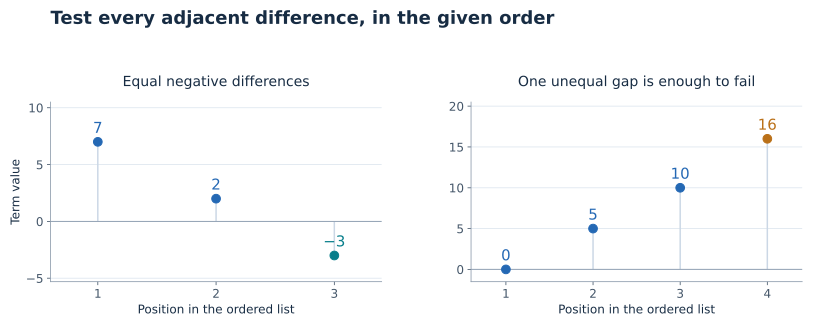
A decreasing three-term progression has equal negative adjacent differences. A separate four-term list has equal first two differences but a different final difference.

Terms in orderSuccessive differencesArithmetic?
7,2,−37,2,-3−5,−5-5,-5Yes
0,5,10,160,5,10,165,5,65,5,6No

Equal spacing in index means equal signed changes in value. A fourth term creates a third difference that must also match.

Worked example

A negative parameter and a decreasing AP

The expressions x+2, 2x−1, 5x+4x+2,\ 2x-1,\ 5x+4, in that order, are consecutive AP terms. Find xx and dd.

  1. 2(2x−1)=(x+2)+(5x+4).2(2x-1)=(x+2)+(5x+4).

    Use the expression in the middle position as the middle term.

  2. 4x−2=6x+6⟹x=−4.4x-2=6x+6\quad\Longrightarrow\quad x=-4.
  3. The terms are −2,−9,−16-2,-9,-16. Both differences equal −7-7, so d=−7d=-7.

    Negative parameter values and negative common differences are allowed unless restricted.

Keep the given order. Rearranging the values changes which expression is the middle term. For four or more terms, check every adjacent difference; passing the test on only the first three is insufficient.

Worked example

Three matching terms are not enough for a four-term claim

The expressions k−2, 2k+1, 3k+4, 5k+5k-2,\ 2k+1,\ 3k+4,\ 5k+5, in that order, are four consecutive terms of an AP. Find kk.

  1. d1=k+3,d2=k+3,d3=2k+1.d_1=k+3,\qquad d_2=k+3,\qquad d_3=2k+1.

    Calculate all three adjacent differences.

  2. k+3=2k+1⟹k=2.k+3=2k+1\quad\Longrightarrow\quad k=2.

    The first equality holds for every parameter, but the last does not.

  3. At k=2k=2, the terms are 0,5,10,150,5,10,15, confirming a common difference of 55.

Your turn

The expressions x+1, 2x+3, 3x+5, 5x+7x+1,\ 2x+3,\ 3x+5,\ 5x+7, in that order, are four consecutive terms of an AP. Find xx and the common difference.

Enter the value on its own or write x = … . Fractions and exact square roots are accepted.

Enter the value on its own or write d = … . Fractions and exact square roots are accepted.

Section 2 of 6 · Core · about 5 min

Which parameter roots are actually allowed?

Substitute the expressions into the AP condition and solve the complete equation. Keep every real root at this stage. For each candidate, reconstruct the actual terms and calculate the common difference. Only then apply the stated restrictions.

Worked example

The zero parameter gives the non-constant case

The expressions x2, 2x+8, 16x^2,\ 2x+8,\ 16, in that order, form an AP. Find all real xx, then determine which values remain if the AP must be non-constant.

  1. 2(2x+8)=x2+16⟹x(x−4)=0.2(2x+8)=x^2+16\quad\Longrightarrow\quad x(x-4)=0.

    Factor instead of dividing by the parameter.

  2. x=0orx=4.x=0\quad\text{or}\quad x=4.
  3. At x=0x=0, the terms are 0,8,160,8,16, with d=8d=8. At x=4x=4, the terms are 16,16,1616,16,16, with d=0d=0.

  4. Both roots give an AP. Only x=0x=0 remains under the extra condition d≠0d\ne0.

Your turn

The expressions t2, 3t+18, 36t^2,\ 3t+18,\ 36, in that order, form an AP. Find every real tt, then retain only the values giving a non-constant AP. Give its common difference.

Give the complete set: {1, 4} for separate values, (1, 5] for an interval, U for union or empty for no real solutions. Use sqrt(...) for exact roots.

Use inequalities in x or interval notation. Join intervals with ‘or’ or ∪. Enter an isolated value on its own.

Enter the value on its own or write d = … . Fractions and exact square roots are accepted.

Section 3 of 6 · Core · about 9 min

How do trigonometric terms change the method?

The AP rule stays the same. First write 2B=A+C2B=A+C, then use sin⁡2θ+cos⁡2θ=1\sin^2\theta+\cos^2\theta=1 to reduce the condition to one trigonometric ratio. Solve every algebraic branch and reject sine or cosine values outside [−1,1][-1,1].

For degree answers, one full turn is 360∘360^\circ; for radians it is 2π2\pi. For a transformed argument, set ϕ=2θ\phi=2\theta, transform the complete interval for θ\theta into an interval for ϕ\phi, find every allowed ϕ\phi, then divide each by 22. This uses no double-angle identity.

Worked example

One squared ratio gives four degree solutions

The ordered values sin⁡2θ, 78, 2cos⁡2θ\sin^2\theta,\ \frac{7}{8},\ 2\cos^2\theta form an AP, where 0∘≤θ<360∘0^\circ\le\theta<360^\circ. Find all angles and the common difference.

  1. 74=sin⁡2θ+2cos⁡2θ=1+cos⁡2θ.\frac{7}{4}=\sin^2\theta+2\cos^2\theta=1+\cos^2\theta.

    Use the AP condition before applying the basic identity.

  2. cos⁡2θ=34⟹cos⁡θ=±32.\cos^2\theta=\frac{3}{4}\quad\Longrightarrow\quad\cos\theta=\pm\frac{\sqrt{3}}{2}.

    Taking a square root gives both signs.

  3. θ=30∘,150∘,210∘,330∘.\theta=30^\circ,150^\circ,210^\circ,330^\circ.

    Use the reference angle and all quadrants that satisfy either sign in the stated interval.

  4. d=78−14=58.d=\frac{7}{8}-\frac{1}{4}=\frac{5}{8}.

    Every solution has the same squared values, so the same difference works for all four.

A cosine-squared graph in degrees meets the horizontal line three quarters at thirty, one hundred fifty, two hundred ten and three hundred thirty degrees.

The positive and negative cosine levels are 32\frac{\sqrt3}{2} and −32-\frac{\sqrt3}{2}. On 0∘≤θ<360∘0^\circ\le\theta<360^\circ, the four angles are 30∘,150∘,210∘,330∘30^\circ,150^\circ,210^\circ,330^\circ.

The equation cos⁡2θ=34\cos^2\theta=\frac{3}{4} has four solutions in 0∘≤θ<360∘0^\circ\le\theta<360^\circ, because both signs of cosine are allowed.

Your turn

The values 2sin⁡2θ, 78, cos⁡2θ2\sin^2\theta,\ \frac{7}{8},\ \cos^2\theta, in that order, form an AP. Find every θ\theta in −π≤θ≤π-\pi\le\theta\le\pi, and the common difference.

Give the complete set: {1, 4} for separate values, (1, 5] for an interval, U for union or empty for no real solutions. Use sqrt(...) for exact roots.

Enter the value on its own or write d = … . Fractions and exact square roots are accepted.

Worked example

Do not divide away a trigonometric branch

The ordered values sin⁡2θ, 12sin⁡θ, 0\sin^2\theta,\ \frac{1}{2}\sin\theta,\ 0 form an AP, for 0≤θ≤2π0\le\theta\le2\pi. Find all angles and identify which gives a non-constant AP.

  1. sin⁡θ=sin⁡2θ⟹sin⁡θ(sin⁡θ−1)=0.\sin\theta=\sin^2\theta\quad\Longrightarrow\quad\sin\theta(\sin\theta-1)=0.

    Dividing by sine would lose every zero-sine solution.

  2. sin⁡θ=0:θ=0,π,2π;sin⁡θ=1:θ=π2.\sin\theta=0:\quad\theta=0,\pi,2\pi;\qquad\sin\theta=1:\quad\theta=\frac{\pi}{2}.

    The interval includes both endpoint angles.

  3. At 0,π,2π0,\pi,2\pi, the terms are 0,0,00,0,0, with d=0d=0. At π2\frac{\pi}{2}, they are 1,12,01,\frac{1}{2},0, with d=−12d=-\frac{1}{2}.

  4. All four angles satisfy the AP condition; only θ=π2\theta=\frac{\pi}{2} gives a non-constant AP.

Your turn

The values sin⁡2θ, sin⁡θ, 0\sin^2\theta,\ \sin\theta,\ 0, in that order, form an AP, with 0∘≤θ≤360∘0^\circ\le\theta\le360^\circ. Find every permitted angle. Which of these angles gives a non-constant AP? Enter “no solutions” if none does.

Give the complete set: {1, 4} for separate values, (1, 5] for an interval, U for union or empty for no real solutions. Use sqrt(...) for exact roots.

Give the complete set: {1, 4} for separate values, (1, 5] for an interval, U for union or empty for no real solutions. Use sqrt(...) for exact roots.

Section 4 of 6 · Core · about 6 min

How do I link two different arithmetic progressions?

Write each progression’s sum with its own parameters too: Sn=n2(2a+(n−1)d)S_n=\frac{n}{2}(2a+(n-1)d) and Tn=n2(2b+(n−1)e)T_n=\frac{n}{2}(2b+(n-1)e). Translate a relation such as v2=u3v_2=u_3 into b+e=a+2db+e=a+2d; do not silently identify the first terms.

Worked example

Two APs have their own parameters

AP UU has u3=8u_3=8, u5=14u_5=14. AP VV has v2=u3v_2=u_3 and a sum of 4242 for its first four terms. Find the first terms and differences of both APs, and v6v_6.

  1. a+2d=8,a+4d=14⟹d=3, a=2.a+2d=8,\qquad a+4d=14\quad\Longrightarrow\quad d=3,\ a=2.

    Use separate symbols for the first progression.

  2. b+e=8,2(2b+3e)=42.b+e=8,\qquad2(2b+3e)=42.

    The shared value is the second term of the second progression, not its first.

  3. 2b+2e=16,2b+3e=21⟹e=5, b=3.2b+2e=16,\qquad2b+3e=21\quad\Longrightarrow\quad e=5,\ b=3.
  4. v6=3+5(5)=28.v_6=3+5(5)=28.
  5. Here a≠ba\ne b and d≠ed\ne e, even though a term value is shared.

Your turn

AP UU has u2=7u_2=7 and u6=19u_6=19. AP VV has v1=u4v_1=u_4 and v4=u8v_4=u_8. Find the first term bb, common difference ee, and sixth term of VV.

Enter the value on its own or write b = … . Fractions and exact square roots are accepted.

Enter the value on its own or write e = … . Fractions and exact square roots are accepted.

Enter an exact number, for example 3/2 or 2-sqrt(3).

A regularly selected subsequence is another useful link. If you move hh places through the original AP each time, its selected values differ by hdhd. Find the new first term from the first selected index. For a rule vn=uhn+kv_n=u_{hn+k}, substitute the whole index into the original term formula, then simplify; the chosen indices must be positive integers.

Section 5 of 6 · Further applications · about 11 min

What if the conditions are about sums or moving endpoints?

Prefix sums are numbers and can themselves be the consecutive terms of another AP. If Sp,Sq,SrS_p,S_q,S_r are in that order, apply the AP condition to the totals:

Worked example

The new AP consists of totals

For an AP with prefix sums SnS_n, the values S2,S4,S7S_2,S_4,S_7, in that order, form an AP. Given that u3=−16u_3=-16, find aa and dd.

  1. S2=2a+d,S4=4a+6d,S7=7a+21d.S_2=2a+d,\quad S_4=4a+6d,\quad S_7=7a+21d.

    These are sums, so use the sum formula for each stated index.

  2. 2(4a+6d)=(2a+d)+(7a+21d)⟹a=−10d.2(4a+6d)=(2a+d)+(7a+21d)\quad\Longrightarrow\quad a=-10d.
  3. a+2d=−16⟹d=2,a=−20.a+2d=-16\quad\Longrightarrow\quad d=2,\qquad a=-20.
  4. S2=−38,S4=−68,S7=−98.S_2=-38,\qquad S_4=-68,\qquad S_7=-98.

    The three totals really do have equal differences, each minus thirty.

Equal neighbouring prefixes have one zero added term: Sn=Sn−1S_n=S_{n-1} implies un=0u_n=0. Equal non-neighbouring prefixes mean only that the intervening block totals zero; its individual terms need not be zero.

For a doubled index, the next nn terms are the first nn terms increased individually by ndnd. Their sum is therefore Sn+n2dS_n+n^2d.

Worked example

Equal adjacent prefixes reveal one zero term

An AP has S5=S6=30S_5=S_6=30. Find aa, dd and S10S_{10}.

  1. u6=S6−S5=0⟹a+5d=0.u_6=S_6-S_5=0\quad\Longrightarrow\quad a+5d=0.
  2. S5=5a+10d=30⟹a+2d=6.S_5=5a+10d=30\quad\Longrightarrow\quad a+2d=6.
  3. 3d=−6⟹d=−2,a=10.3d=-6\quad\Longrightarrow\quad d=-2,\qquad a=10.
  4. S10=2S5+52d=60−50=10.S_{10}=2S_5+5^2d=60-50=10.

    The second block of five terms is lower than the first, so doubling the first sum alone would be wrong.

Your turn

An AP has S4=S5=20S_4=S_5=20. Find aa, dd and S8S_8.

Enter the value on its own or write a = … . Fractions and exact square roots are accepted.

Enter the value on its own or write d = … . Fractions and exact square roots are accepted.

Enter an exact number, for example 3/2 or 2-sqrt(3).

When a block endpoint depends on an unknown index, write its first index, last index and inclusive count before forming a sum equation.

Let uk=2k−1u_k=2k-1. Moving the start from term 66 to term 77 removes u6=11u_6=11.

StartIncluded termsCountSum
6611,13,15,17,19,21,2311,13,15,17,19,21,2377S12−S5=144−25=119S_{12}-S_5=144-25=119
7713,15,17,19,21,2313,15,17,19,21,2366S12−S6=144−36=108S_{12}-S_6=144-36=108

For n=6n=6, the block from term nn through term 2n2n includes seven terms. Starting at n+1n+1 instead removes the value 1111 and leaves six terms.

Worked example

Both endpoints move with the unknown index

An AP has uk=2k−1u_k=2k-1. The sum of terms nn through 2n2n, inclusive, is 119119. Find the positive integer nn and S2nS_{2n}.

  1. N=n+1,un=2n−1,u2n=4n−1.N=n+1,\qquad u_n=2n-1,\qquad u_{2n}=4n-1.

    Both endpoint values and the number of included terms depend on the same index.

  2. n+12((2n−1)+(4n−1))=119.\frac{n+1}{2}\bigl((2n-1)+(4n-1)\bigr)=119.
  3. 3n2+2n−120=0⟹(n−6)(3n+20)=0.3n^2+2n-120=0\quad\Longrightarrow\quad(n-6)(3n+20)=0.
  4. Only n=6n=6 is a positive integer. The selected terms have indices 66 through 1212, so there are 77 of them.

  5. S12=122(1+23)=144.S_{12}=\frac{12}{2}(1+23)=144.
  6. S12−S5=144−25=119.S_{12}-S_5=144-25=119.

    Subtract the prefix before the starting term, not the prefix including it.

Your turn

An AP has uk=2ku_k=2k. The sum of terms nn through 2n2n, inclusive, is 9090. Find the positive integer nn, the number of terms in the block and S2nS_{2n}.

Enter the value on its own or write n = … . Fractions and exact square roots are accepted.

Enter an exact number, for example 3/2 or 2-sqrt(3).

Enter an exact number, for example 3/2 or 2-sqrt(3).

Section 6 of 6 · Further applications · about 6 min

Can the same expressions describe an AP and a GP?

Distinguish two questions: whether one fixed ordered numerical triple has both properties, and whether the same expressions can produce either type at different parameter values.

For alternative models, solve 2B=A+C2B=A+C for the AP and B2=ACB^2=AC for the GP separately. Check each candidate in the original ordered expressions. In particular, verify that one multiplier actually takes the first value to the second and the second to the third; the squared condition alone can hide a zero-value failure.

Worked example

The same expressions need not give the same numerical triple

Consider the ordered expressions x, x+2, 2x+1x,\ x+2,\ 2x+1. Find xx if they form an AP. Separately, find all real xx if they form a GP.

  1. 2(x+2)=x+(2x+1)⟹x=3.2(x+2)=x+(2x+1)\quad\Longrightarrow\quad x=3.
  2. The AP is 3,5,73,5,7, with d=2d=2.

  3. (x+2)2=x(2x+1)⟹(x−4)(x+1)=0.(x+2)^2=x(2x+1)\quad\Longrightarrow\quad(x-4)(x+1)=0.
  4. At x=4x=4, the GP is 4,6,94,6,9, with ratio 32\frac{3}{2}. At x=−1x=-1, it is −1,1,−1-1,1,-1, with ratio −1-1.

  5. The numerical triples are different. This does not contradict the fact that one fixed ordered triple cannot be both non-constant types.

Your turn

Consider the ordered expressions x, x+3, 2x−2x,\ x+3,\ 2x-2.

Find xx if they form an AP. Separately, find all real xx if they form a GP. Finally, choose the correct statement about one fixed ordered triple.

Enter an exact number, for example 3/2 or 2-sqrt(3).

Give the complete set: {1, 4} for separate values, (1, 5] for an interval, U for union or empty for no real solutions. Use sqrt(...) for exact roots.

One fixed triple can be both types only when…

Worked examples

Practise the method

Core practice

Question 1 of 4

0 / 4 checked in this collection

Question list

Core practice

Fresh variants

Exam-style

Equal differences determine a parameter

2 marks

The expressions x+1x + 1, 2x−12 x - 1, 5x+35 x + 3 are consecutive AP terms in that order. Find x and d.

Enter the value on its own or write x = … . Fractions and exact square roots are accepted.

Enter an exact number, for example 3/2 or 2-sqrt(3).

Full answer-format guide

Exact numbers: 3/2, sqrt(5), 2-sqrt(3), pi/6, 3*pi/2. Sets: {1,4}. Intervals: (3,5]; a round bracket excludes the endpoint. Infinity: inf; union: U; no solutions: empty. Separate coordinate pairs or triples with semicolons. Expressions: 2x^2+3x-1; equations: x^2=3x+1 or the polynomial equal to zero. Factors: x-1 ; x+2. Parameter fraction: numerator ; denominator. List integer answers individually.

Review the method

Progress stays in this browser. Create an account to save it or sign in.

Extra practice from this lesson

A negative parameter with a positive difference

The ordered expressions x−3, 2x+1, 4x+8x-3,\ 2x+1,\ 4x+8 are consecutive AP terms. Find xx and dd.

Enter the value on its own or write x = … . Fractions and exact square roots are accepted.

Enter the value on its own or write d = … . Fractions and exact square roots are accepted.

Both roots can remain non-constant

The ordered expressions x2, 3x+4, 8x^2,\ 3x+4,\ 8 form a non-constant AP. Find every allowed xx, and give the difference for each of the two candidate values 00 and 66.

Use inequalities in x or interval notation. Join intervals with ‘or’ or ∪. Enter an isolated value on its own.

Enter an exact number, for example 3/2 or 2-sqrt(3).

Enter an exact number, for example 3/2 or 2-sqrt(3).

The fourth term can make the conditions inconsistent

Find every real xx for which x, 2x+1, 4x+2, 7x+4x,\ 2x+1,\ 4x+2,\ 7x+4, in that order, are consecutive AP terms. Enter “no solutions” if necessary.

Give the complete set: {1, 4} for separate values, (1, 5] for an interval, U for union or empty for no real solutions. Use sqrt(...) for exact roots.

A linear trigonometric condition

The ordered values sin⁡θ, 14, 0\sin\theta,\ \frac{1}{4},\ 0 form an AP, for 0∘≤θ<360∘0^\circ\le\theta<360^\circ. Find all angles and the common difference.

Give the complete set: {1, 4} for separate values, (1, 5] for an interval, U for union or empty for no real solutions. Use sqrt(...) for exact roots.

Enter the value on its own or write d = … . Fractions and exact square roots are accepted.

A zero angle can give a non-constant AP

The ordered values cos⁡2θ, 12cos⁡θ, 0\cos^2\theta,\ \frac{1}{2}\cos\theta,\ 0 form an AP for −π≤θ≤π-\pi\le\theta\le\pi. Find all angles, then the subset giving a non-constant AP.

Give the complete set: {1, 4} for separate values, (1, 5] for an interval, U for union or empty for no real solutions. Use sqrt(...) for exact roots.

Give the complete set: {1, 4} for separate values, (1, 5] for an interval, U for union or empty for no real solutions. Use sqrt(...) for exact roots.

A new progression from selected indices

AP UU is defined by uk=2k+3u_k=2k+3. Define vn=u3n−1v_n=u_{3n-1}, for positive integer nn. Find the first term and common difference of VV, and v10v_{10}.

Enter the value on its own or write b = … . Fractions and exact square roots are accepted.

Enter the value on its own or write e = … . Fractions and exact square roots are accepted.

Enter an exact number, for example 3/2 or 2-sqrt(3).

Prefix totals form another AP

For an AP, S1,S3,S6S_1,S_3,S_6, in that order, form an AP. Also u2=−16u_2=-16. Find the original aa, original dd, and the common difference of the three selected totals.

Enter the value on its own or write a = … . Fractions and exact square roots are accepted.

Enter the value on its own or write d = … . Fractions and exact square roots are accepted.

Enter an exact number, for example 3/2 or 2-sqrt(3).

Equal non-neighbouring prefixes need no zero term

An AP has S4=S6=24S_4=S_6=24. Find aa, dd, u5u_5 and u6u_6.

Enter the value on its own or write a = … . Fractions and exact square roots are accepted.

Enter the value on its own or write d = … . Fractions and exact square roots are accepted.

Enter an exact number, for example 3/2 or 2-sqrt(3).

Enter an exact number, for example 3/2 or 2-sqrt(3).

Apply it · original exam-style problems

Show your working on paper and compare it with the worked solution and marking guidance.

Start after this lesson

Apply positivity to the terms, not to a guessed parameter 6 marks

The ordered expressions t2, 4t+9, 18t^2,\ 4t+9,\ 18 are the first three terms of an AP.

  1. Find all real values of tt.

(b) If these first three values must all be strictly positive, find the permitted tt, the common difference and S6S_6.

Hint

The positivity condition applies to the first three terms only. Later terms may be negative.

Worked solution
  1. 2(4t+9)=t2+18⟹t(t−8)=0.2(4t+9)=t^2+18\quad\Longrightarrow\quad t(t-8)=0.
  2. At t=0t=0, the terms are 0,9,180,9,18, so strict positivity fails. At t=8t=8, they are 64,41,1864,41,18, all positive.

  3. a=64,d=41−64=−23.a=64,\qquad d=41-64=-23.
  4. S6=62(128+5(−23))=39.S_6=\frac{6}{2}(128+5(-23))=39.
Marking guidance
  • 1 mark: form the ordered AP equation.
  • 1 mark: obtain both roots 00 and 88.
  • 1 mark: reconstruct the first three values for each root.
  • 1 mark: apply strict positivity to select t=8t=8.
  • 1 mark: obtain a=64a=64 and d=−23d=-23.
  • 1 mark: calculate S6=39S_6=39 without assuming later terms stay positive.
Transform the complete angle interval 6 marks

The ordered values sin⁡2(2θ), 58, 2cos⁡2(2θ)\sin^2(2\theta),\ \frac{5}{8},\ 2\cos^2(2\theta) form an AP, with −π2≤θ<π2-\frac{\pi}{2}\le\theta<\frac{\pi}{2}. Find every permitted θ\theta and the common difference.

Hint

Set ϕ=2θ\phi=2\theta. Its interval is −π≤ϕ<π-\pi\le\phi<\pi.

Worked solution
  1. 54=sin⁡2(2θ)+2cos⁡2(2θ)=1+cos⁡2(2θ).\frac{5}{4}=\sin^2(2\theta)+2\cos^2(2\theta)=1+\cos^2(2\theta).
  2. cos⁡2ϕ=14,−π≤ϕ<π.\cos^2\phi=\frac{1}{4},\qquad-\pi\le\phi<\pi.
  3. cos⁡ϕ=±12⟹ϕ=−2π3,−π3,π3,2π3.\cos\phi=\pm\frac{1}{2}\quad\Longrightarrow\quad\phi=-\frac{2\pi}{3},-\frac{\pi}{3},\frac{\pi}{3},\frac{2\pi}{3}.
  4. θ=−π3,−π6,π6,π3.\theta=-\frac{\pi}{3},-\frac{\pi}{6},\frac{\pi}{6},\frac{\pi}{3}.
  5. d=58−34=−18.d=\frac{5}{8}-\frac{3}{4}=-\frac{1}{8}.
Marking guidance
  • 1 mark: form the ordered AP condition.
  • 1 mark: use the basic identity to obtain cos⁡2(2θ)=14\cos^2(2\theta)=\frac{1}{4}.
  • 1 mark: transform the full interval to −π≤ϕ<π-\pi\le\phi<\pi.
  • 1 mark: include both cosine signs and all four values of ϕ\phi.
  • 1 mark: divide every angle by 22 and retain the correct final interval.
  • 1 mark: calculate the common difference −18-\frac{1}{8}.
Link two progressions and then change the index 8 marks

AP UU has S3=18S_3=18 and S6=54S_6=54. AP VV has first term v1=u4v_1=u_4 and common difference equal to the negative of the common difference of UU.

Find both first terms and both common differences. Let TnT_n be the sum of the first nn terms of VV. Find the positive integer nn for which Tn=0T_n=0, then calculate S2nS_{2n} for UU.

Hint

Find UU from its own sums first. The zero-total equation uses VV, but the final doubled-index sum uses UU.

Worked solution
  1. 3a+3d=18,6a+15d=54.3a+3d=18,\qquad6a+15d=54.
  2. a+d=6,2a+5d=18⟹d=2, a=4.a+d=6,\quad2a+5d=18\quad\Longrightarrow\quad d=2,\ a=4.
  3. b=u4=10,e=−2.b=u_4=10,\qquad e=-2.
  4. Tn=n2(20−2(n−1))=n(11−n).T_n=\frac{n}{2}(20-2(n-1))=n(11-n).
  5. The equation Tn=0T_n=0 has algebraic roots 00 and 1111. A positive term count gives n=11n=11.

  6. S2n=S22=222(8+21⋅2)=550.S_{2n}=S_{22}=\frac{22}{2}(8+21\cdot2)=550.
Marking guidance
  • 1 mark: form the correct equation from S3=18S_3=18.
  • 1 mark: form the correct equation from S6=54S_6=54.
  • 1 mark: obtain d=2d=2.
  • 1 mark: obtain a=4a=4.
  • 1 mark: correctly link b=10b=10 and e=−2e=-2.
  • 1 mark: obtain Tn=n(11−n)T_n=n(11-n).
  • 1 mark: retain the positive integer solution n=11n=11.
  • 1 mark: return to UU and calculate S22=550S_{22}=550.
Separate alternative models from a simultaneous claim 7 marks

The three terms x, x+4, 2x+2x,\ x+4,\ 2x+2 are listed in order.

  1. Find xx if the terms form an AP.

    [2]
  2. Find every real value of xx for which the terms form a GP.

    [3]
  3. Prove that a fixed ordered triple of real numbers cannot be both a non-constant AP and a GP.

    [2]
Hint

For part (c), write an AP as m−d,m,m+dm-d,m,m+d and compare the product of its outside terms with its middle square.

Worked solution
  1. 2(x+4)=x+(2x+2)⟹x=6.2(x+4)=x+(2x+2)\quad\Longrightarrow\quad x=6.
  2. (x+4)2=x(2x+2)⟹(x−8)(x+2)=0.(x+4)^2=x(2x+2)\quad\Longrightarrow\quad(x-8)(x+2)=0.
  3. The GP candidates give 8,12,188,12,18, with ratio 32\frac{3}{2}, and −2,2,−2-2,2,-2, with ratio −1-1.

  4. m2=(m−d)(m+d)=m2−d2⟹d2=0.m^2=(m-d)(m+d)=m^2-d^2\quad\Longrightarrow\quad d^2=0.
  5. For real terms, d=0d=0, so the fixed triple is constant. The different parameter values in parts (a) and (b) produce different triples.

Marking guidance
  • 1 mark: form the AP condition.
  • 1 mark: obtain the AP parameter x=6x=6.
  • 1 mark: form the GP squared-product condition.
  • 1 mark: obtain both candidate GP parameters −2-2 and 88.
  • 1 mark: check the actual common multiplier for both GP triples.
  • 1 mark: derive d2=0d^2=0 for a fixed triple with both properties.
  • 1 mark: conclude that the fixed triple must be constant, distinguishing this from alternative parameter models.

Come back to what needs practice

Quick revision sheet (A4)

Your review plan starts after your first check.

Question bank and saved work