← Back to the lesson

Pure Mathematics 3 (9709) · Algebra · Quick revision

Modulus and its graph

Distance and the two branches

∣u∣=u|u|=u for u≥0u\ge0 and ∣u∣=−u|u|=-u for u<0u<0. For a≠0a\ne0, y=∣ax+b∣y=|ax+b| has vertex (−ba,0)\left(-\frac ba,0\right), yy-intercept (0,∣b∣)(0,|b|) and gradients −∣a∣-|a|, then ∣a∣|a|.

Sketch example

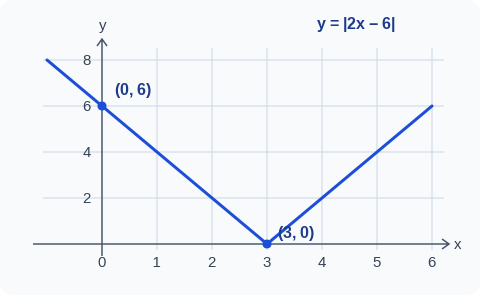
y=∣2x−6∣=2∣x−3∣y=|2x-6|=2|x-3| has vertex (3,0)(3,0) and passes through (0,6)(0,6).

A V-shaped graph of y equals the modulus of 2x minus 6. The vertex is at (3, 0), the y-intercept is (0, 6), and the two branches have gradients −2 and 2.

Read a horizontal intersection

If c>0c>0, ∣ax+b∣=c|ax+b|=c gives two points at distance c∣a∣\frac{c}{|a|} from the vertex. At c=0c=0 there is one point, and at c<0c<0 there are none.

Recover the scale

A point (p,h)(p,h) on a V with vertex (r,0)(r,0) gives k=h∣p−r∣k=\frac{h}{|p-r|} for y=k∣x−r∣y=k|x-r|.