Maths4UBETA

Modulus and its graph

Interpret modulus as distance and sketch the two straight branches of a linear modulus.

Try the quick check →
Lesson 1 of 5

Section 1 of 4 · Core · about 8 min

What does a modulus measure?

∣u∣|u| is the distance from uu to 00 on a number line. It is always non-negative and is zero exactly when u=0u=0.

Worked example

Same height, different inputs

Evaluate ∣x−2∣|x-2| at x=−1x=-1 and x=5x=5.

  1. At x=−1x=-1, the expression inside the bars is −1−2=−3-1-2=-3. Its distance from zero is 33.

  2. At x=5x=5, the inside value is 5−2=35-2=3. Its modulus is also 33.

  3. The two inputs lie 33 units to either side of x=2x=2.

Your turn

For y=∣2x+1∣y=|2x+1|, find yy at x=−3x=-3 and at x=2x=2.

Enter an exact number, for example 3/2 or 2-sqrt(3).

Enter an exact number, for example 3/2 or 2-sqrt(3).

Worked example

Read a scaled distance

Interpret the height of the graph y=∣3x−6∣y=|3x-6| at x=−1x=-1. Find the point on the other arm at the same height.

  1. Rewrite the formula as y=3∣x−2∣y=3|x-2|. The height is three times the horizontal distance from x=2x=2.

  2. At x=−1x=-1 that distance is three. The height is 99 and the other input is x=2+3=5x=2+3=5.

Your turn

Write ∣2x+6∣=k∣x−r∣|2x+6|=k|x-r| with k>0k>0. Give k,rk,r.

Enter the value on its own or write k = … . Fractions and exact square roots are accepted.

Enter the value on its own or write r = … . Fractions and exact square roots are accepted.

Section 2 of 4 · Core · about 10 min

How do I sketch the two lines?

Start with the line y=ax+by=ax+b. Keep its points on or above the xx-axis. A point below it has negative height, so reflect that part upwards. Both parts keep the same xx-coordinates. They join at (x,0)(x,0), where ax+b=0ax+b=0.

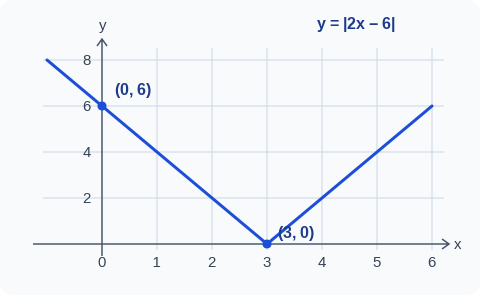
A V-shaped graph of y equals the modulus of 2x minus 6. The vertex is at (3, 0), the y-intercept is (0, 6), and the two branches have gradients −2 and 2.
The vertex is (3,0) (3,0) . The two branches have gradients −2 -2 and 2 2 .

Worked example

Sketch a shifted V

Sketch y=∣2x−6∣y=|2x-6|, labelling the vertex, intercepts and gradients.

  1. Solve 2x−6=02x-6=0. The vertex is (3,0)(3,0) and is the only xx-intercept.

  2. At x=0x=0, y=∣−6∣=6y=|-6|=6, so the graph meets the yy-axis at (0,6)(0,6).

  3. To the left of 33, the line y=2x−6y=2x-6 has negative height. Reflect it in the xx-axis to get y=−2x+6y=-2x+6. To the right, keep y=2x−6y=2x-6. Their gradients are −2-2 and 22.

Your turn

For y=∣−4x+2∣y=|-4x+2|, give the vertex's xx-coordinate, the yy-intercept's yy-coordinate and both gradients.

Enter an exact number, for example 3/2 or 2-sqrt(3).

Enter an exact number, for example 3/2 or 2-sqrt(3).

Enter an exact number, for example 3/2 or 2-sqrt(3).

Enter an exact number, for example 3/2 or 2-sqrt(3).

Worked example

Sketch a V when the inner slope is negative

Give the vertex, the vertical intercept and both branch gradients of y=∣−5x−10∣y=|-5x-10|.

  1. The inner line vanishes at x=−2x=-2, so the vertex is (−2,0)(-2,0).

  2. Since y=5∣x+2∣y=5|x+2|, the left arm has gradient −5-5 and the right arm has gradient 55.

  3. At x=0x=0 the modulus is 1010, giving the intercept (0,10)(0,10).

Your turn

For y=∣−3x+12∣y=|-3x+12|, give the vertex's x-coordinate, the y-intercept value and the gradients of the left and right arms.

Enter an exact number, for example 3/2 or 2-sqrt(3).

Enter an exact number, for example 3/2 or 2-sqrt(3).

Enter an exact number, for example 3/2 or 2-sqrt(3).

Enter an exact number, for example 3/2 or 2-sqrt(3).

Section 3 of 4 · Core · about 8 min

How many times does a horizontal line meet the graph?

Compare the requested height with the minimum 00. A negative height cannot occur, height zero meets the graph at the vertex, and a positive height meets both arms when a≠0a\ne0.

Worked example

Find two points at a prescribed height

Where does the line y=4y=4 meet y=∣2x−6∣y=|2x-6|?

  1. Rewrite the height condition as 2∣x−3∣=42|x-3|=4, so ∣x−3∣=2|x-3|=2.

  2. Move 22 units to either side of 33, giving x=1x=1 or x=5x=5.

  3. The intersections are (1,4)(1,4) and (5,4)(5,4).

Your turn

Give all xx-values where y=∣3x+6∣y=|3x+6| meets the line y=9y=9.

Give every root, for example x = 1 or x = 4, or 1, 4. Use sqrt(...) for exact roots, or empty if there are none.

Worked example

Recover the second intersection by symmetry

The line y=8y=8 meets y=∣2x−10∣y=|2x-10| at an input x=9x=9. Find the other input.

  1. The vertex has input 55. The known input is four units to its right.

  2. The other input is four units to its left, x=1x=1. Both have height 2×4=82\times4=8.

Your turn

Find all inputs where y=∣4x+12∣y=|4x+12| meets the line y=20y=20.

Give every root, for example x = 1 or x = 4, or 1, 4. Use sqrt(...) for exact roots, or empty if there are none.

Section 4 of 4 · Core · about 7 min

How do I read a formula from the vertex and another point?

For a V with vertex (r,0)(r,0) and another point (p,h)(p,h), the height hh tells you how many times the distance from the vertex was scaled.

Worked example

Build a formula from a given vertex

A graph of the form y=∣ax+b∣y=|ax+b| has vertex (−2,0)(-2,0) and passes through (4,18)(4,18). Find one formula with a>0a>0.

  1. The form is y=k∣x+2∣y=k|x+2|. The extra point is six horizontal units from the vertex.

  2. Since 18=6k18=6k, k=3k=3. Hence y=3∣x+2∣=∣3x+6∣y=3|x+2|=|3x+6|.

Your turn

The graph y=∣ax+b∣y=|ax+b| has vertex (3,0)(3,0) and contains (−1,8)(-1,8). Find a,ba,b with a>0a>0.

Enter the value on its own or write a = … . Fractions and exact square roots are accepted.

Enter the value on its own or write b = … . Fractions and exact square roots are accepted.

Worked examples

Practise the method

Core practice

Question 1 of 4

0 / 4 checked in this collection

Question list

Core practice

Fresh variants

Exam-style

Vertex and vertical intercept

2 marks

The graph is y=3∣x+4∣+2y=3\left|x + 4\right|+2. Find its vertex and its yy-intercept. Give both as coordinate pairs.

Enter a point as (1, 2) or x = 1, y = 2. Separate complete pairs with commas or semicolons.

Enter a point as (1, 2) or x = 1, y = 2. Separate complete pairs with commas or semicolons.

Full answer-format guide

Exact numbers: 3/2, sqrt(5), 2-sqrt(3), pi/6, 3*pi/2. Sets: {1,4}. Intervals: (3,5]; a round bracket excludes the endpoint. Infinity: inf; union: U; no solutions: empty. Separate coordinate pairs or triples with semicolons. Expressions: 2x^2+3x-1; equations: x^2=3x+1 or the polynomial equal to zero. Factors: x-1 ; x+2. Parameter fraction: numerator ; denominator. List integer answers individually.

Review the method

Progress stays in this browser. Create an account to save it or sign in.

Extra practice from this lesson

Factor out the positive scale

Write ∣6−2x∣=k∣x−r∣|6-2x|=k|x-r| with k>0k>0. Give k,rk,r.

Enter the value on its own or write k = … . Fractions and exact square roots are accepted.

Enter the value on its own or write r = … . Fractions and exact square roots are accepted.

Find the contact with the horizontal axis

Give the complete solution set of ∣5x+4∣=0|5x+4|=0.

Give every root, for example x = 1 or x = 4, or 1, 4. Use sqrt(...) for exact roots, or empty if there are none.

Decide whether the V meets a negative height

Give all inputs where y=∣3x−7∣y=|3x-7| meets y=−2y=-2.

Give every root, for example x = 1 or x = 4, or 1, 4. Use sqrt(...) for exact roots, or empty if there are none.

Find the two exact intersections

Find all inputs where y=∣3x−2∣y=|3x-2| meets y=4y=4.

Give every root, for example x = 1 or x = 4, or 1, 4. Use sqrt(...) for exact roots, or empty if there are none.

Apply it · original exam-style problems

Show your working on paper and compare it with the worked solution and marking guidance.

Come back to what needs practice

Quick revision sheet (A4)

Your review plan starts after your first check.