Maths4UBETA

Binomial models and event probabilities

Justify a binomial model and translate exact counts, tails and intervals into probabilities.

Try the quick check →
Lesson 1 of 5

Section 1 of 5 · Core · about 11 min

What is one trial, and what counts as a success?

A binomial random variable counts successes in a fixed number of trials. Before writing a formula, identify the physical trial and the event called success. Then check the model assumptions:

  • The number of trials nn is fixed in advance.
  • Each trial is classified as success or failure for the chosen count.
  • The success indicators from different trials are independent.
  • The success probability pp is the same on every trial.

Under these conditions, write

X∼B(n,p).X\sim\mathrm{B}(n,p).

The first parameter is the trial count; the second is the probability of the success that XX counts. They have different meanings and are not interchangeable.

Worked example

Define one trial and the success being counted

A fair die with faces numbered one to six is rolled independently eight times. Let XX count the rolls on which the score is at least four. State a suitable distribution for XX, explaining every parameter and model assumption.

  1. One trial is one die roll. Call a score of four, five or six a success; the other three faces are failures for this particular count. Each roll therefore contributes either one success or none.

  2. The number of trials is fixed at n=8n=8. The rolls are independent, and the die stays fair on every roll. Hence the success probability stays constant:

    p=P(score at least 4)=36=12.p=P(\text{score at least }4)=\frac{3}{6}=\frac{1}{2}.
  3. Therefore

    X∼B(8,12),X∈{0,1,…,8}.X\sim\mathrm{B}\left(8,\frac{1}{2}\right),\qquad X\in\{0,1,\ldots,8\}.
  4. The die has six physical outcomes, but only two success categories for this variable. The binomial condition concerns the success indicator for each trial; it does not require the underlying experiment to have only two physical outcomes.
Your turn

A bag contains two gold and three silver tokens. Which procedure directly satisfies the standard fixed-trial binomial assumptions using the per-draw gold probability 25\frac{2}{5}? For that procedure, state nn and pp.

Select the binomial procedure

Enter the value on its own or write n = … . Fractions and exact square roots are accepted.

Enter an exact value or round to 3 significant figures.

The possible listed counts are 0,1,…,n0,1,\ldots,n. For 0<p<10<p<1, every one has positive probability. At p=0p=0, the count is always zero; at p=1p=1, it is always nn. Handle these constant cases directly, without relying on an ambiguous expression such as 000^0.

Section 2 of 5 · Core · about 11 min

Why does the count event need a combination factor?

For one specified success/failure string containing rr successes and n−rn-r failures, independence gives probability

pr(1−p)n−r.p^r(1-p)^{n-r}.

The count event “exactly rr successes” usually allows many strings. Choose which rr of the nn labelled trial positions contain successes:

(nr)=n!r!(n−r)!.\binom{n}{r}=\frac{n!}{r!(n-r)!}.

Each permitted position set gives one string. These strings are disjoint and have the same probability because they have the same numbers of success and failure factors.

Worked example

One specified pattern is not the whole count event

Five independent trials each have success probability 25\frac{2}{5}. Find the probability of the specified pattern SSFFF, then the probability of exactly two successes in any order.

  1. For SSFFF, the two success positions and three failure positions are fixed. Independence gives

    P(SSFFF)=(25)2(35)3=1083125.P(\mathrm{SSFFF})=\left(\frac{2}{5}\right)^2\left(\frac{3}{5}\right)^3=\frac{108}{3125}.
  2. Exactly two successes may occupy any two of the five positions. The number of position sets is

    (52)=5!2!3!=10.\binom{5}{2}=\frac{5!}{2!3!}=10.
  3. Every such pattern has two factors 25\frac{2}{5} and three factors 35\frac{3}{5}, so its probability is the same as the specified pattern. These ten patterns are disjoint:

    P(X=2)=10⋅1083125=216625.P(X=2)=10\cdot\frac{108}{3125}=\frac{216}{625}.
  4. The combination factor counts the positions of the successes. It does not reorder labelled physical trials or assume that every possible success/failure string has equal probability. Strings with different numbers of successes generally have different weights when p≠12p\ne\frac{1}{2}.

Exactly two successes in five trials

In each independent trial, P(S)=25P(\mathrm{S})=\frac{2}{5} and P(F)=35P(\mathrm{F})=\frac{3}{5}. Choose the two successful positions in (52)=10\binom{5}{2}=10 ways.

Success positionsTrial sequence
1 and 2S S F F F
1 and 3S F S F F
1 and 4S F F S F
1 and 5S F F F S
2 and 3F S S F F
2 and 4F S F S F
2 and 5F S F F S
3 and 4F F S S F
3 and 5F F S F S
4 and 5F F F S S

One specified pattern has probability (25)2(35)3=1083125\left(\frac{2}{5}\right)^2\left(\frac{3}{5}\right)^3=\frac{108}{3125}.

The patterns are disjoint and equally likely, so P(X=2)=10×1083125=216625P(X=2)=10\times\frac{108}{3125}=\frac{216}{625}.

The ten choices of two success positions give ten disjoint strings with the same probability. The probability of the unrestricted count event is their sum.

Your turn

Four independent trials have success probability 13\frac{1}{3}. Find the probability of the specified pattern SFFF, the number of distinct patterns with exactly one success, and the probability of exactly one success in any order.

Enter an exact value or round to 3 significant figures.

Enter an exact number, for example 3/2 or 2-sqrt(3).

Enter an exact value or round to 3 significant figures.

The coefficient is one when r=0r=0 or r=nr=n: there is one all-failure string and one all-success string. It is not an additional probability, so it may exceed one; the complete weighted expression must still lie between zero and one.

Section 3 of 5 · Core · about 10 min

How is an exact count probability calculated?

Combining the equal-weight pattern calculation with the number of success-position sets gives the binomial probability formula:

P(X=r)=(nr)pr(1−p)n−r,r=0,1,…,n.P(X=r)=\binom{n}{r}p^r(1-p)^{n-r},\qquad r=0,1,\ldots,n.

Read the expression as a position count multiplied by a success factor and a failure factor. The two exponents add to nn, the total trial count. An impossible count, such as a negative count, a count above nn, or a noninteger count, has probability zero.

Worked example

Substitute the counted success probability into the exact formula

There are eight questions, each with four answer options and exactly one correct option. A student chooses uniformly and independently among the options on each question. Let XX be the number correct. Find P(X=3)P(X=3), giving an exact value and a decimal to three significant figures.

  1. A success is a correct answer. Thus X∼B(8,14)X\sim\mathrm{B}(8,\frac{1}{4}), and the failure probability is 34\frac{3}{4}.

  2. Exactly three successes leave five failures:

    P(X=3)=(83)(14)3(34)5.P(X=3)=\binom{8}{3}\left(\frac{1}{4}\right)^3\left(\frac{3}{4}\right)^5.
  3. The position count is (83)=56\binom{8}{3}=56. Hence

    P(X=3)=56⋅164⋅2431024=17018192=0.2076416015625.P(X=3)=56\cdot\frac{1}{64}\cdot\frac{243}{1024}=\frac{1701}{8192}=0.2076416015625.
  4. To three significant figures, the required probability is 0.2080.208. Keep the unrounded value during the calculation; a binomial probability is a number between zero and one, not a count of answers.

Your turn

Let X∼B(5,14)X\sim\mathrm{B}(5,\frac{1}{4}). Find the exact probabilities P(X=2)P(X=2) and P(X=0)P(X=0).

Enter an exact number, for example 3/2 or 2-sqrt(3).

Enter an exact number, for example 3/2 or 2-sqrt(3).

Keep exact fractions or unrounded calculator values through a multi-term calculation, and round only the final probability to the requested precision. For a percentage, multiply the final probability by one hundred and label it as a percentage.

Section 4 of 5 · Core · about 17 min

Which integer counts are included by the wording?

Translate the words into an event before evaluating it. For an integer threshold kk,

WordingEventIncluded counts or complement
Exactly kkX=kX=kOne count
At most kkX≤kX\le kCounts up to and including kk
Fewer than kkX<kX<kX≤k−1X\le k-1
At least kkX≥kX\ge k1−P(X≤k−1)1-P(X\le k-1)
More than kkX>kX>k1−P(X≤k)1-P(X\le k)

Intersect the event with the actual count range 0,1,…,n0,1,\ldots,n. For a noninteger threshold, list the permitted integer counts directly; the one-step endpoint shifts above are stated for integer kk.

Worked example

Use the complement for at least one success

Twelve components are tested independently. Each has probability 110\frac{1}{10} of being defective, with the same probability for every component. Find the probability that at least one component is defective, to three significant figures.

  1. Define a success as finding a defective component. For the number of defectives,

    X∼B(12,110).X\sim\mathrm{B}\left(12,\frac{1}{10}\right).

    The word “success” is a model label; the event need not be desirable.

  2. The complement of at least one defective is no defectives:

    P(X≥1)=1−P(X=0).P(X\ge1)=1-P(X=0).
  3. All twelve must be nondefective for X=0X=0, giving

    P(X≥1)=1−(910)12=0.717570463519.P(X\ge1)=1-\left(\frac{9}{10}\right)^{12}=0.717570463519.
  4. The answer is 0.7180.718 to three significant figures. This avoids adding twelve separate binomial terms and keeps the rounding to the final step.

Your turn

Let X∼B(4,13)X\sim\mathrm{B}(4,\frac{1}{3}). Find P(X≥1)P(X\ge1) and P(X>1)P(X>1).

Enter an exact value or round to 3 significant figures.

Enter an exact value or round to 3 significant figures.

Worked example

At most and fewer than have different endpoints

Let X∼B(6,13)X\sim\mathrm{B}(6,\frac{1}{3}). Find the probabilities of at most two successes and of fewer than two successes.

  1. At most two includes zero, one and two. Fewer than two includes only zero and one because XX is an integer.

  2. The required individual terms are

    P(X=0)=(23)6=64729,P(X=0)=\left(\frac{2}{3}\right)^6=\frac{64}{729},P(X=1)=(61)⋅13(23)5=192729,P(X=1)=\binom{6}{1}\cdot\frac{1}{3}\left(\frac{2}{3}\right)^5=\frac{192}{729},P(X=2)=(62)(13)2(23)4=240729.P(X=2)=\binom{6}{2}\left(\frac{1}{3}\right)^2\left(\frac{2}{3}\right)^4=\frac{240}{729}.
  3. Therefore

    P(X≤2)=64+192+240729=496729,P(X\le2)=\frac{64+192+240}{729}=\frac{496}{729},P(X<2)=P(X≤1)=64+192729=256729.P(X<2)=P(X\le1)=\frac{64+192}{729}=\frac{256}{729}.
  4. The difference is exactly P(X=2)=240729P(X=2)=\frac{240}{729}, the boundary value included by “at most” but excluded by “fewer than”.

Worked example

Translate a strict interval before using sums or cumulative values

Let X∼B(6,12)X\sim\mathrm{B}(6,\frac{1}{2}). Find the probability of more than one but fewer than five successes. Show a direct sum and a complementary or cumulative method.

  1. The phrase means 1<X<51<X<5. The included integer counts are two, three and four:

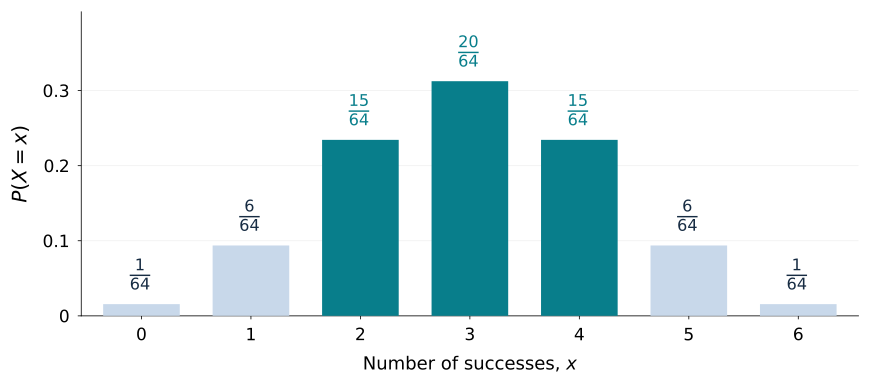
    P(1<X<5)=P(X=2)+P(X=3)+P(X=4).P(1<X<5)=P(X=2)+P(X=3)+P(X=4).
  2. All six-trial strings have probability 164\frac{1}{64} because the success probability is 12\frac{1}{2}. Thus

    P(1<X<5)=(62)+(63)+(64)64=15+20+1564=2532.P(1<X<5)=\frac{\binom{6}{2}+\binom{6}{3}+\binom{6}{4}}{64}=\frac{15+20+15}{64}=\frac{25}{32}.
  3. The excluded lower counts are zero and one, with total probability 764\frac{7}{64}. The excluded upper counts are five and six, also with total 764\frac{7}{64}:

    P(1<X<5)=1−764−764=2532.P(1<X<5)=1-\frac{7}{64}-\frac{7}{64}=\frac{25}{32}.
  4. If F(k)=P(X≤k)F(k)=P(X\le k), the same event is

    P(2≤X≤4)=F(4)−F(1)=5764−764=2532.P(2\le X\le4)=F(4)-F(1)=\frac{57}{64}-\frac{7}{64}=\frac{25}{32}.

    Subtract the cumulative probability through one, not through two, because the value two must remain included.

The binomial distribution with six trials and success probability one half has probabilities one six fifteen twenty fifteen six one over sixty-four at counts zero through six. Bars two three and four are highlighted for the strict interval one less than X less than five. Their combined probability is fifty over sixty-four, or twenty-five thirty-seconds. Excluding counts zero and one and counts five and six gives the same probability.

The highlighted counts are 2,3,42,3,4. Their total is P(1<X<5)=15+20+1564=2532P(1<X<5)=\frac{15+20+15}{64}=\frac{25}{32}.

For more than one but fewer than five successes, the included bars are exactly two, three and four. The excluded tails each have total probability seven sixty-fourths.

Your turn

Let X∼B(5,12)X\sim\mathrm{B}(5,\frac{1}{2}). For “at least two but fewer than four”, give the smallest and largest included counts and the probability. Then find the probability of “more than two but at most four”.

Enter an exact number, for example 3/2 or 2-sqrt(3).

Enter an exact number, for example 3/2 or 2-sqrt(3).

Enter an exact value or round to 3 significant figures.

Enter an exact value or round to 3 significant figures.

If F(k)=P(X≤k)F(k)=P(X\le k), an inclusive integer interval satisfies

P(a≤X≤b)=F(b)−F(a−1).P(a\le X\le b)=F(b)-F(a-1).

The subtraction removes every count below aa while leaving aa itself included. If the event is a<X≤ba<X\le b, subtract F(a)F(a) instead. A quick list of included integers is often the safest way to choose the bounds.

Section 5 of 5 · Core · about 11 min

Do the physical assumptions justify an exact binomial model?

A fixed trial count and two success categories do not by themselves establish a binomial model. Check independence and the constant success probability using the experiment’s actual structure. A changing population, a shared hidden state, copied outcomes or different success probabilities can invalidate the standard formula.

Worked example

A small sample without replacement needs a different exact model

A bag contains eight distinct balls: three red and five blue. Three are selected uniformly without replacement. Let XX be the red count. Explain why X∼B(3,38)X\sim\mathrm{B}(3,\frac{3}{8}) is not the exact model, and find the exact probability of one red.

  1. The number of draws is fixed and each draw can be classified red or blue. However, the colour of an earlier draw changes the remaining composition. After a first red, the next red probability is 27\frac{2}{7}; after a first blue, it is 37\frac{3}{7}. The success indicators are dependent.

  2. The first-draw red probability 38\frac{3}{8} cannot be multiplied repeatedly as if the draws were independent. The marginal red probability at each fixed draw position is still 38\frac{3}{8}; that fact alone does not establish independence.

  3. There are (83)=56\binom{8}{3}=56 equally likely three-ball subsets. For one red, choose one of the three reds and two of the five blues:

    P(X=1)=(31)(52)(83)=3056=1528.P(X=1)=\frac{\binom{3}{1}\binom{5}{2}}{\binom{8}{3}}=\frac{30}{56}=\frac{15}{28}.
  4. The binomial calculation would instead give

    (31)⋅38(58)2=225512,\binom{3}{1}\cdot\frac{3}{8}\left(\frac{5}{8}\right)^2=\frac{225}{512},

    which differs from the exact probability. In this small finite population, replacement and independence cannot be assumed.

Your turn

A fair coin is tossed once. Its result is then copied into six labelled record positions. Let XX count the positions labelled heads. Every individual position has head probability 12\frac{1}{2}. Is X∼B(6,12)X\sim\mathrm{B}(6,\frac{1}{2})? Find the actual probabilities P(X=3)P(X=3) and P(X=6)P(X=6).

Which model statement is correct?

Enter an exact number, for example 3/2 or 2-sqrt(3).

Enter an exact value or round to 3 significant figures.

Sampling a very small fraction of a sufficiently large population without replacement can sometimes be modelled approximately as binomial because the composition changes little. State that this is an approximation and explain why it is reasonable in the given context; do not describe a small-population calculation as exact binomial sampling.

Likewise, independent trials with different success probabilities do not generally have the standard binomial count distribution. Stopping as soon as a success occurs changes the trial count from fixed to random. Recheck the model whenever the procedure changes.

Worked examples

Practise the method

Core practice

Question 1 of 4

0 / 4 checked in this collection

Question list

Core practice

Fresh variants

Exam-style

A count model and its lower tail

4 marks

A sensor is tested 4 times independently. Each test fails with probability 13\frac{1}{3}. X counts failed tests. Give n and p in its binomial model, then P(X=2)\mathrm P(X=2) and P(X≤2)\mathrm P(X\le 2).

Enter the value on its own or write n = … . Fractions and exact square roots are accepted.

Enter an exact value or round to 3 significant figures.

Enter an exact value or round to 3 significant figures.

Enter an exact value or round to 3 significant figures.

Full answer-format guide

Exact numbers: 3/2, sqrt(5), 2-sqrt(3), pi/6, 3*pi/2. Sets: {1,4}. Intervals: (3,5]; a round bracket excludes the endpoint. Infinity: inf; union: U; no solutions: empty. Separate coordinate pairs or triples with semicolons. Expressions: 2x^2+3x-1; equations: x^2=3x+1 or the polynomial equal to zero. Factors: x-1 ; x+2. Parameter fraction: numerator ; denominator. List integer answers individually.

Review the method

Progress stays in this browser. Create an account to save it or sign in.

Extra practice from this lesson

Check the experiment rather than the word success

Decide whether an exact binomial model describes each stated count.

A: Five counters are drawn without replacement from a bag containing three red and seven blue counters; count the reds.

B: Six independent tests are made, each positive with probability 0.30.3; count the positive tests.

C: A fair coin is tossed until its first head; count the number of tosses made.

D: Ten independent trials are performed; success probability is 0.20.2 on each of the first five and 0.50.5 on each of the last five; count all successes.

Experiment A
Experiment B
Experiment C
Experiment D

A specified order has no combination factor

A player makes seven independent shots, each successful with probability 25\frac{2}{5}. Write S for a success and F for a failure. Find the probability of the particular ordered sequence SSFFSFF, the number of different success/failure sequences containing exactly three successes, and the probability of exactly three successes in any order.

Enter an exact value or round to 3 significant figures.

Enter an exact number, for example 3/2 or 2-sqrt(3).

Enter an exact value or round to 3 significant figures.

Exact probabilities include the support endpoints

Let X∼B(9,13)X\sim\mathrm{B}\left(9,\frac{1}{3}\right). Find P(X=0)P(X=0) and P(X=2)P(X=2), each to four decimal places. Give the exact value of P(X=10)P(X=10).

Give your answer to 4 decimal places.

Give your answer to 4 decimal places.

Enter an exact number, for example 3/2 or 2-sqrt(3).

Translate each endpoint before choosing a calculation

Let X∼B(10,0.2)X\sim\mathrm{B}(10,0.2). Find P(X≥1)P(X\ge1), P(X>2)P(X>2), P(2≤X≤4)P(2\le X\le4) and P(X<2)P(X<2). Give every probability to four decimal places.

Give your answer to 4 decimal places.

Give your answer to 4 decimal places.

Give your answer to 4 decimal places.

Give your answer to 4 decimal places.

Two or more failures is the complement of zero or one

Twelve sensors operate independently. Each has probability 0.080.08 of failing a test. Let FF be the number that fail. Find the probability that none fails, that at most one fails, and that at least two fail. Give each answer to four decimal places.

Give your answer to 4 decimal places.

Give your answer to 4 decimal places.

Give your answer to 4 decimal places.

Count an exact number of successes

XX counts successes in five independent trials with success probability 13\frac13. Find P(X=2)\mathrm P(X=2).

Enter an exact value or round to 3 significant figures.

Use binomial moments

Find the variance of X∼B(8,14)X\sim\mathrm B(8,\frac14).

Enter an exact value or round to 3 significant figures.

Translate a strict count

For six trials, give the smallest count included by the event “more than three successes”.

Enter an exact number, for example 3/2 or 2-sqrt(3).

Read a specified order

For three independent trials with success probability 14\frac14, find the probability of success, failure, success in that order.

Enter an exact value or round to 3 significant figures.

Apply it · original exam-style problems

Show your working on paper and compare it with the worked solution and marking guidance.

Start after this lesson

Choose the counted outcome and translate the pass count 9 marks

Fifteen devices are tested independently. Each passes with probability 0.90.9. Let FF be the number that fail. State the two parameters nn and pp in the binomial model for FF. Then find the probability of exactly two failures, the probability of no more than two failures, and the probability that between eleven and thirteen devices inclusive pass. Give the three event probabilities to four decimal places.

Hint

The variable counts failures, so its binomial probability is 0.10.1. The number of passes is 15−F15-F; translate both endpoints of the pass interval into failure counts.

Worked solution
  1. There are fifteen fixed trials, each with independent failure probability 0.10.1. Thus

    F∼B(15,0.1),n=15,p=110.F\sim\mathrm{B}(15,0.1),\qquad n=15,\quad p=\frac{1}{10}.
  2. P(F=2)=(152)⋅0.12⋅0.913≈0.2669(4 d.p.).P(F=2)=\binom{15}{2}\cdot0.1^2\cdot0.9^{13}\approx0.2669\quad\text{(4 d.p.)}.
  3. P(F≤2)=∑r=02(15r)⋅0.1r⋅0.915−r≈0.8159(4 d.p.).P(F\le2)=\sum_{r=0}^{2}\binom{15}{r}\cdot0.1^r\cdot0.9^{15-r}\approx0.8159\quad\text{(4 d.p.)}.
  4. The pass condition is 11≤15−F≤1311\le15-F\le13, which is equivalent to 2≤F≤42\le F\le4. Therefore

    P(11≤passes≤13)=∑r=24(15r)⋅0.1r⋅0.915−r≈0.4382(4 d.p.).P(11\le\text{passes}\le13)=\sum_{r=2}^{4}\binom{15}{r}\cdot0.1^r\cdot0.9^{15-r}\approx0.4382\quad\text{(4 d.p.)}.

    The lower pass endpoint becomes the upper failure endpoint, so check both bounds after reversing the count.

Marking guidance
  • 1 mark: recognize the fixed independent trials and the counted failure outcome.
  • 1 mark: state the correct model parameters.
  • 1 mark: include the success-position factor in the exactly-two calculation.
  • 1 mark: obtain the exactly-two probability to the requested accuracy.
  • 1 mark: include zero, one and two in the no-more-than-two event.
  • 1 mark: obtain that cumulative probability.
  • 1 mark: translate the pass interval into the correct failure interval.
  • 1 mark: include both translated endpoints.
  • 1 mark: obtain the interval probability to the requested accuracy.
Wins and losses describe the same fixed experiment 9 marks

A player completes ten independent rounds. In each round the probability of a win is 0.60.6; otherwise the round is lost. Find the probabilities of exactly six wins; winning more than half the rounds; at least two losses but fewer than five losses; and at least one win together with at least one loss. Give all answers to four decimal places.

Hint

Let W∼B(10,0.6)W\sim\mathrm{B}(10,0.6). More than half means W≥6W\ge6. Convert the stated loss interval using losses equal to 10−W10-W. For the final event, exclude only all wins and all losses.

Worked solution
  1. P(W=6)=(106)⋅0.66⋅0.44≈0.2508(4 d.p.).P(W=6)=\binom{10}{6}\cdot0.6^6\cdot0.4^4\approx0.2508\quad\text{(4 d.p.)}.
  2. P(W>5)=1−∑r=05(10r)⋅0.6r⋅0.410−r≈0.6331(4 d.p.).P(W>5)=1-\sum_{r=0}^{5}\binom{10}{r}\cdot0.6^r\cdot0.4^{10-r}\approx0.6331\quad\text{(4 d.p.)}.
  3. The allowed loss counts are two, three and four. They correspond to win counts eight, seven and six:

    P(2≤losses<5)=P(6≤W≤8)=∑r=68(10r)⋅0.6r⋅0.410−r≈0.5867(4 d.p.).P(2\le\text{losses}<5)=P(6\le W\le8)=\sum_{r=6}^{8}\binom{10}{r}\cdot0.6^r\cdot0.4^{10-r}\approx0.5867\quad\text{(4 d.p.)}.
  4. All wins and all losses are disjoint. Their complement has both kinds of result:

    P(1≤W≤9)=1−0.610−0.410≈0.9938(4 d.p.).P(1\le W\le9)=1-0.6^{10}-0.4^{10}\approx0.9938\quad\text{(4 d.p.)}.

    Subtracting only one extreme would still allow the other. The word “and” requires both a win and a loss.

Marking guidance
  • 1 mark: define the correct binomial win count.
  • 1 mark: form the exactly-six probability with its position factor.
  • 1 mark: obtain the exactly-six value to the requested accuracy.
  • 1 mark: interpret more than half as at least six wins.
  • 1 mark: calculate the majority probability.
  • 1 mark: translate the strict loss endpoint to the three allowed loss counts.
  • 1 mark: calculate the corresponding inclusive win interval.
  • 1 mark: identify and exclude both disjoint extreme outcomes for the final event.
  • 1 mark: obtain its probability to the requested accuracy.

Come back to what needs practice

Quick revision sheet (A4)

Your review plan starts after your first check.

Question bank and saved work