Maths4UBETA

Bearings, scales and constructions

Read positions on maps and construct exact angles and regular polygons.

Try the quick check →
Lesson 2 of 2

Section 1 of 4 · Core · about 8 min

Measure clockwise from north

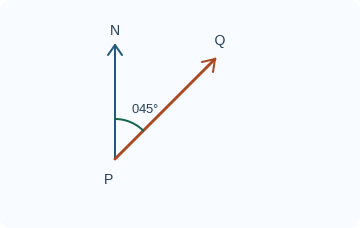
Draw a north line through the point you start from.

A north arrow at P and a north-east ray to Q, with an angle of forty-five degrees clockwise from north

Start at P, face north and turn clockwise. Give 045°, using three digits.

Worked example

Reverse a bearing

On a plan, the bearing of Q from P is 063°.

  1. Find the bearing of P from Q in degrees.

    [2]
  2. Give a reminder for writing a bearing.

    [1]
  1. (a) Draw a north line at Q parallel to the one at P. The opposite direction is half a full turn away.

  2. Add 180° to 063°.

  3. 243243

  4. (b) A leading zero marks the position of the hundreds digit.

  5. Use three digits measured clockwise from north.
Your turn

On a plan, the bearing of Q from P is 087°.

Find the bearing of P from Q in degrees.

Enter a three-figure bearing, for example 065°.

Worked example

Reverse a bearing

On a plan, the bearing of Q from P is 068°.

  1. Find the bearing of P from Q in degrees.

    [2]
  2. Give a reminder for writing a bearing.

    [1]

Try it on paper first.

  1. (a) Draw a north line at Q parallel to the one at P. The opposite direction is half a full turn away.

  2. Add 180° to 068°.

  3. 248248

  4. (b) A leading zero marks the position of the hundreds digit.

  5. Use three digits measured clockwise from north.

Your turn

On a plan, the bearing of Q from P is 092°.

Find the bearing of P from Q in degrees.

Enter a three-figure bearing, for example 065°.

Section 2 of 4 · Core · about 8 min

Convert plan length to real length

Read both units in the map scale before calculating.

Worked example

Use a plan scale

On a plan, 1 cm represents 170 m. A walking route measures 3 cm along a straight segment.

  1. Find the actual length in metres.

    [2]
  2. If the map were drawn at half its size, what happens to route length on the map?

    [1]
  1. (a) Use 170 m for each of 3 cm.

  2. 510510

  3. (b) The actual route length stays the same.

  4. It is halved.

Your turn

On a plan, 1 cm represents 200 m. A walking route measures 7 cm along a straight segment.

Find the actual length in metres.

Enter one number. Fractions and decimals are accepted.

Worked example

Use a plan scale

On a plan, 1 cm represents 170 m. A walking route measures 4 cm along a straight segment.

  1. Find the actual length in metres.

    [2]
  2. If the map were drawn at half its size, what happens to route length on the map?

    [1]

Try it on paper first.

  1. (a) Use 170 m for each of 4 cm.

  2. 680680

  3. (b) The actual route length stays the same.

  4. It is halved.

Your turn

On a plan, 1 cm represents 200 m. A walking route measures 8 cm along a straight segment.

Find the actual length in metres.

Enter one number. Fractions and decimals are accepted.

Section 3 of 4 · Core · about 8 min

Build an angle with compass arcs

Make 60° from an equilateral triangle and 90° from a perpendicular construction.

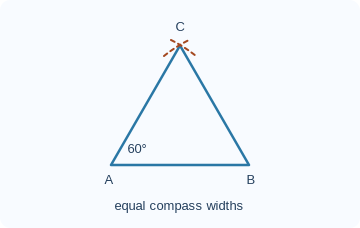
A sixty-degree construction using the three equal sides of an equilateral triangle

Use the length AB as the compass opening for the two arcs that cross at C.

Worked example

Construct an exact angle

Draw a right angle on a 16 cm base. Use equal arcs inside the angle and join their crossing back to the vertex.

  1. Find the size of the constructed angle in degrees.

    [2]
  2. Construct the 45° angle on paper. Leave the compass arcs visible.

    [2]
  1. (a) The angle bisector splits 90° into two equal angles.

  2. 4545

  3. (b) Start with the stated base. Use a consistent compass width for each pair of arcs.

  4. A 45° angle with usable construction marks.

Your turn

Draw an equilateral-triangle corner on a 4 cm base to build a 60° angle. Use equal arcs inside the angle and join their crossing back to the vertex.

Find the size of the constructed angle in degrees.

Enter the angle in degrees.

Worked example

Construct an exact angle

Draw a base segment 17 cm long. With a compass opening equal to the segment, draw an arc from each endpoint. Join an arc crossing to each endpoint.

  1. Find the size of the constructed angle in degrees.

    [2]
  2. Construct the 60° angle on paper. Leave the compass arcs visible.

    [2]

Try it on paper first.

  1. (a) An equilateral triangle has three equal angles of 60°.

  2. 6060

  3. (b) Start with the stated base. Use a consistent compass width for each pair of arcs.

  4. A 60° angle with usable construction marks.

Your turn

Draw a right angle on a 5 cm base. Use equal arcs inside the angle and join their crossing back to the vertex.

Find the size of the constructed angle in degrees.

Enter the angle in degrees.

Section 4 of 4 · Core · about 8 min

Put equally spaced points around a circle

Make each central angle the same so the chords are the same length.

Worked example

Construct a regular polygon

You want to draw a regular 6-sided polygon around a circle with radius 13 cm.

  1. Give the angle at the centre between successive vertices in degrees.

    [2]
  2. Describe how to finish the drawing from one marked vertex.

    [2]
  1. (a) Equal central angles divide the full 360° into 6 pieces.

  2. 6060

  3. (b) For a regular hexagon, the compass radius also equals its side length.

  4. Mark the central angles consecutively and join neighbouring points on the circle.

Your turn

You want to draw a regular 9-sided polygon around a circle with radius 17 cm.

Give the angle at the centre between successive vertices in degrees.

Enter the angle in degrees.

Worked example

Construct a regular polygon

You want to draw a regular 8-sided polygon around a circle with radius 14 cm.

  1. Give the angle at the centre between successive vertices in degrees.

    [2]
  2. Describe how to finish the drawing from one marked vertex.

    [2]

Try it on paper first.

  1. (a) Equal central angles divide the full 360° into 8 pieces.

  2. 4545

  3. (b) For a regular hexagon, the compass radius also equals its side length.

  4. Mark the central angles consecutively and join neighbouring points on the circle.

Your turn

You want to draw a regular 10-sided polygon around a circle with radius 18 cm.

Give the angle at the centre between successive vertices in degrees.

Enter the angle in degrees.

Worked examples

Practise the method

Core practice

Question 1 of 12

0 / 12 checked in this collection

Question list

Core practice

Fresh variants

Exam-style

Reverse a bearing

1 mark

On a plan, the bearing of Q from P is 082°.

Find the bearing of P from Q in degrees.

Enter a three-figure bearing, for example 065°.

Full answer-format guide

Exact numbers: 3/2, sqrt(5), 2-sqrt(3), pi/6, 3*pi/2. Sets: {1,4}. Intervals: (3,5]; a round bracket excludes the endpoint. Infinity: inf; union: U; no solutions: empty. Separate coordinate pairs or triples with semicolons. Expressions: 2x^2+3x-1; equations: x^2=3x+1 or the polynomial equal to zero. Factors: x-1 ; x+2. Parameter fraction: numerator ; denominator. List integer answers individually.

Review the method

Progress stays in this browser. Create an account to save it or sign in.

Extra practice from this lesson

On a plan, the bearing of Q from P is 111°.

Find the bearing of P from Q in degrees.

Enter a three-figure bearing, for example 065°.

On a plan, the bearing of Q from P is 116°.

Find the bearing of P from Q in degrees.

Enter a three-figure bearing, for example 065°.

On a plan, 1 cm represents 220 m. A walking route measures 11 cm along a straight segment.

Find the actual length in metres.

Enter one number. Fractions and decimals are accepted.

On a plan, 1 cm represents 220 m. A walking route measures 12 cm along a straight segment.

Find the actual length in metres.

Enter one number. Fractions and decimals are accepted.

Draw a base segment 8 cm long. With a compass opening equal to the segment, draw an arc from each endpoint. Join an arc crossing to each endpoint.

Find the size of the constructed angle in degrees.

Enter the angle in degrees.

Draw an equilateral-triangle corner on a 9 cm base to build a 60° angle. Use equal arcs inside the angle and join their crossing back to the vertex.

Find the size of the constructed angle in degrees.

Enter the angle in degrees.

You want to draw a regular 12-sided polygon around a circle with radius 5 cm.

Give the angle at the centre between successive vertices in degrees.

Enter the angle in degrees.

You want to draw a regular 15-sided polygon around a circle with radius 6 cm.

Give the angle at the centre between successive vertices in degrees.

Enter the angle in degrees.

Apply it · original exam-style problems

Show your working on paper and compare it with the worked solution and marking guidance.

Come back to what needs practice

Quick revision sheet (A4)

Your review plan starts after your first check.