Maths4UBETA

Polygon and parallel-line angles

Explain polygon angle sums and use angle relationships to find missing values.

Try the quick check →
Lesson 1 of 2

Section 1 of 3 · Core · about 8 min

Split a polygon into triangles

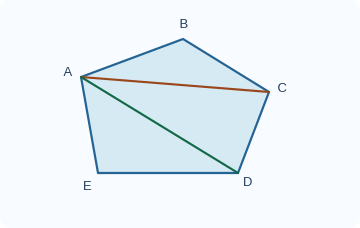
Draw all possible diagonals from one vertex in a convex polygon.

A pentagon has two diagonals from the same vertex, splitting it into three triangles

An n-sided polygon splits into n minus 2 triangles from one vertex.

Worked example

Find an interior angle sum

A community tile design is based on a convex polygon with 8 sides.

  1. Find the sum of its interior angles in degrees.

    [2]
  2. Does the sum require a regular polygon? Explain.

    [1]
  1. (a) Draw diagonals from one vertex. The number of triangles is 6.

  2. Each triangle contributes 180°, making 1080°.

  3. 10801080

  4. (b) A fan of diagonals still gives the same total for any convex polygon of this size.

  5. No. The number of triangles depends on the sides, not their lengths.

Your turn

A community tile design is based on a convex polygon with 5 sides.

Find the sum of its interior angles in degrees.

Enter one number. Fractions and decimals are accepted.

Worked example

Find an interior angle sum

A community tile design is based on a convex polygon with 9 sides.

  1. Find the sum of its interior angles in degrees.

    [2]
  2. Does the sum require a regular polygon? Explain.

    [1]

Try it on paper first.

  1. (a) Draw diagonals from one vertex. The number of triangles is 7.

  2. Each triangle contributes 180°, making 1260°.

  3. 12601260

  4. (b) A fan of diagonals still gives the same total for any convex polygon of this size.

  5. No. The number of triangles depends on the sides, not their lengths.

Your turn

A community tile design is based on a convex polygon with 6 sides.

Find the sum of its interior angles in degrees.

Enter one number. Fractions and decimals are accepted.

Section 2 of 3 · Core · about 8 min

Follow the turns around a boundary

Imagine walking one complete lap while facing along the next side.

Worked example

Walk once around a regular polygon

A robot walks the sides of a regular 90-sided polygon. It turns through the same angle at each vertex.

  1. Give the angle of each exterior turn in degrees.

    [2]
  2. Find a single interior angle.

    [1]
  1. (a) A complete circuit needs 360°. Share it equally among 90 turns.

  2. 44

  3. (b) An exterior and its adjacent interior angle lie on a straight line.

  4. 176°.

Your turn

A robot walks the sides of a regular 5-sided polygon. It turns through the same angle at each vertex.

Give the angle of each exterior turn in degrees.

Enter the angle in degrees.

Worked example

Walk once around a regular polygon

A robot walks the sides of a regular 120-sided polygon. It turns through the same angle at each vertex.

  1. Give the angle of each exterior turn in degrees.

    [2]
  2. Find a single interior angle.

    [1]

Try it on paper first.

  1. (a) A complete circuit needs 360°. Share it equally among 120 turns.

  2. 33

  3. (b) An exterior and its adjacent interior angle lie on a straight line.

  4. 177°.

Your turn

A robot walks the sides of a regular 6-sided polygon. It turns through the same angle at each vertex.

Give the angle of each exterior turn in degrees.

Enter the angle in degrees.

Section 3 of 3 · Core · about 8 min

Combine one angle rule at a time

Mark parallel lines, then name any right angles, straight lines or triangles you can see.

Worked example

Trace an angle between parallels

A transversal crosses two parallel lines. One acute angle is 44°. A triangle uses a matching corresponding angle and another interior angle of 56°.

  1. Find the third angle in degrees.

    [2]
  2. State the relationship used for the first angle.

    [1]
  1. (a) The first interior angle equals 44° because corresponding angles in parallel lines are equal.

  2. Subtract 44° and 56° from 180°.

  3. 8080

  4. (b) Both angles are in matching positions relative to a parallel line and the transversal.

  5. Corresponding angles are equal.

Your turn

A transversal crosses two parallel lines. One acute angle is 42°. A triangle uses a matching corresponding angle and another interior angle of 58°.

Find the third angle in degrees.

Enter the angle in degrees.

Worked example

Trace an angle between parallels

A transversal crosses two parallel lines. One acute angle is 45°. A triangle uses a matching corresponding angle and another interior angle of 56°.

  1. Find the third angle in degrees.

    [2]
  2. State the relationship used for the first angle.

    [1]

Try it on paper first.

  1. (a) The first interior angle equals 45° because corresponding angles in parallel lines are equal.

  2. Subtract 45° and 56° from 180°.

  3. 7979

  4. (b) Both angles are in matching positions relative to a parallel line and the transversal.

  5. Corresponding angles are equal.

Your turn

A transversal crosses two parallel lines. One acute angle is 43°. A triangle uses a matching corresponding angle and another interior angle of 58°.

Find the third angle in degrees.

Enter the angle in degrees.

Worked examples

Practise the method

Core practice

Question 1 of 12

0 / 12 checked in this collection

Question list

Core practice

Fresh variants

Exam-style

Find an interior angle sum

1 mark

A community tile design is based on a convex polygon with 22 sides.

Find the sum of its interior angles in degrees.

Enter one number. Fractions and decimals are accepted.

Full answer-format guide

Exact numbers: 3/2, sqrt(5), 2-sqrt(3), pi/6, 3*pi/2. Sets: {1,4}. Intervals: (3,5]; a round bracket excludes the endpoint. Infinity: inf; union: U; no solutions: empty. Separate coordinate pairs or triples with semicolons. Expressions: 2x^2+3x-1; equations: x^2=3x+1 or the polynomial equal to zero. Factors: x-1 ; x+2. Parameter fraction: numerator ; denominator. List integer answers individually.

Review the method

Progress stays in this browser. Create an account to save it or sign in.

Extra practice from this lesson

A community tile design is based on a convex polygon with 25 sides.

Find the sum of its interior angles in degrees.

Enter one number. Fractions and decimals are accepted.

A community tile design is based on a convex polygon with 26 sides.

Find the sum of its interior angles in degrees.

Enter one number. Fractions and decimals are accepted.

A robot walks the sides of a regular 8-sided polygon. It turns through the same angle at each vertex.

Give the angle of each exterior turn in degrees.

Enter the angle in degrees.

A robot walks the sides of a regular 9-sided polygon. It turns through the same angle at each vertex.

Give the angle of each exterior turn in degrees.

Enter the angle in degrees.

A transversal crosses two parallel lines. One acute angle is 64°. A triangle uses a matching corresponding angle and another interior angle of 60°.

Find the third angle in degrees.

Enter the angle in degrees.

A transversal crosses two parallel lines. One acute angle is 65°. A triangle uses a matching corresponding angle and another interior angle of 60°.

Find the third angle in degrees.

Enter the angle in degrees.

Apply it · original exam-style problems

Show your working on paper and compare it with the worked solution and marking guidance.

Come back to what needs practice

Quick revision sheet (A4)

Your review plan starts after your first check.