Worked example
Use the same subtraction order twice
Find the gradient from to . Check it by reversing the order.
From to , the rise is and the run is , so .
From to , the changes are and . The ratio is still .
Choose a direction from gradients, while treating horizontal and vertical lines correctly.
Try the quick check →Section 1 of 6 · Core · about 5 min
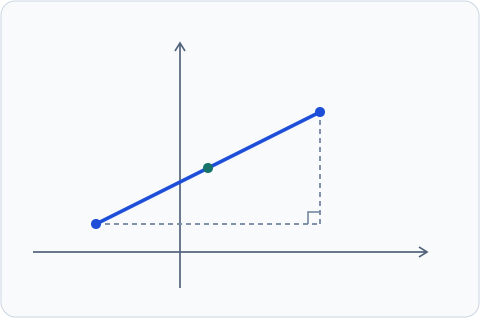
The segment from to rises units in a horizontal run of . The gradient measures the signed rise per unit of run.
Worked example
Find the gradient from to . Check it by reversing the order.
From to , the rise is and the run is , so .
From to , the changes are and . The ratio is still .
Section 2 of 6 · Core · about 5 min
A parallel line follows the same direction as the original line. Its position is fixed by the point it must pass through.
Worked example
Find the line parallel to that passes through . The gradient of is .
Using through the given point gives .
Multiply by and rearrange to . The original line and this line have the same gradient.
Check , so the new line contains .
Section 3 of 6 · Core · about 6 min
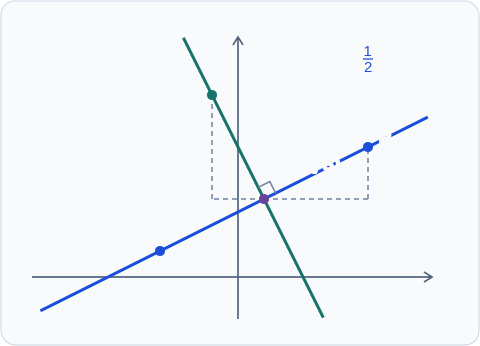
On , a step of right and up has gradient . Rotating that step a quarter turn anticlockwise gives left and up. The perpendicular gradient is .
Worked example
Find the line through perpendicular to , whose gradient is .
The perpendicular gradient is .
Using the given point gives . This becomes .
The product of the gradients is , and the point gives .
Section 4 of 6 · Core · about 5 min
The perpendicular line in the sketch passes through , the midpoint of . These two conditions give one perpendicular bisector.
Worked example
Find the perpendicular bisector of and .
The midpoint is and the segment gradient is .
The bisector has gradient and passes through . Its equation is , or .
The line meets the -axis at , the point found earlier by equating the distances to and .
Section 5 of 6 · Core · about 5 min
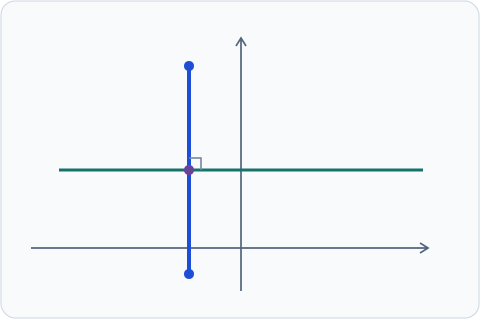
Horizontal lines have constant . Vertical lines have constant . They are perpendicular to each other.
Worked example
Find the perpendicular bisector of and .
The segment is vertical because its endpoints have the same -coordinate.
The midpoint is . A perpendicular is horizontal, so its equation is .
Section 6 of 6 · Extension · about 6 min
When one coordinate is unknown, start from the required direction. That gives an equation for the coordinate change.
Worked example
The segment from to is perpendicular to . Find .
The required gradient is . In particular the segment has non-zero horizontal change.
Use , so and .
The changes are horizontally and vertically. Their ratio gives .
Question 1 of 4
0 / 4 checked in this collection
Find the gradient of AB for A and B, and the gradient of a perpendicular line.
Progress stays in this browser. Create an account to save it or sign in.
Show your working on paper and compare it with the worked solution and marking guidance.
Try these after completing this chapter.
Review Circle equations, centres and tangents first.
Review Circle equations, centres and tangents first.
Review Circle equations, centres and tangents and Line–circle intersections, chords and tangency first.
Review Circle equations, centres and tangents first.
Review Circle equations, centres and tangents first.
Review Circle equations, centres and tangents and Line–circle intersections, chords and tangency first.
Review Circle equations, centres and tangents and Two tangents from a point first.
Review Circle equations, centres and tangents first.
Your review plan starts after your first check.