Maths4UBETA

Straight-line equations, intercepts and intersections

Build a complete line equation from a direction and point, then use it in a geometric problem.

Try the quick check →
Lesson 3 of 5

Section 1 of 5 · Core · about 5 min

Which form uses the given point and gradient?

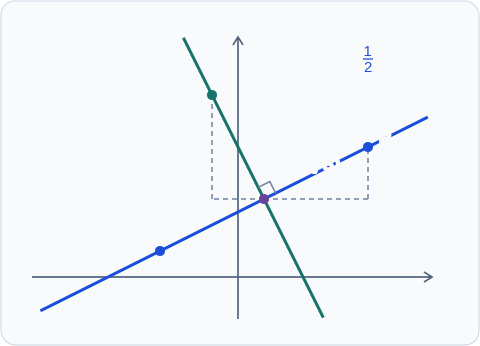
The line ABAB has gradient 12\tfrac12 and passes through A(−3,1)A(-3,1). Writing the changes from AA gives the equation in one step.

Worked example

Write three forms for the same line

Write the equation of the line through A(−3,1)A(-3,1) with gradient 12\tfrac12.

  1. Point and gradient give y−1=12(x+3)y-1=\tfrac12(x+3).

  2. Rearrange to y=12x+52y=\tfrac12x+\tfrac52. The constant 52\tfrac52 is the height at x=0x=0.

  3. Multiply by 22 and move all terms to one side to get x−2y+5=0x-2y+5=0. The three equations describe the same line.
Your turn

Find the line through (4,−2)(4,-2) with gradient −34-\tfrac34.

Enter both sides of the equation or give an expression equal to zero. Use ^ for powers and / for fractions.

Section 2 of 5 · Core · about 5 min

How do two points determine the equation?

Distinct points specify both a direction and a position. If the xx-coordinates agree, the line is vertical and its equation already follows.

Worked example

Find a line through two distinct points

Find the equation of the line through (−2,5)(-2,5) and (4,−1)(4,-1).

  1. The gradient is −1−54−(−2)=−1\frac{-1-5}{4-(-2)}=-1.

  2. Use the first point to get y−5=−(x+2)y-5=-(x+2), or x+y=3x+y=3.

  3. Check the second point gives 4+(−1)=34+(-1)=3.

Your turn

Find the line through (−1,4)(-1,4) and (5,1)(5,1).

Enter both sides of the equation or give an expression equal to zero. Use ^ for powers and / for fractions.

Your turn

Find the line through (−3,1)(-3,1) and (−3,7)(-3,7).

Enter both sides of the equation or give an expression equal to zero. Use ^ for powers and / for fractions.

Section 3 of 5 · Core · about 5 min

Where does the line meet each axis?

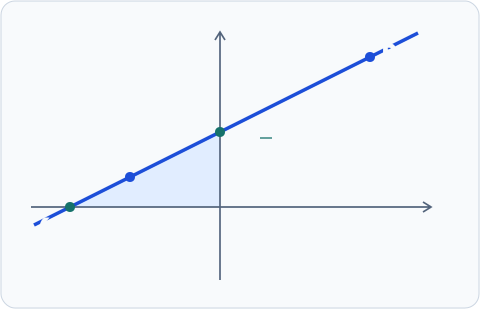
Every point on the xx-axis has y=0y=0. Every point on the yy-axis has x=0x=0. Use these conditions one at a time.

The line through A (−3, 1) and B (5, 5) meets the axes at (−5, 0) and (0, 5/2). A shaded triangle is bounded by the line and the axes.

Worked example

Find both places where AB meets an axis

Find the two axis intercepts of 2y=x+52y=x+5.

  1. With y=0y=0, 0=x+50=x+5 gives x=−5x=-5. The xx-intercept is (−5,0)(-5,0).

  2. With x=0x=0, 2y=52y=5 gives y=52y=\tfrac52. The yy-intercept is (0,52)(0,\tfrac52).

Your turn

Give the two axis intercepts of 3x−2y=123x-2y=12 as coordinate pairs.

Enter a point as (1, 2) or x = 1, y = 2. Separate complete pairs with commas or semicolons.

Section 4 of 5 · Core · about 6 min

What does a simultaneous solution represent?

A common point satisfies both line equations. The segment ABAB and its perpendicular bisector meet at their shared point CC.

AB and its perpendicular bisector meet at C (1, 3). Each line contains C.

Worked example

Find the same point from two equations

Find the intersection of 2y=x+52y=x+5 and 2x+y=52x+y=5.

  1. Double 2x+y=52x+y=5 to get 4x+2y=104x+2y=10.

  2. Replace 2y2y by x+5x+5. Then 5x+5=105x+5=10, so x=1x=1.

  3. From 2y=1+52y=1+5, y=3y=3. The point (1,3)(1,3) satisfies both equations.

Your turn

Find the intersection of y=2x−1y=2x-1 and 3x+y=143x+y=14.

Enter a point as (1, 2) or x = 1, y = 2. Separate complete pairs with commas or semicolons.

Your turn

Give all common points of y=−x+4y=-x+4 and 2x+2y=102x+2y=10. Enter empty if there are none.

Enter a point as (1, 2) or x = 1, y = 2. Separate complete pairs with commas or semicolons.

Section 5 of 5 · Core · about 5 min

How do the intercepts give the area?

The line 2y=x+52y=x+5 and the axes bound a right-angled triangle. The two sides from the origin have lengths 55 and 52\tfrac52.

Worked example

Turn signed intercepts into lengths

Find the area of the triangle formed by 2y=x+52y=x+5 and the axes.

  1. The intercepts are (−5,0)(-5,0) and (0,52)(0,\tfrac52).

  2. Using the base 55 and height 52\tfrac52, the area is 12(5)(52)=254\tfrac12(5)(\tfrac52)=\tfrac{25}4 square units.

Your turn

Find the area of the triangle bounded by 4x−3y=244x-3y=24 and the axes.

Enter the value on its own or write area = … . Fractions and exact square roots are accepted.

Worked examples

Practise the method

Core practice

Question 1 of 4

0 / 4 checked in this collection

Question list

Core practice

Fresh variants

Exam-style

A line from point and gradient

1 mark

Find a line through (−3, 2)\left( -3, \ 2\right) with gradient −23- \frac{2}{3}.

Enter both sides of the equation or give an expression equal to zero. Use ^ for powers and / for fractions.

Full answer-format guide

Exact numbers: 3/2, sqrt(5), 2-sqrt(3), pi/6, 3*pi/2. Sets: {1,4}. Intervals: (3,5]; a round bracket excludes the endpoint. Infinity: inf; union: U; no solutions: empty. Separate coordinate pairs or triples with semicolons. Expressions: 2x^2+3x-1; equations: x^2=3x+1 or the polynomial equal to zero. Factors: x-1 ; x+2. Parameter fraction: numerator ; denominator. List integer answers individually.

Review the method

Progress stays in this browser. Create an account to save it or sign in.

Apply it · original exam-style problems

Show your working on paper and compare it with the worked solution and marking guidance.

Start after this lesson

Find a line, its intersection and its intercept area 7 marks

The line ll passes through A(−2,5)A(-2,5) and B(4,2)B(4,2).

  1. Find an equation of ll. [3]
  2. Find the intersection of ll with y=x+1y=x+1. [2]
  3. Find the area of the triangle bounded by ll and the axes. [2]
Worked solution
  1. The gradient is 2−54−(−2)=−12\frac{2-5}{4-(-2)}=-\tfrac12. Using AA gives y−5=−12(x+2)y-5=-\tfrac12(x+2), so ll is y=4−12xy=4-\tfrac12x. [3]
  2. From 4−12x=x+14-\tfrac12x=x+1, find x=2x=2 and y=3y=3. The intersection is (2,3)(2,3). [2]
  3. The intercepts are (8,0)(8,0) and (0,4)(0,4). The area is 12(8)(4)=16\tfrac12(8)(4)=16 square units. [2]
Meet a perpendicular and find the exact distance 7 marks

The line ll has equation x+2y=8x+2y=8. A line mm goes through P(3,−2)P(3,-2) perpendicular to ll.

  1. Find an equation of mm. [2]
  2. Find the intersection HH of ll and mm. [3]
  3. Find the exact length PHPH. [2]
Worked solution
  1. The gradient of ll is −12-\tfrac12. The perpendicular through PP is y+2=2(x−3)y+2=2(x-3), or y=2x−8y=2x-8. [2]
  2. Substitute into x+2y=8x+2y=8 to get 5x=245x=24. The point is H=(245,85)H=(\tfrac{24}5,\tfrac85). [3]
  3. The coordinate changes are 95\tfrac95 and 185\tfrac{18}5. Hence PH=955PH=\frac{9\sqrt5}{5}. [2]
Mixed chapter practice

Try these after completing this chapter.

Review Circle equations, centres and tangents and Line–circle intersections, chords and tangency first.

Review Circle equations, centres and tangents first.

Review Circle equations, centres and tangents and Line–circle intersections, chords and tangency first.

Review Circle equations, centres and tangents first.

Review Circle equations, centres and tangents first.

Review Circle equations, centres and tangents first.

Review Circle equations, centres and tangents and Two tangents from a point first.

Review Circle equations, centres and tangents and Two tangents from a point first.

Review Circle equations, centres and tangents and Line–circle intersections, chords and tangency first.

Review Circle equations, centres and tangents and Line–circle intersections, chords and tangency first.

Come back to what needs practice

Quick revision sheet (A4)

Your review plan starts after your first check.

Question bank and saved work