Worked example
Follow the number through the two rules
For , , and , , find and .
For , start with . The value is allowed in , so .
For , start with . Now goes into , which accepts every real input. So .
Apply the inside function first, and check that its output is allowed by the outside function.
Try the quick check →Section 1 of 6 · Core · about 4 min
In the first lesson, took to . Now let for all real . Start at , add using , then put the result into . You have found .

Worked example
For , , and , , find and .
For , start with . The value is allowed in , so .
For , start with . Now goes into , which accepts every real input. So .
Section 2 of 6 · Core · about 6 min
Work with instead of a single number. Write the outside rule with an empty input, then put the whole inside expression into that space.
Worked example
Using the same and , find the two composite formulae wherever they are defined.
For , the inside rule gives . Replace the input of with .
For , the inside rule gives . The outside rule adds .
At , the formulae give and , matching the two calculations in the previous section. Now check which other inputs are allowed.
Worked example
Let and on the real numbers. Find and .
Write the outside rule as . Both places marked receive .
Expand the square and the linear term to get .
With on the outside, subtract from the entire output of .
Section 3 of 6 · Core · about 7 min
With , an input of gives . The original function has domain . Since it cannot take , the calculation of stops there.
Worked example
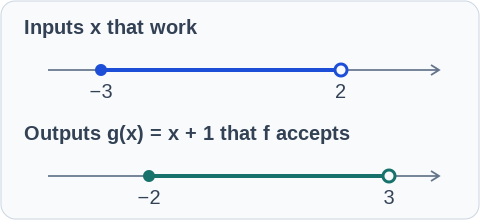
For on and on , which inputs work in ? Which work in ?
For , can start at any real . The intermediate value must belong to .
Subtract throughout. The inputs that work are , or . In particular, works and does not.
For , start with the given domain of , . Every output of is real and accepts every real number, so there is no further restriction.
Section 4 of 6 · Core · about 6 min
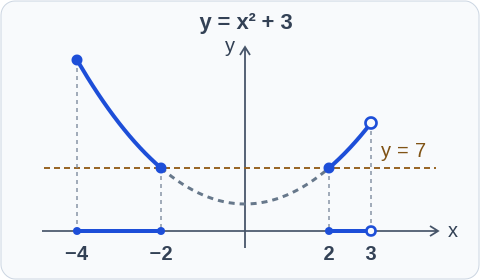
Let on . If the outside rule is , it only accepts values . Look for both parts of the graph of at or above .
Worked example
For on , and on , find and its domain.
The outside rule needs , so , or .
This is true when or . The endpoints and give a square root of zero, so both are allowed.
Restrict both branches to the stated interval . The composite is on .
Section 5 of 6 · Core · about 6 min
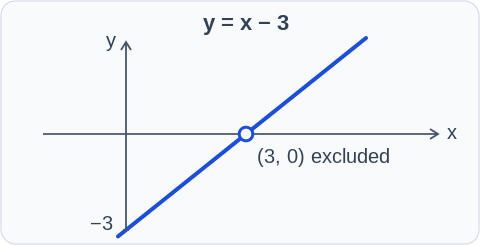
The graph below comes from composing two fractions. The rule simplifies to , but the inside fraction is undefined at . The hollow point is part of the final answer.
Worked example
Find when , , and , . State the domain.
First record from . For every allowed , the fraction in is non-zero. So its output never equals and the outside rule takes it.
Substitute the output of into .
The resulting rule is for . At the first step still has no value, so the point is absent.
When two rules undo each other, their composite gives back its input. For the from the first lesson, for . In the reverse order, for . Both expressions are , with different allowed inputs.
Section 6 of 6 · Core · about 8 min
If one rule and the composite are known, use the order of the composition to see what can be recovered. The missing rule may be on the inside or the outside.
Worked example
Let for real , and let for real . Find .
The outside rule acts on . That makes the equation .
Add to both sides and divide every term by .
Putting this into gives , as required.
Worked example
Let for , and suppose throughout that interval. Find the rule for wherever it is determined.
The input of is . Since , we know that . Express the old input as .
Substitute into the given composite and simplify.
This determines for . Smaller values of are never reached by the stated , so the composite gives no information about them.
Question 1 of 4
0 / 4 checked in this collection
Let and , both for real x. Find and .
Progress stays in this browser. Create an account to save it or sign in.
Show your working on paper and compare it with the worked solution and marking guidance.
Try these after completing this chapter.
Review Ranges, restrictions and inverse branches first.
Review Ranges, restrictions and inverse branches first.
Review Ranges, restrictions and inverse branches first.
Review Ranges, restrictions and inverse branches first.
Your review plan starts after your first check.