Maths4UBETA

Ranges, restrictions and inverse branches

Use the graph and the actual domain to choose the correct inverse branch and interval.

Try the quick check →
Lesson 3 of 5

Section 1 of 6 · Core · about 5 min

Where can I cut the parabola to make it one–one?

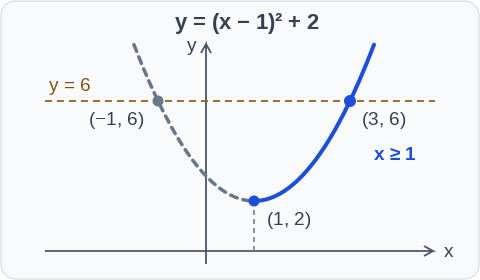
Return to q(x)=(x−1)2+2q(x)=(x-1)^2+2 from the first lesson. The horizontal line y=6y=6 meets the full parabola at x=−1x=-1 and x=3x=3. If we keep x≥1x\ge1, every attained output comes from a single input.

Both branches of the full parabola meet y = 6. Keeping x greater than or equal to 1 leaves the solid branch and just one point at that level.

Worked example

Find the cutoff for each full branch

For q(x)=(x−1)2+2q(x)=(x-1)^2+2, find the smallest cutoff cc for a one–one domain x≥cx\ge c, and the largest cutoff for a one–one domain x≤cx\le c.

  1. The vertex has x=1x=1. On x≥1x\ge1, the square (x−1)2(x-1)^2 increases with xx, so no two allowed inputs give the same output.

  2. If c<1c<1, then both cc and 2−c2-c lie in x≥cx\ge c and give the same output. Thus the smallest right-hand cutoff is 11.

  3. On x≤1x\le1, the outputs decrease as xx moves towards the vertex. If c>1c>1, the left-hand domain includes both cc and 2−c2-c. Its largest one–one cutoff is therefore also 11.

Your turn

Let w(x)=8−(x+2)2w(x)=8-(x+2)^2 for x≥cx\ge c. Give the smallest cc for which ww is one–one.

Enter the value on its own or write c = … . Fractions and exact square roots are accepted.

Your turn

Let s(x)=3(x−4)2+6s(x)=3(x-4)^2+6 for x≤cx\le c. Give the largest cc for which ss is one–one.

Enter the value on its own or write c = … . Fractions and exact square roots are accepted.

Section 2 of 6 · Core · about 6 min

Which outputs does the chosen piece reach?

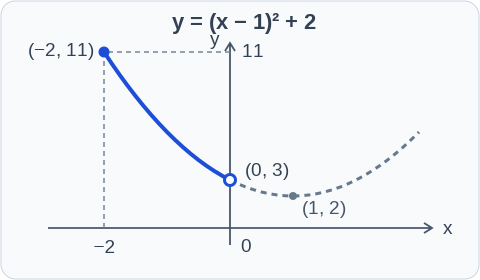
Start with q(x)=(x−1)2+2q(x)=(x-1)^2+2. Keep only −2≤x<0-2\le x<0, a piece to the left of the vertex. The filled point gives an attained output, and the hollow point marks an output the piece approaches.

The kept arc runs from the filled point (−2, 11) to the open point (0, 3). The vertex (1, 2) lies on the discarded part of the parabola.

Worked example

Read the range away from the vertex

Find the range of q(x)=(x−1)2+2q(x)=(x-1)^2+2 on −2≤x<0-2\le x<0.

  1. As xx moves from −2-2 towards 00, its distance from the vertex x=1x=1 decreases. The expression decreases along this piece.

  2. At −2-2, the output is q(−2)=(−3)2+2=11q(-2)=(-3)^2+2=11, which is included. At the right boundary the expression approaches (−1)2+2=3(-1)^2+2=3, which is excluded.

  3. The curve takes every output in between. Give 3<q(x)≤113<q(x)\le11, 3<y≤113<y\le11 or (3,11](3,11].

Your turn

Find the range of r(x)=4+2(x−2)2r(x)=4+2(x-2)^2 on 3<x≤53<x\le5. Give an interval or an inequality in r(x)r(x) or yy.

Give the output range as an inequality or an interval. For example, y ≤ 4 is (−∞, 4]. You can type <= for ≤.

Section 3 of 6 · Core · about 8 min

Which sign belongs in the inverse formula?

Write the original equation as y=a(x−h)2+ky=a(x-h)^2+k. Rearranging gives (x−h)2=y−ka(x-h)^2=\dfrac{y-k}{a}. The sign of x−hx-h on the chosen domain tells you which square-root branch to take.

Worked example

Choose the left-hand square-root branch

Find the inverse of q(x)=(x−1)2+2q(x)=(x-1)^2+2, −2≤x<0-2\le x<0, and check what it does to the output 66.

  1. From y=(x−1)2+2y=(x-1)^2+2, get (x−1)2=y−2(x-1)^2=y-2. The original inputs are all below 11, so x−1x-1 is negative.

  2. Take x−1=−y−2x-1=-\sqrt{y-2}. Rename the old output as the input of the inverse.

    q−1(x)=1−x−2,3<x≤11.q^{-1}(x)=1-\sqrt{x-2},\qquad 3<x\le11.
  3. The original input −1-1 gives 66. Check that q−1(6)=1−4=−1q^{-1}(6)=1-\sqrt4=-1. The other root would give 33, which is outside the original domain.

Worked example

Use the plus sign on a downward parabola

Find the inverse of s(x)=12−3(x+2)2s(x)=12-3(x+2)^2 on x≥−1x\ge-1.

  1. The vertex lies at x=−2x=-2. The permitted inputs lie to its right. The selected branch decreases from s(−1)=9s(-1)=9, so its range is (−∞,9](-\infty,9].

  2. Rearrange y=12−3(x+2)2y=12-3(x+2)^2 to get (x+2)2=12−y3(x+2)^2=\dfrac{12-y}{3}. On x≥−1x\ge-1, x+2x+2 is positive, so choose the plus sign.

  3. The inverse is s−1(x)=−2+12−x3s^{-1}(x)=-2+\sqrt{\dfrac{12-x}{3}} for x≤9x\le9. Check that s(0)=0s(0)=0 and that the inverse returns 00.

Your turn

Let r(x)=10−2(x−3)2r(x)=10-2(x-3)^2 for x≥4x\ge4. Use the allowed branch to give the exact value of r−1(0)r^{-1}(0).

Enter the value on its own or write r⁻¹(0) = … . Fractions and exact square roots are accepted.

Your turn

Let m(x)=4(x+1)2−2m(x)=4(x+1)^2-2 for x≤−2x\le-2. Find m−1(10)m^{-1}(10) exactly.

Enter the value on its own or write m⁻¹(10) = … . Fractions and exact square roots are accepted.

Section 4 of 6 · Core · about 7 min

Which interval belongs to the inverse?

Take q(x)=(x−1)2+2q(x)=(x-1)^2+2 on [−2,0)[-2,0). Its inverse takes the original outputs as inputs, so the two intervals swap.

FunctionDomainRange
qq[−2,0)[-2,0)(3,11](3,11]
q−1q^{-1}(3,11](3,11][−2,0)[-2,0)

Worked example

Keep both bounds of a short branch

Find the inverse of m(x)=7−2(x−1)2m(x)=7-2(x-1)^2 on −2<x≤0-2<x\le0, and state its domain and range.

  1. On the selected left branch of the downward parabola, mm increases. Its output approaches −11-11 as xx approaches −2-2, and reaches 55 at x=0x=0. Its range is (−11,5](-11,5].

  2. Since x<1x<1, the rearrangement gives x−1=−7−y2x-1=-\sqrt{\dfrac{7-y}{2}}. Thus the inverse rule is m−1(x)=1−7−x2m^{-1}(x)=1-\sqrt{\dfrac{7-x}{2}}.

  3. The inverse domain is (−11,5](-11,5], and its range is (−2,0](-2,0]. The radical alone allows every x≤7x\le7, but the actual original range supplies both inverse input bounds.

Your turn

Let w(x)=(x+1)2−1w(x)=(x+1)^2-1 for −4≤x<−2-4\le x<-2. Find the complete domain of w−1w^{-1}.

Use inequalities in x or interval notation. Join intervals with ‘or’ or ∪. Enter an isolated value on its own.

Your turn

For the same w(x)=(x+1)2−1w(x)=(x+1)^2-1 on −4≤x<−2-4\le x<-2, give the range of w−1w^{-1}. Use an interval or an inequality in w−1(x)w^{-1}(x) or yy.

Give the output range as an inequality or an interval. For example, y ≤ 4 is (−∞, 4]. You can type <= for ≤.

Section 5 of 6 · Core · about 7 min

What if the original rule contains a square root?

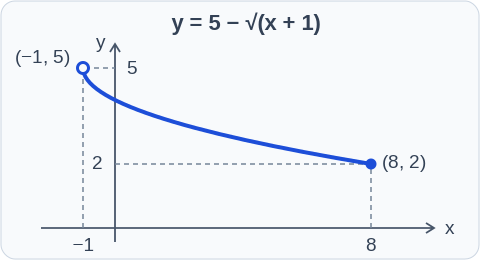
For p(x)=5−x+1p(x)=5-\sqrt{x+1} on −1<x≤8-1<x\le8, the output approaches 55 at the open end and reaches 22 at the closed end. The inverse will accept exactly those outputs.

The decreasing square-root curve has an open point at (−1, 5) and a filled point at (8, 2). Its outputs include 2 and exclude 5.

Worked example

Square only after isolating the root

Invert p(x)=5−x+1p(x)=5-\sqrt{x+1}, −1<x≤8-1<x\le8, and give the inverse domain and range.

  1. The square root takes values from just above 00 to 33 inclusive. Subtract them from 55: 2≤y<52\le y<5.

  2. Write 5−y=x+15-y=\sqrt{x+1}. On the original range, 5−y5-y is positive. Squaring gives x=(5−y)2−1x=(5-y)^2-1.

  3. So p−1(x)=(5−x)2−1p^{-1}(x)=(5-x)^2-1 for 2≤x<52\le x<5. Its range is −1<y≤8-1<y\le8. The included point checks out because p(8)=2p(8)=2 and p−1(2)=8p^{-1}(2)=8.

Your turn

Let g(x)=x+3−2g(x)=\sqrt{x+3}-2 for −3<x≤13-3<x\le13. Enter the expression on the right-hand side of the equation for g−1(x)g^{-1}(x). Brackets or expanded form are both accepted.

Enter an expression in x; use ^ for powers and / for fractions.

Your turn

For the same g(x)=x+3−2g(x)=\sqrt{x+3}-2 on −3<x≤13-3<x\le13, give the complete domain of g−1g^{-1}.

Use inequalities in x or interval notation. Join intervals with ‘or’ or ∪. Enter an isolated value on its own.

Section 6 of 6 · Extension · about 6 min

Can another input supply an excluded endpoint's output?

When a restriction crosses the vertex, two different inputs may give the same output. An open endpoint removes an output only if no remaining input gives that value.

Worked example

One boundary is open but its output is included

Find the range of u(x)=3+(x−1)2u(x)=3+(x-1)^2 on −1<x≤3-1<x\le3. Then give the inverse domain after restricting to 1≤x≤31\le x\le3.

  1. The vertex at x=1x=1 gives 33. The output 77 comes from the included input 33, even though the corresponding left-hand boundary −1-1 is excluded. The range is [3,7][3,7].

  2. The full stated interval is many–one. For example, u(0)=u(2)=4u(0)=u(2)=4. Keep [1,3][1,3] to get a one–one right branch.

  3. The selected right branch still reaches every output from 33 to 77, inclusive. That makes [3,7][3,7] the domain of its inverse.

Your turn

Let h(x)=2+(x+1)2h(x)=2+(x+1)^2 for −4<x≤2-4<x\le2. Find its range.

Give the output range as an inequality or an interval. For example, y ≤ 4 is (−∞, 4]. You can type <= for ≤.

Your turn

Now keep only −4<x≤−1-4<x\le-1 for h(x)=2+(x+1)2h(x)=2+(x+1)^2. Give the domain of the inverse of this left piece.

Use inequalities in x or interval notation. Join intervals with ‘or’ or ∪. Enter an isolated value on its own.

Worked examples

Practise the method

Core practice

Question 1 of 4

0 / 4 checked in this collection

Question list

Core practice

Fresh variants

Exam-style

A right branch with a later cutoff

3 marks

For f(x)=2(x−1)2−3f(x)=2 \left(x - 1\right)^{2} - 3, x≥3x\ge3, choose the inverse formula and give its domain and range.

Inverse formula

Choose one option. Explain your reasoning on paper.

Use inequalities in x or interval notation. Join intervals with ‘or’ or ∪. Enter an isolated value on its own.

Give the output range as an inequality or an interval. For example, y ≤ 4 is (−∞, 4]. You can type <= for ≤.

Full answer-format guide

Exact numbers: 3/2, sqrt(5), 2-sqrt(3), pi/6, 3*pi/2. Sets: {1,4}. Intervals: (3,5]; a round bracket excludes the endpoint. Infinity: inf; union: U; no solutions: empty. Separate coordinate pairs or triples with semicolons. Expressions: 2x^2+3x-1; equations: x^2=3x+1 or the polynomial equal to zero. Factors: x-1 ; x+2. Parameter fraction: numerator ; denominator. List integer answers individually.

Review the method

Progress stays in this browser. Create an account to save it or sign in.

Apply it · original exam-style problems

Show your working on paper and compare it with the worked solution and marking guidance.

Come back to what needs practice

Quick revision sheet (A4)

Your review plan starts after your first check.

Question bank and saved work