Maths4UBETA

Trigonometric graphs, periods and transformations

Read a full cycle, distinguish inside and outside changes and keep tangent branches separate.

Try the quick check →
Lesson 2 of 5

Section 1 of 6 · Core · about 6 min

How do I sketch sine and cosine from key points?

As a point travels around the unit circle, its vertical coordinate gives sin⁡x\sin x and its horizontal coordinate gives cos⁡x\cos x. A full turn repeats both coordinates, so both graphs have period 2π2\pi radians, or 360∘360^\circ.

Start with the axis points of the circle. Join the graph points with a smooth wave, then repeat the pattern to the left or right when needed.

Radian inputDegree inputsin⁡x\sin xcos⁡x\cos x
000∘0^\circ0011
π2\frac{\pi}{2}90∘90^\circ1100
π\pi180∘180^\circ00−1-1
3π2\frac{3\pi}{2}270∘270^\circ−1-100
2π2\pi360∘360^\circ0011

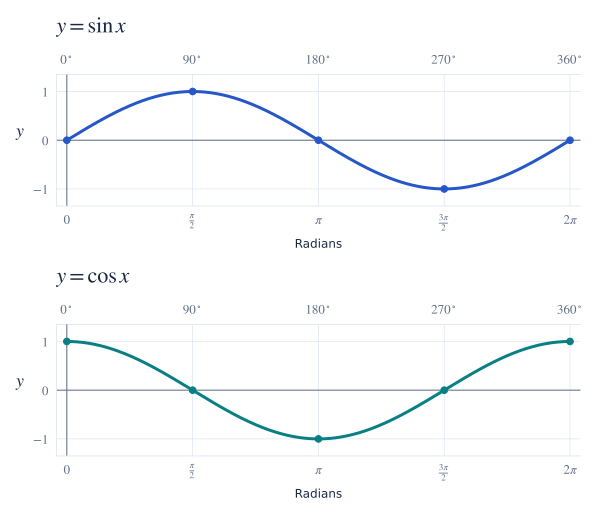
Both graphs show one full turn, with equivalent degree and radian scales. Sine heights are zero, one, zero, negative one, zero. Cosine heights are one, zero, negative one, zero, one.

The same five anchor positions describe one full cycle. Read the top scale in degrees or the bottom scale in radians.

Worked example

Extend the basic sine graph

Sketch y=sin⁡xy=\sin x for −π≤x≤2π-\pi\le x\le2\pi. State its minimum value and period.

  1. Plot (−π,0)(-\pi,0), (−π2,−1)\left(-\frac{\pi}{2},-1\right), (0,0)(0,0), (π2,1)\left(\frac{\pi}{2},1\right), (π,0)(\pi,0), (3π2,−1)\left(\frac{3\pi}{2},-1\right), (2π,0)(2\pi,0).

    The negative-angle points follow from sine’s symmetry.

  2. Join successive points smoothly. The curve crosses the horizontal axis at each listed zero and turns smoothly at each extreme point.

    A sine curve is not a series of straight segments.

  3. min⁡y=−1,T=2π.\min y=-1,\qquad T=2\pi.

    The period measures a full repeated pattern, not the distance from a maximum to a minimum.

Your turn

For y=cos⁡xy=\cos x, with 0≤x≤2π0\le x\le2\pi, give every input where y=0y=0. State the minimum value and the period.

Give the complete set: {1, 4} for separate values, (1, 5] for an interval, U for union or empty for no real solutions. Use sqrt(...) for exact roots.

Enter an exact number, for example 3/2 or 2-sqrt(3).

Enter an exact number, for example 3/2 or 2-sqrt(3).

Section 2 of 6 · Core · about 6 min

Why is the tangent graph split into separate branches?

Use tan⁡x=sin⁡xcos⁡x\tan x=\frac{\sin x}{\cos x}. Tangent is undefined wherever cos⁡x=0\cos x=0. In the central interval −π2<x<π2-\frac{\pi}{2}<x<\frac{\pi}{2}, the curve passes through (−π4,−1)\left(-\frac{\pi}{4},-1\right), (0,0)(0,0) and (π4,1)\left(\frac{\pi}{4},1\right). It increases without an upper bound as it approaches the right-hand asymptote.

Its branches repeat after π\pi radians, or 180∘180^\circ. Draw vertical asymptotes as dashed guide lines and leave a gap between neighbouring branches.

The tangent branches are not joined across the dashed vertical asymptotes at negative pi over two and positive pi over two. Zeros at negative pi, zero and pi are marked; the two central quarter-turn anchor points have heights negative one and one.

The central branch lies between x=−π2x=-\frac{\pi}{2} and x=π2x=\frac{\pi}{2}. The graph repeats after π\pi, not after a full turn.

Worked example

Sketch a tangent graph across two periods

Sketch y=tan⁡xy=\tan x for −π≤x≤π-\pi\le x\le\pi, showing zeros and vertical asymptotes.

  1. x=−π2,x=π2x=-\frac{\pi}{2},\quad x=\frac{\pi}{2}

    are the two vertical asymptotes in this interval.

    Cosine is zero at these inputs, so the quotient is undefined.

  2. (−π,0),(0,0),(π,0)(-\pi,0),\quad(0,0),\quad(\pi,0)

    are the zero points.

    Sine is zero and cosine is non-zero at these inputs.

  3. Use (−π4,−1)\left(-\frac{\pi}{4},-1\right) and (π4,1)\left(\frac{\pi}{4},1\right) on the central increasing branch, then repeat it by horizontal shifts of π\pi.

    Keep every branch separate at its asymptotes.

Your turn

For y=tan⁡xy=\tan x, identify every vertical asymptote with 0<x<2π0<x<2\pi. State the period.

Give the complete set: {1, 4} for separate values, (1, 5] for an interval, U for union or empty for no real solutions. Use sqrt(...) for exact roots.

Enter an exact number, for example 3/2 or 2-sqrt(3).

Section 3 of 6 · Core · about 6 min

How do a stretch, reflection and vertical shift change a graph?

In y=af(x)+dy=a f(x)+d, the input is unchanged. Multiply each old height by aa, then add dd. Thus (x,y)(x,y) becomes (x,ay+d)(x,ay+d). A negative aa reflects the graph in the horizontal axis before the vertical translation.

Worked example

A reflected and shifted sine wave

Find the amplitude, midline, range and period of y=−3sin⁡x+2y=-3\sin x+2. Describe its first movement to the right of x=0x=0.

  1. amplitude=3,midline:y=2.\text{amplitude}=3,\qquad\text{midline}:y=2.

    Amplitude is a positive distance, even when the coefficient is negative.

  2. −1≤y≤5,T=2π.-1\le y\le5,\qquad T=2\pi.

    The extremes are three units below and above the midline.

  3. The point (0,0)(0,0) on the basic sine graph becomes (0,2)(0,2). The graph initially falls because the negative coefficient reverses the basic sine graph’s initial rise.

    Describe the direction as well as the starting height.

Your turn

For y=4cos⁡x−1y=4\cos x-1, state its amplitude, minimum value and maximum value.

Enter an exact number, for example 3/2 or 2-sqrt(3).

Enter an exact number, for example 3/2 or 2-sqrt(3).

Enter an exact number, for example 3/2 or 2-sqrt(3).

Worked example

A vertical scale is not always an amplitude

Describe y=−2tan⁡x+1y=-2\tan x+1: give its period, the image of (0,0)(0,0), and whether it has an amplitude.

  1. T=π,(0,0)↦(0,1).T=\pi,\qquad(0,0)\mapsto(0,1).

    Only vertical coordinates changed.

  2. The factor −2-2 reflects and vertically stretches every branch. The central branch now falls. The asymptotes remain x=−π2x=-\frac{\pi}{2} and x=π2x=\frac{\pi}{2}.

    Input restrictions are unchanged.

  3. There is no amplitude: the tangent graph has no finite upper or lower extreme.

    Do not apply the sine-wave amplitude formula to tangent.

Your turn

Which description of y=5tan⁡x−3y=5\tan x-3 is correct?

Description

Section 4 of 6 · Core · about 10 min

How do I read the scale and shift inside the argument?

Write the argument in factored form before reading a horizontal shift. For example, 3x−π=3(x−π3)3x-\pi=3\left(x-\frac{\pi}{3}\right). The horizontal shift is π3\frac{\pi}{3} to the right.

For y=af(b(x−h))+dy=a f(b(x-h))+d, a basic point (t,v)(t,v) maps to

(h+tb, av+d),b≠0.\left(h+\frac{t}{b},\ av+d\right),\qquad b\ne0.

The horizontal scale factor is 1∣b∣\frac{1}{|b|}. If b<0b<0, the input direction also reverses.

Worked example

Factor, then map the five anchors

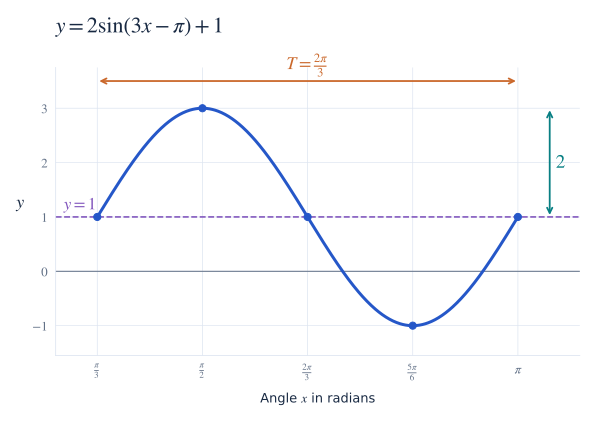
Sketch one cycle of y=2sin⁡(3x−π)+1y=2\sin(3x-\pi)+1, starting where its argument is zero.

  1. y=2sin⁡(3(x−π3))+1.y=2\sin\left(3\left(x-\frac{\pi}{3}\right)\right)+1.

    Its amplitude is 22, midline y=1y=1, horizontal shift h=π3h=\frac{\pi}{3}, and period 2π3\frac{2\pi}{3}.

    Factor the whole argument before reading the shift.

  2. Use basic inputs t=0,π2,π,3π2,2πt=0,\frac{\pi}{2},\pi,\frac{3\pi}{2},2\pi. Map each by x=π3+t3x=\frac{\pi}{3}+\frac{t}{3} and y=2sin⁡t+1y=2\sin t+1.

    This changes the spacing and height of the anchor points consistently.

  3. (π3,1), (π2,3), (2π3,1), (5π6,−1), (π,1).\left(\frac{\pi}{3},1\right),\ \left(\frac{\pi}{2},3\right),\ \left(\frac{2\pi}{3},1\right),\ \left(\frac{5\pi}{6},-1\right),\ (\pi,1).

    Join the five points smoothly. Repeat this cycle when a larger interval is requested.

    The first and last inputs differ by one period.

One full cycle begins at pi over three, one. The maximum is at pi over two, three; the next midline crossing at two pi over three, one; the minimum at five pi over six, negative one; and the endpoint at pi, one. Amplitude two and period two pi over three are marked.

One cycle of y=2sin⁡(3x−π)+1y=2\sin(3x-\pi)+1, with all five transformed anchor points.

Your turn

For y=3cos⁡(2x+π)−2y=3\cos(2x+\pi)-2, give the amplitude, period and the value of hh obtained by factoring the displayed argument as 2(x−h)2(x-h).

Enter an exact number, for example 3/2 or 2-sqrt(3).

Enter an exact number, for example 3/2 or 2-sqrt(3).

Enter an exact number, for example 3/2 or 2-sqrt(3).

Worked example

Degree inputs follow the same mapping

For y=−sin⁡(2x+30∘)y=-\sin(2x+30^\circ), where xx is measured in degrees, find the period, horizontal shift and first minimum at a non-negative input.

  1. 2x+30∘=2(x+15∘),h=−15∘,T=360∘2=180∘.2x+30^\circ=2(x+15^\circ),\quad h=-15^\circ,\quad T=\frac{360^\circ}{2}=180^\circ.
  2. The negative sine reaches its minimum when the basic sine reaches 11, at argument 90∘90^\circ. The mapped input is −15∘+90∘2=30∘-15^\circ+\frac{90^\circ}{2}=30^\circ.

    The reflection changes a maximum into a minimum.

  3. first minimum point=(30∘,−1).\text{first minimum point}=(30^\circ,-1).

    This is the first such point at a non-negative input.

Your turn

For y=2sin⁡(x2−45∘)+3y=2\sin\left(\frac{x}{2}-45^\circ\right)+3, with degree input xx, give the period and the horizontal shift obtained from the displayed argument.

Enter an exact number, for example 3/2 or 2-sqrt(3).

Enter an exact number, for example 3/2 or 2-sqrt(3).

Worked example

A negative input coefficient reverses direction

For y=sin⁡(−2x)+1y=\sin(-2x)+1, give the period and the image of the basic sine point (π2,1)\left(\frac{\pi}{2},1\right).

  1. T=2π∣−2∣=π.T=\frac{2\pi}{|-2|}=\pi.

    A period is a positive distance.

  2. x=π2−2=−π4,y=1+1=2.x=\frac{\frac{\pi}{2}}{-2}=-\frac{\pi}{4},\qquad y=1+1=2.
  3. (π2,1)↦(−π4,2).\left(\frac{\pi}{2},1\right)\mapsto\left(-\frac{\pi}{4},2\right).

    Equivalently, sin⁡(−2x)+1=−sin⁡(2x)+1\sin(-2x)+1=-\sin(2x)+1.

    Sine’s odd symmetry turns the input reflection into a vertical reflection.

Your turn

For y=2sin⁡(−3x)−1y=2\sin(-3x)-1, state the period and the image coordinates of the basic sine point (π2,1)\left(\frac{\pi}{2},1\right).

Enter an exact number, for example 3/2 or 2-sqrt(3).

Enter the value on its own or write x = … . Fractions and exact square roots are accepted.

Enter the value on its own or write y = … . Fractions and exact square roots are accepted.

Map tangent’s asymptotes with the same input rule. For y=tan⁡(2x)y=\tan(2x), a basic input tt maps to x=t2x=\frac{t}{2}. The basic asymptotes at t=−π2t=-\frac{\pi}{2} and t=π2t=\frac{\pi}{2} therefore move to x=−π4x=-\frac{\pi}{4} and x=π4x=\frac{\pi}{4}. The branch pattern repeats every π2\frac{\pi}{2}. For a shifted argument, apply x=h+tbx=h+\frac{t}{b} to every relevant asymptote input as well as to the key points.

Section 5 of 6 · Further applications · about 8 min

How do I build an equation from a graph?

For a non-constant sine or cosine wave, let its maximum be MM, minimum be mm, and period be TT. With a positive amplitude and positive input coefficient,

a=M−m2,d=M+m2,b=2πTfor radian inputs.a=\frac{M-m}{2},\qquad d=\frac{M+m}{2},\qquad b=\frac{2\pi}{T}\quad\text{for radian inputs}.

For degree inputs use b=360∘Tb=\frac{360^\circ}{T}. Then select a specified anchor for the shift: a maximum starts a positive cosine cycle; an upward midline crossing starts a positive sine cycle.

Worked example

Use two neighbouring maxima

A wave has maximum 55, minimum −1-1, and consecutive maxima at x=π6x=\frac{\pi}{6} and x=7π6x=\frac{7\pi}{6}. Write it as y=acos⁡(b(x−h))+dy=a\cos(b(x-h))+d, with a>0a>0, b>0b>0 and 0≤h<T0\le h<T.

  1. a=5−(−1)2=3,d=5+(−1)2=2.a=\frac{5-(-1)}{2}=3,\qquad d=\frac{5+(-1)}{2}=2.
  2. T=7π6−π6=π,b=2ππ=2.T=\frac{7\pi}{6}-\frac{\pi}{6}=\pi,\qquad b=\frac{2\pi}{\pi}=2.

    Use consecutive matching points to obtain a whole period.

  3. h=π6,y=3cos⁡(2(x−π6))+2.h=\frac{\pi}{6},\qquad y=3\cos\left(2\left(x-\frac{\pi}{6}\right)\right)+2.

    The chosen maximum is inside the required shift interval.

  4. At x=hx=h, the height is 3(1)+2=53(1)+2=5, as required. Half a period later the height is 3(−1)+2=−13(-1)+2=-1.

    Check both extremes.

Your turn

A wave has maximum 44, minimum −2-2, and consecutive maxima at x=π4x=\frac{\pi}{4} and x=5π4x=\frac{5\pi}{4}. Find a,b,h,da,b,h,d in y=acos⁡(b(x−h))+dy=a\cos(b(x-h))+d, with a>0a>0, b>0b>0, 0≤h<T0\le h<T.

Enter the value on its own or write a = … . Fractions and exact square roots are accepted.

Enter the value on its own or write b = … . Fractions and exact square roots are accepted.

Enter the value on its own or write h = … . Fractions and exact square roots are accepted.

Enter the value on its own or write d = … . Fractions and exact square roots are accepted.

Worked example

Use an upward midline crossing

A wave has minimum −2-2 and maximum 66. Consecutive upward midline crossings occur at x=π8x=\frac{\pi}{8} and x=5π8x=\frac{5\pi}{8}. Find a,b,h,da,b,h,d in y=asin⁡(b(x−h))+dy=a\sin(b(x-h))+d, with a>0a>0, b>0b>0, 0≤h<T0\le h<T.

  1. a=6−(−2)2=4,d=6+(−2)2=2.a=\frac{6-(-2)}{2}=4,\qquad d=\frac{6+(-2)}{2}=2.
  2. T=5π8−π8=π2,b=2ππ2=4.T=\frac{5\pi}{8}-\frac{\pi}{8}=\frac{\pi}{2},\quad b=\frac{2\pi}{\frac{\pi}{2}}=4.
  3. h=π8,y=4sin⁡(4(x−π8))+2.h=\frac{\pi}{8},\qquad y=4\sin\left(4\left(x-\frac{\pi}{8}\right)\right)+2.

    A positive sine wave starts at its midline and rises. Choosing a downward crossing would give the wrong phase.

Section 6 of 6 · Core · about 6 min

How can a graph show whether I have every solution?

Solving f(x)=kf(x)=k means finding the horizontal coordinates where the graph y=f(x)y=f(x) meets the horizontal line y=ky=k. For counting, check the line’s height against the range, inspect every cycle, and include or exclude the interval endpoints exactly as stated.

Worked example

The same curve, different horizontal levels

For y=1+2cos⁡xy=1+2\cos x on 0≤x≤2π0\le x\le2\pi, count the solutions of y=1y=1, y=3y=3, y=−1y=-1 and y=4y=4.

  1. The range is −1≤y≤3-1\le y\le3. The line y=1y=1 crosses at x=π2x=\frac{\pi}{2} and x=3π2x=\frac{3\pi}{2}: two solutions.

    The midline is crossed twice in the displayed cycle.

  2. The line y=3y=3 meets the graph at x=0x=0 and x=2πx=2\pi: two distinct inputs, both included. The line y=−1y=-1 meets it only at x=πx=\pi: one solution.

    A contact at an extreme counts as one input; two included endpoints count separately.

  3. The line y=4y=4 is outside the range: no solutions.

    Use the range before searching for intersections.

The curve is one plus two cosine x on the closed interval from zero to two pi. The level one has two intersections. The level three meets both endpoints, giving two inputs. The level negative one meets the minimum once.

Count the marked inputs, not just the number of complete waves. Both endpoints belong to [0,2π][0,2\pi].

Your turn

For y=3sin⁡x−2y=3\sin x-2 on 0≤x≤2π0\le x\le2\pi, how many solutions are there for each equation: y=1y=1, y=−2y=-2, and y=−5y=-5?

Enter an exact number, for example 3/2 or 2-sqrt(3).

Enter an exact number, for example 3/2 or 2-sqrt(3).

Enter an exact number, for example 3/2 or 2-sqrt(3).

Your turn

How many zero inputs does y=sin⁡(2x)y=\sin(2x) have on 0≤x≤2π0\le x\le2\pi?

Enter an exact number, for example 3/2 or 2-sqrt(3).

Worked examples

Practise the method

Core practice

Question 1 of 4

0 / 4 checked in this collection

Question list

Core practice

Fresh variants

Exam-style

Amplitude, period and full range

4 marks

For y=−3cos⁡(2x)+2y=-3\cos(2x)+2, give the amplitude, period in radians, minimum and maximum.

Enter an exact number, for example 3/2 or 2-sqrt(3).

Enter an exact number, for example 3/2 or 2-sqrt(3).

Enter an exact number, for example 3/2 or 2-sqrt(3).

Enter an exact number, for example 3/2 or 2-sqrt(3).

Full answer-format guide

Exact numbers: 3/2, sqrt(5), 2-sqrt(3), pi/6, 3*pi/2. Sets: {1,4}. Intervals: (3,5]; a round bracket excludes the endpoint. Infinity: inf; union: U; no solutions: empty. Separate coordinate pairs or triples with semicolons. Expressions: 2x^2+3x-1; equations: x^2=3x+1 or the polynomial equal to zero. Factors: x-1 ; x+2. Parameter fraction: numerator ; denominator. List integer answers individually.

Review the method

Progress stays in this browser. Create an account to save it or sign in.

Extra practice from this lesson

Cosine with two included end minima

For y=cos⁡xy=\cos x on −π≤x≤π-\pi\le x\le\pi, give all inputs at the minimum value. State that minimum.

Give the complete set: {1, 4} for separate values, (1, 5] for an interval, U for union or empty for no real solutions. Use sqrt(...) for exact roots.

Enter an exact number, for example 3/2 or 2-sqrt(3).

One tangent interval

For y=tan⁡xy=\tan x on 0≤x≤π0\le x\le\pi, give the vertical asymptote input and all zero inputs.

Enter an exact number, for example 3/2 or 2-sqrt(3).

Give the complete set: {1, 4} for separate values, (1, 5] for an interval, U for union or empty for no real solutions. Use sqrt(...) for exact roots.

A shifted reflected wave

For y=5−2sin⁡xy=5-2\sin x, give the amplitude, midline height, minimum and maximum.

Enter an exact number, for example 3/2 or 2-sqrt(3).

Enter an exact number, for example 3/2 or 2-sqrt(3).

Enter an exact number, for example 3/2 or 2-sqrt(3).

Enter an exact number, for example 3/2 or 2-sqrt(3).

A cosine shift from its factored input

Sketch one cycle of y=4cos⁡(2x−π3)+1y=4\cos\left(2x-\frac{\pi}{3}\right)+1 on paper. Give its period, the shift hh from factoring the displayed argument, and its minimum and maximum values.

Enter an exact number, for example 3/2 or 2-sqrt(3).

Enter an exact number, for example 3/2 or 2-sqrt(3).

Enter an exact number, for example 3/2 or 2-sqrt(3).

Enter an exact number, for example 3/2 or 2-sqrt(3).

Transform tangent’s asymptotes

For y=1−3tan⁡(2x+π2)y=1-3\tan\left(2x+\frac{\pi}{2}\right), find the period and every vertical asymptote input in −π4<x<3π4-\frac{\pi}{4}<x<\frac{3\pi}{4}.

Enter an exact number, for example 3/2 or 2-sqrt(3).

Give the complete set: {1, 4} for separate values, (1, 5] for an interval, U for union or empty for no real solutions. Use sqrt(...) for exact roots.

Degree scale and shift

For y=3sin⁡(4x−60∘)−2y=3\sin(4x-60^\circ)-2, where xx is measured in degrees, find the period, the shift from the displayed argument, and the first maximum input with x≥0x\ge0.

Enter an exact number, for example 3/2 or 2-sqrt(3).

Enter an exact number, for example 3/2 or 2-sqrt(3).

Enter an exact number, for example 3/2 or 2-sqrt(3).

A negative coefficient inside cosine

For y=2cos⁡(−x2)+3y=2\cos\left(-\frac{x}{2}\right)+3, give the period, minimum and maximum. Is this the same graph as y=2cos⁡x2+3y=2\cos\frac{x}{2}+3?

Enter an exact number, for example 3/2 or 2-sqrt(3).

Enter an exact number, for example 3/2 or 2-sqrt(3).

Enter an exact number, for example 3/2 or 2-sqrt(3).

Same graph?

Count before solving

For y=2sin⁡xy=2\sin x on −π≤x≤π-\pi\le x\le\pi, count the solutions of y=0y=0, y=2y=2 and y=3y=3.

Enter an exact number, for example 3/2 or 2-sqrt(3).

Enter an exact number, for example 3/2 or 2-sqrt(3).

Enter an exact number, for example 3/2 or 2-sqrt(3).

Apply it · original exam-style problems

Show your working on paper and compare it with the worked solution and marking guidance.

Start after this lesson

Transform a whole cosine cycle 7 marks

For y=−2cos⁡(3x+π2)+1y=-2\cos\left(3x+\frac{\pi}{2}\right)+1, find the amplitude, period, minimum and maximum. Find the image of the basic cosine point (π,−1)(\pi,-1), and hence the first maximum input with x≥0x\ge0.

Hint

Factor the input as 3(x+π6)3\left(x+\frac{\pi}{6}\right), then use the signed vertical coefficient in the point map.

Worked solution
  1. ∣a∣=2,T=2π3,−1≤y≤3.|a|=2,\quad T=\frac{2\pi}{3},\quad-1\le y\le3.
  2. h=−π6,x=h+π3=π6,y=−2(−1)+1=3.h=-\frac{\pi}{6},\quad x=h+\frac{\pi}{3}=\frac{\pi}{6},\quad y=-2(-1)+1=3.
  3. The point (π6,3)\left(\frac{\pi}{6},3\right) is a maximum. The previous maximum lies one period earlier, at −π2-\frac{\pi}{2}, so π6\frac{\pi}{6} is the first non-negative maximum input.

Marking guidance
  • Find amplitude and period: 2 marks.
  • Obtain both extreme values: 2 marks.
  • Factor the argument and map the basic point: 2 marks.
  • Use the period to justify the first non-negative maximum: 1 mark.
Reconstruct with a unique parameter convention 6 marks

A cosine wave has maximum 77, minimum −3-3, and consecutive maxima at x=π5x=\frac{\pi}{5} and x=6π5x=\frac{6\pi}{5}. Find a,b,h,da,b,h,d in y=acos⁡(b(x−h))+dy=a\cos(b(x-h))+d, with a>0a>0, b>0b>0, 0≤h<T0\le h<T. Give the first minimum input after x=hx=h.

Hint

The height range gives amplitude and midline. Neighbouring maxima give a full period; the minimum is half a period after a maximum.

Worked solution
  1. a=7−(−3)2=5,d=7+(−3)2=2.a=\frac{7-(-3)}{2}=5,\quad d=\frac{7+(-3)}{2}=2.
  2. T=6π5−π5=π,b=2,h=π5.T=\frac{6\pi}{5}-\frac{\pi}{5}=\pi,\quad b=2,\quad h=\frac{\pi}{5}.
  3. xmin⁡=π5+π2=7π10.x_{\min}=\frac{\pi}{5}+\frac{\pi}{2}=\frac{7\pi}{10}.
Marking guidance
  • Find amplitude and midline from the extremes: 2 marks.
  • Find the period and input coefficient: 2 marks.
  • Choose the shift in the required interval: 1 mark.
  • Find the following minimum input: 1 mark.
Read a periodic height model 6 marks

A point’s height, in metres, is modelled by H(t)=6+2cos⁡πt4H(t)=6+2\cos\frac{\pi t}{4}, where tt is time in seconds and the trigonometric argument is in radians. Find its maximum and minimum heights, its period, the first time it reaches its minimum, and every time it is at height 66 m on 0≤t≤80\le t\le8.

Hint

Map the five basic cosine inputs through the coefficient multiplying time.

Worked solution
  1. 4≤H≤8,T=2ππ4=8 s.4\le H\le8,\qquad T=\frac{2\pi}{\frac{\pi}{4}}=8\text{ s}.
  2. The cosine anchors map to (t,H)=(0,8),(2,6),(4,4),(6,6),(8,8)(t,H)=(0,8),(2,6),(4,4),(6,6),(8,8).

    Use the input map rather than guessing from a rough sketch.

  3. The first minimum is at t=4 st=4\text{ s}. The complete midline-time set is t=2 st=2\text{ s} and t=6 st=6\text{ s}.

Marking guidance
  • Find the two extreme heights: 2 marks.
  • Calculate the full period: 1 mark.
  • Map the minimum to its first time: 1 mark.
  • Find both midline times in the stated interval: 2 marks.

Come back to what needs practice

Quick revision sheet (A4)

Your review plan starts after your first check.

Question bank and saved work