Worked example
Replace a whole expression
Find the exact value of .
Match the whole expression to the rearranged identity.
Square the numerator and the denominator.
Use the two basic identities and retain every restriction from the original expression.
Try the quick check →Section 1 of 6 · Core · about 7 min
An identity is an equality that holds for every angle for which both sides are defined. An equation to solve asks which angles make an equality true.
For example, is an identity. The equation is true only at particular angles.
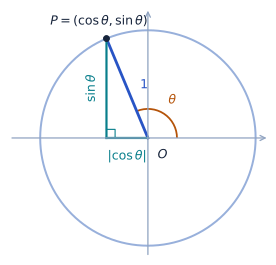
At the unit-circle point , Pythagoras gives . The cosine is negative and the sine is positive in the second quadrant, and both squares are non-negative.
The point has coordinates on a circle of radius . Pythagoras uses the squares of both coordinates, including when one coordinate is negative.Worked example
Find the exact value of .
Match the whole expression to the rearranged identity.
Square the numerator and the denominator.
If you need a ratio rather than its square, the identity gives two possible signs. The quadrant decides which sign is correct. Do not choose a sign from the square alone.
Worked example
Given and , find and .
Use the identity before taking a square root.
The angle is in the second quadrant, where sine is positive.
Divide the signed sine value by the signed cosine value.
Section 2 of 6 · Core · about 5 min
On the unit circle, tangent is the vertical coordinate divided by the horizontal coordinate. A point directly above or below the centre has horizontal coordinate zero, so this ratio cannot be formed.

Worked example
Simplify , stating the restriction.
Cancel the common numerical factor first.
Replace the complete sine-over-cosine ratio.
Sometimes the original expression has more than one restriction. In , tangent must first exist, so . It must also be non-zero because it is the denominator, so . On this domain,
Section 3 of 6 · Core · about 8 min
Inspect the target before expanding. Look for , , or a quotient of sine and cosine. These patterns often turn an expression into factors you can cancel.
Worked example
Simplify .
The original expression requires .
A quotient has no value when its denominator is zero.
The identity supplies a common factor. Cancel it only on the stated domain.
The difference of squares is useful too:
This is ordinary algebra with a trigonometric expression in place of a number.
Worked example
Simplify .
Both denominators must be non-zero. Thus and , equivalently .
Use the product of the two denominators. Multiply each numerator by its missing factor.
The sine terms cancel in the numerator. Apply the identity in the denominator.
Section 4 of 6 · Core · about 8 min
Begin with one side, usually the more complicated side. Rewrite it with justified steps until it becomes the other side. Write an equality only when the expressions on that line are equal on the stated domain.
A numerical check can detect an error, but it cannot prove that an identity holds for every allowed angle.
Worked example
Prove that , for .
Start from the left side and replace tangent by its ratio.
The cancellation is valid because ; then apply the circle identity.
The result is the right side, so the proof is complete on the stated domain.
This relationship is derived from the two basic identities; it need not be a new memorised rule.
Worked example
Prove that , on the common domain .
Combine the fractions on the left side.
Expand the square, then replace the sum of squares by one.
On the stated domain, as well, so cancellation is valid.
Section 5 of 6 · Core · about 7 min
Yes. Simplifying preserves values where the original expression exists. The new formula may also exist at extra angles. Those extra values do not automatically belong to the original expression.
Worked example
Let . Simplify it and decide whether exists.
The original denominator requires .
Keep the original restriction after cancellation.
At , the original numerator and denominator are both zero. Division by zero is undefined. Therefore does not exist.
This is the value of the extended rule at the missing point, not a value of the original function.

For example, holds when . At , the left side exists and equals , but the right side is undefined. That angle is outside the common domain.
Section 6 of 6 · Core · about 5 min
When solving an equation, a factor may be zero. Dividing by that factor can remove valid solutions. Bring all terms to one side and factor first.
Worked example
Rewrite as two possible conditions. Do not find the angles yet.
Move everything to one side.
Factor out the common sine factor without dividing by it.
A product is zero when at least one factor is zero.
Dividing the original equation by immediately would keep only the cosine condition and lose the sine-zero branch.

Question 1 of 4
0 / 4 checked in this collection
Simplify as a polynomial in . Give every excluded x in .
Progress stays in this browser. Create an account to save it or sign in.
Show your working on paper and compare it with the worked solution and marking guidance.
Given and , find exact values of , and . Show your working.
Find the cosine square, then apply the fourth-quadrant sign before forming the quotients.
Cosine is positive in the fourth quadrant.
Prove that , on its common domain.
Write the proof on paper. Then choose the simplified numerator after combining the left-hand fractions, the final expression, and the common-domain restriction.
Use denominator , then expand the squared bracket in the numerator.
The common domain requires . This also ensures , so every original denominator and cancelled factor is non-zero.
For , let .
Factor . The original denominator is zero whenever . Check both endpoints.
On the stated closed interval, at and at . Both angles are excluded from .
The extended rule has this value at each missing point, while the original quotient is undefined.
Your review plan starts after your first check.