Maths4UBETA

Trigonometric quadratics and complete angle sets

Solve the algebra, reject impossible ratio values and recover every permitted angle.

Try the quick check →
Lesson 5 of 5

Section 1 of 6 · Core · about 6 min

How does substitution turn the equation into a quadratic?

When the same trigonometric expression appears squared and unsquared, temporarily treat it as one number. For example, with t=sin⁡xt=\sin x, the expression 2sin⁡2x−3sin⁡x+12\sin^2x-3\sin x+1 becomes 2t2−3t+12t^2-3t+1.

After solving for the temporary variable, return to the trigonometric ratio and find every angle in the stated interval. Keep these as two separate stages.

Worked example

Two sine values, three angles

Solve 2sin⁡2x−3sin⁡x+1=02\sin^2x-3\sin x+1=0 for 0≤x≤2π0\le x\le2\pi.

  1. Put t=sin⁡xt=\sin x, so 2t2−3t+1=(2t−1)(t−1)=02t^2-3t+1=(2t-1)(t-1)=0.

  2. The algebra gives t=12t=\frac{1}{2} or t=1t=1. Both lie in the sine range [−1,1][-1,1].

  3. For sin⁡x=12\sin x=\frac{1}{2}, the angles are π6,5π6\frac{\pi}{6},\frac{5\pi}{6}. For sin⁡x=1\sin x=1, the angle is π2\frac{\pi}{2}.

  4. The complete set is {π6,π2,5π6}\left\{\frac{\pi}{6},\frac{\pi}{2},\frac{5\pi}{6}\right\}.

Your turn

Solve 2cos⁡2x+cos⁡x−1=02\cos^2x+\cos x-1=0 for 0∘≤x<360∘0^\circ\le x<360^\circ.

Give the complete set: {1, 4} for separate values, (1, 5] for an interval, U for union or empty for no real solutions. Use sqrt(...) for exact roots.

Section 2 of 6 · Core · about 7 min

Which quadratic roots can become angles?

The polynomial may produce values that no sine or cosine can take. Keep only values in [−1,1][-1,1] for those two ratios. Tangent has no such bounded range, but its angle must still avoid undefined inputs.

The number of algebraic roots is not the number of angle solutions. Each valid ratio value can occur at several angles, and a repeated algebraic root is processed only once.
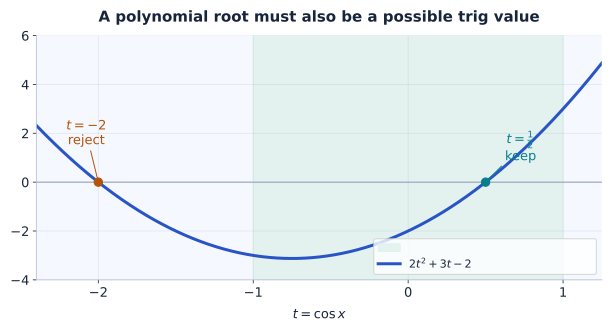
The roots are negative two and one half. The range from negative one to one is shaded; only one half is allowed for cosine.

The shaded interval shows −1≤cos⁡x≤1-1\le\cos x\le1. Of the polynomial roots t=−2t=-2 and t=12t=\frac12, only the latter is a possible cosine value.

The polynomial 2t2+3t−22t^2+3t-2 has two real roots, but only t=12t=\frac{1}{2} lies in the cosine range [−1,1][-1,1].

Worked example

An impossible cosine value

Solve 2cos⁡2x+3cos⁡x−2=02\cos^2x+3\cos x-2=0 for 0≤x≤2π0\le x\le2\pi.

  1. With t=cos⁡xt=\cos x, factor 2t2+3t−2=(2t−1)(t+2)=02t^2+3t-2=(2t-1)(t+2)=0.

  2. The values are t=12t=\frac{1}{2} and t=−2t=-2. Reject −2-2, because cosine cannot be less than −1-1.

  3. For cos⁡x=12\cos x=\frac{1}{2}, the interval solutions are x=π3x=\frac{\pi}{3} and x=5π3x=\frac{5\pi}{3}.

Your turn

Solve cos⁡2x−4cos⁡x+3=0\cos^2x-4\cos x+3=0 for 0≤x≤2π0\le x\le2\pi.

Give the complete set: {1, 4} for separate values, (1, 5] for an interval, U for union or empty for no real solutions. Use sqrt(...) for exact roots.

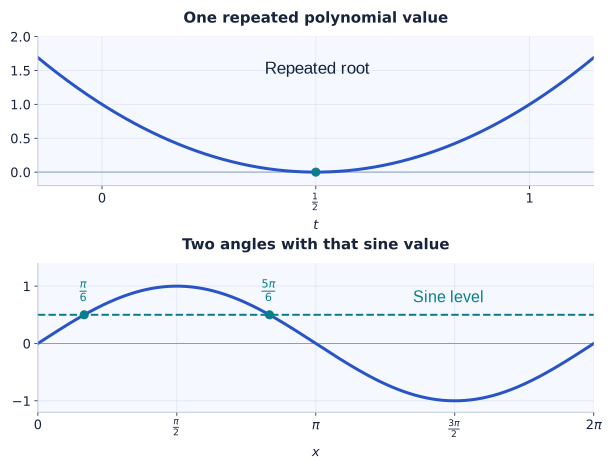
A quadratic touches its axis at one half. A sine graph below meets the corresponding level at pi over six and five pi over six.

The repeated polynomial root from (2t−1)2=0(2t-1)^2=0 is t=12t=\frac12. When t=sin⁡xt=\sin x, it corresponds to two distinct angles on one complete turn.

One repeated polynomial root, t=12t=\frac{1}{2}, still gives two sine angles in one full turn.

Worked example

A repeated root is not one angle

Solve (2sin⁡x−1)2=0(2\sin x-1)^2=0 for 0≤x≤2π0\le x\le2\pi.

  1. The squared factor is zero only when 2sin⁡x−1=02\sin x-1=0, so sin⁡x=12\sin x=\frac{1}{2}.

  2. The ratio value is repeated algebraically, but the sine graph reaches that value at π6\frac{\pi}{6} and 5π6\frac{5\pi}{6}.

  3. List each angle once: {π6,5π6}\left\{\frac{\pi}{6},\frac{5\pi}{6}\right\}.

Your turn

Solve 4sin⁡2x+4sin⁡x+1=04\sin^2x+4\sin x+1=0 for 0≤x<2π0\le x<2\pi.

Give the complete set: {1, 4} for separate values, (1, 5] for an interval, U for union or empty for no real solutions. Use sqrt(...) for exact roots.

Section 3 of 6 · Core · about 7 min

How do I combine sine and cosine safely?

A squared ratio can often be replaced by the basic identity. If the unsquared term is cosine, use sin⁡2x=1−cos⁡2x\sin^2x=1-\cos^2x. If it is sine, use cos⁡2x=1−sin⁡2x\cos^2x=1-\sin^2x. This leaves a quadratic in just one ratio.

Do not replace sin⁡x\sin x by 1−cos⁡x1-\cos x. The identity concerns the squares.

Worked example

Convert the squared ratio

Solve 2sin⁡2x+3cos⁡x=02\sin^2x+3\cos x=0 for 0∘≤x≤360∘0^\circ\le x\le360^\circ.

  1. Replace the squared sine: 2(1−cos⁡2x)+3cos⁡x=02(1-\cos^2x)+3\cos x=0.

  2. Rearrange and factor: 2cos⁡2x−3cos⁡x−2=(2cos⁡x+1)(cos⁡x−2)=02\cos^2x-3\cos x-2=(2\cos x+1)(\cos x-2)=0.

  3. The values are cos⁡x=−12\cos x=-\frac{1}{2} and cos⁡x=2\cos x=2. Reject the second.

  4. Negative cosine with reference angle 60∘60^\circ gives x=120∘,240∘x=120^\circ,240^\circ.

Your turn

Solve 2cos⁡2x−3sin⁡x=02\cos^2x-3\sin x=0 for 0≤x≤2π0\le x\le2\pi.

Give the complete set: {1, 4} for separate values, (1, 5] for an interval, U for union or empty for no real solutions. Use sqrt(...) for exact roots.

Worked example

A quadratic in tangent

Solve tan⁡2x−3tan⁡x+2=0\tan^2x-3\tan x+2=0 for 0≤x<π0\le x<\pi. Give exact answers, allowing inverse trigonometric notation.

  1. Factor (tan⁡x−1)(tan⁡x−2)=0(\tan x-1)(\tan x-2)=0. Both ratio values are possible for tangent.

  2. The branch tan⁡x=1\tan x=1 gives x=π4x=\frac{\pi}{4}. The branch tan⁡x=2\tan x=2 gives x=tan⁡−1(2)x=\tan^{-1}(2).

  3. Both angles lie in the first quadrant. Adding a tangent period would leave the interval. The complete set is {π4,tan⁡−1(2)}\left\{\frac{\pi}{4},\tan^{-1}(2)\right\}.

Your turn

Solve tan⁡2x−1=0\tan^2x-1=0 for 0≤x<2π0\le x<2\pi.

Give the complete set: {1, 4} for separate values, (1, 5] for an interval, U for union or empty for no real solutions. Use sqrt(...) for exact roots.

Section 4 of 6 · Core · about 6 min

How do I keep roots when a factor can be zero?

When a trigonometric factor occurs on both sides, bring everything to one side and factor. The zero-product rule keeps every branch. Dividing by a factor assumes it is nonzero and can remove valid angles.

Worked example

A shared angle from two factors

Solve sin⁡xcos⁡x=cos⁡x\sin x\cos x=\cos x for 0≤x≤2π0\le x\le2\pi.

  1. Rearrange to cos⁡x(sin⁡x−1)=0\cos x(\sin x-1)=0.

  2. For cos⁡x=0\cos x=0, the angles are π2\frac{\pi}{2} and 3π2\frac{3\pi}{2}. For sin⁡x=1\sin x=1, the angle is π2\frac{\pi}{2}.

  3. Combine the branches and remove the repeated entry: x∈{π2,3π2}x\in\left\{\frac{\pi}{2},\frac{3\pi}{2}\right\}.

  4. Direct substitution confirms both. Dividing by cosine at the start would assume away its zero branch.
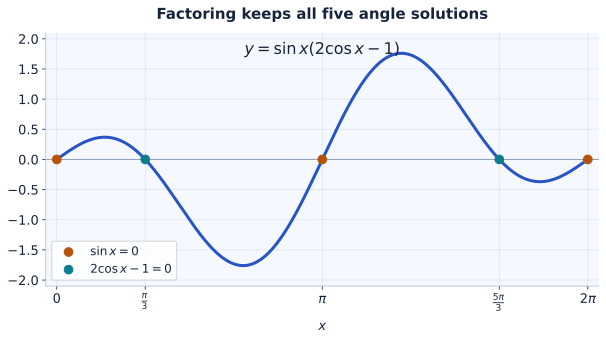
The factored expression has zeros at zero, pi over three, pi, five pi over three and two pi. Three zeros come from the sine factor.

The equation 2sin⁡xcos⁡x−sin⁡x=02\sin x\cos x-\sin x=0 has five roots on [0,2π][0,2\pi]. The zero-sine branch supplies three of them.

Your turn

Solve 2sin⁡xcos⁡x=sin⁡x2\sin x\cos x=\sin x for 0≤x≤2π0\le x\le2\pi.

Give the complete set: {1, 4} for separate values, (1, 5] for an interval, U for union or empty for no real solutions. Use sqrt(...) for exact roots.

Section 5 of 6 · Further applications · about 8 min

How do denominators and squaring change the final check?

A fraction is zero when its numerator is zero and its denominator is nonzero. Record the original denominator restriction before multiplying or cancelling. A simplified expression does not restore an angle excluded by the original one.

Worked example

A factor that must not be zero

Solve 2sin⁡2x−sin⁡xsin⁡x=0\frac{2\sin^2x-\sin x}{\sin x}=0 for 0≤x≤2π0\le x\le2\pi.

  1. The original denominator requires sin⁡x≠0\sin x\ne0, excluding 0,π,2π0,\pi,2\pi.

  2. Factor the numerator: sin⁡x(2sin⁡x−1)sin⁡x=0\frac{\sin x(2\sin x-1)}{\sin x}=0. On the allowed domain, cancel to get 2sin⁡x−1=02\sin x-1=0.

  3. Thus sin⁡x=12\sin x=\frac{1}{2}, so x=π6x=\frac{\pi}{6} or x=5π6x=\frac{5\pi}{6}. Both satisfy the original restriction.

Your turn

Solve cos⁡2x−cos⁡xcos⁡x=0\frac{\cos^2x-\cos x}{\cos x}=0 for −π≤x≤π-\pi\le x\le\pi.

Give the complete set: {1, 4} for separate values, (1, 5] for an interval, U for union or empty for no real solutions. Use sqrt(...) for exact roots.

Squaring an equation can add candidates because it removes sign information. It is a useful algebraic step only if every candidate is checked in the original equation.
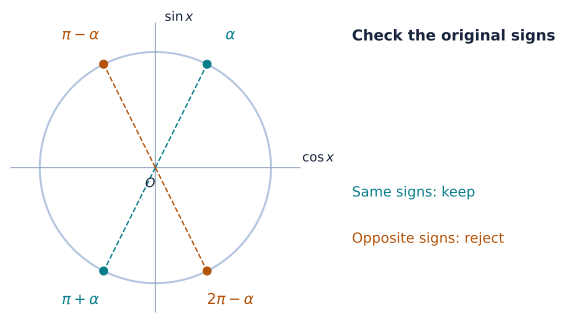
Four unit-circle candidates arise after squaring. The first and third quadrant points have matching sine and cosine signs and satisfy the original equation.

After squaring sin⁡x=2cos⁡x\sin x=2\cos x, check the original signs. With α=tan⁡−12\alpha=\tan^{-1}2, keep α\alpha and π+α\pi+\alpha because the sine and cosine signs agree. The other two candidates have opposite signs.

Squaring sin⁡x=2cos⁡x\sin x=2\cos x finds four candidate points. Only the two where sine and cosine have the same sign satisfy the original equation.

Worked example

Squaring creates two extra candidates

Solve sin⁡x=2cos⁡x\sin x=2\cos x for 0≤x≤2π0\le x\le2\pi. Give exact answers using inverse trigonometric notation.

  1. Squaring gives sin⁡2x=4cos⁡2x\sin^2x=4\cos^2x. Use the identity to obtain cos⁡2x=15\cos^2x=\frac{1}{5}.

  2. Let α=tan⁡−1(2)\alpha=\tan^{-1}(2), an acute angle. The squared equation has candidates α,π−α,π+α,2π−α\alpha,\pi-\alpha,\pi+\alpha,2\pi-\alpha.

  3. The original equation requires sine and cosine to have the same sign. Keep the first and third quadrants; reject the other two.

  4. Therefore x=tan⁡−1(2)x=\tan^{-1}(2) or x=π+tan⁡−1(2)x=\pi+\tan^{-1}(2). Alternatively, first show cosine cannot be zero, then divide safely to obtain tan⁡x=2\tan x=2.

Your turn

Solve sin⁡x=cos⁡x\sin x=\cos x for 0≤x<2π0\le x<2\pi.

Give the complete set: {1, 4} for separate values, (1, 5] for an interval, U for union or empty for no real solutions. Use sqrt(...) for exact roots.

Section 6 of 6 · Further applications · about 9 min

How do I combine a transformed argument and the quadratic formula?

Use the same order even when the algebra does not factor neatly: transform the angle interval, solve the polynomial in a ratio value, reject impossible values, find all allowed angles, and undo the argument.

Two temporary variables can help: one for the angle and one for its trigonometric value. Name their roles clearly.

Worked example

A quadratic formula inside a doubled angle

Solve 2cos⁡2(2x)+cos⁡(2x)−2=02\cos^2(2x)+\cos(2x)-2=0 for 0≤x≤π0\le x\le\pi. Give radians to three decimal places.

  1. Let u=2xu=2x, so 0≤u≤2π0\le u\le2\pi. Then let t=cos⁡ut=\cos u.

  2. Solve 2t2+t−2=02t^2+t-2=0: t=−1±174t=\frac{-1\pm\sqrt{17}}{4}. Only t=−1+174t=\frac{-1+\sqrt{17}}{4} lies in [−1,1][-1,1].

  3. Store α=cos⁡−1(−1+174)\alpha=\cos^{-1}\left(\frac{-1+\sqrt{17}}{4}\right). The two transformed angles are u=αu=\alpha and u=2π−αu=2\pi-\alpha.

  4. Return to xx: x=α2x=\frac{\alpha}{2} or x=π−α2x=\pi-\frac{\alpha}{2}. To three decimal places, x=0.337x=0.337 or x=2.804x=2.804.

Your turn

Solve 2sin⁡2(3x)−3sin⁡(3x)+1=02\sin^2(3x)-3\sin(3x)+1=0 for 0≤x≤π0\le x\le\pi.

Give the complete set: {1, 4} for separate values, (1, 5] for an interval, U for union or empty for no real solutions. Use sqrt(...) for exact roots.

Worked examples

Practise the method

Core practice

Question 1 of 4

0 / 4 checked in this collection

Question list

Core practice

Fresh variants

Exam-style

Polynomial roots and all angles

2 marks

With u=cos⁡xu=\cos x, solve 2u2+u−1=02 u^{2} + u - 1=0 and give every x in [0,2π)[0,2\pi).

Give the complete set: {1, 4} for separate values, (1, 5] for an interval, U for union or empty for no real solutions. Use sqrt(...) for exact roots.

Give the complete set: {1, 4} for separate values, (1, 5] for an interval, U for union or empty for no real solutions. Use sqrt(...) for exact roots.

Full answer-format guide

Exact numbers: 3/2, sqrt(5), 2-sqrt(3), pi/6, 3*pi/2. Sets: {1,4}. Intervals: (3,5]; a round bracket excludes the endpoint. Infinity: inf; union: U; no solutions: empty. Separate coordinate pairs or triples with semicolons. Expressions: 2x^2+3x-1; equations: x^2=3x+1 or the polynomial equal to zero. Factors: x-1 ; x+2. Parameter fraction: numerator ; denominator. List integer answers individually.

Review the method

Progress stays in this browser. Create an account to save it or sign in.

Extra practice from this lesson

A positive and a negative sine value

Solve 2sin⁡2x+sin⁡x−1=02\sin^2x+\sin x-1=0 for 0∘≤x≤360∘0^\circ\le x\le360^\circ.

Give the complete set: {1, 4} for separate values, (1, 5] for an interval, U for union or empty for no real solutions. Use sqrt(...) for exact roots.

Cosine branches across zero

Solve 2cos⁡2x−3cos⁡x+1=02\cos^2x-3\cos x+1=0 for −π≤x≤π-\pi\le x\le\pi.

Give the complete set: {1, 4} for separate values, (1, 5] for an interval, U for union or empty for no real solutions. Use sqrt(...) for exact roots.

No real ratio root

Solve sin⁡2x+sin⁡x+1=0\sin^2x+\sin x+1=0 for 0≤x≤2π0\le x\le2\pi.

Give the complete set: {1, 4} for separate values, (1, 5] for an interval, U for union or empty for no real solutions. Use sqrt(...) for exact roots.

One repeated cosine value

Solve 4cos⁡2x−4cos⁡x+1=04\cos^2x-4\cos x+1=0 for 0≤x<2π0\le x<2\pi.

Give the complete set: {1, 4} for separate values, (1, 5] for an interval, U for union or empty for no real solutions. Use sqrt(...) for exact roots.

Identity and approximate angles

Solve 3sin⁡2x+cos⁡x−1=03\sin^2x+\cos x-1=0 for 0∘≤x≤360∘0^\circ\le x\le360^\circ. Give non-integer angles to one decimal place.

Give the complete set: {1, 4} for separate values, (1, 5] for an interval, U for union or empty for no real solutions. Use sqrt(...) for exact roots.

An unrestricted tangent value

Solve tan⁡2x+2tan⁡x−3=0\tan^2x+2\tan x-3=0 for −π2<x<π2-\frac{\pi}{2}<x<\frac{\pi}{2}. Give exact answers, allowing inverse trigonometric notation.

Give all exact angles. You can type asin, acos or atan.

Two factors on a symmetric interval

Solve sin⁡x(2cos⁡x+1)=0\sin x(2\cos x+1)=0 for −π≤x≤π-\pi\le x\le\pi.

Give the complete set: {1, 4} for separate values, (1, 5] for an interval, U for union or empty for no real solutions. Use sqrt(...) for exact roots.

A cancelled branch is forbidden

Solve 2cos⁡2x+cos⁡x−12cos⁡x−1=0\frac{2\cos^2x+\cos x-1}{2\cos x-1}=0 for 0≤x≤2π0\le x\le2\pi.

Give the complete set: {1, 4} for separate values, (1, 5] for an interval, U for union or empty for no real solutions. Use sqrt(...) for exact roots.

Restore the lost sign information

Solve sin⁡x=−cos⁡x\sin x=-\cos x for 0∘≤x<360∘0^\circ\le x<360^\circ.

Give the complete set: {1, 4} for separate values, (1, 5] for an interval, U for union or empty for no real solutions. Use sqrt(...) for exact roots.

Use the quadratic formula

Solve 2sin⁡2x+2sin⁡x−1=02\sin^2x+2\sin x-1=0 for 0≤x≤π0\le x\le\pi. Give radians to three decimal places.

Give the complete set: {1, 4} for separate values, (1, 5] for an interval, U for union or empty for no real solutions. Use sqrt(...) for exact roots.

Apply it · original exam-style problems

Show your working on paper and compare it with the worked solution and marking guidance.

Start after this lesson

A shifted quadratic in cosine 6 marks

Solve 2cos⁡2(2x−π3)+3cos⁡(2x−π3)+1=02\cos^2\left(2x-\frac{\pi}{3}\right)+3\cos\left(2x-\frac{\pi}{3}\right)+1=0 for 0≤x≤π0\le x\le\pi.

Hint

Keep the two ratio branches separate until each interval search is complete.

Worked solution
  1. Let u=2x−π3u=2x-\frac{\pi}{3}, so −π3≤u≤5π3-\frac{\pi}{3}\le u\le\frac{5\pi}{3}.

  2. Factor (2cos⁡u+1)(cos⁡u+1)=0(2\cos u+1)(\cos u+1)=0, giving cos⁡u=−12\cos u=-\frac{1}{2} or cos⁡u=−1\cos u=-1.

  3. The transformed angles are u=2π3,π,4π3u=\frac{2\pi}{3},\pi,\frac{4\pi}{3}. Apply x=u+π32x=\frac{u+\frac{\pi}{3}}{2} to each.

  4. Therefore x∈{π2, 2π3, 5π6}x\in \left\{\frac{\pi}{2},\ \frac{2 \pi}{3},\ \frac{5 \pi}{6}\right\} radians.

    Keep every valid angle and list a repeated angle only once.

Marking guidance
  • 1 mark: let u=2x−π3u=2x-\frac{\pi}{3} and obtain −π3≤u≤5π3-\frac{\pi}{3}\le u\le\frac{5\pi}{3}.
  • 1 mark: factor the quadratic as (2cos⁡u+1)(cos⁡u+1)=0(2\cos u+1)(\cos u+1)=0.
  • 1 mark: obtain both valid branches, cos⁡u=−12\cos u=-\frac{1}{2} and cos⁡u=−1\cos u=-1.
  • 1 mark: find all transformed angles u=2π3,π,4π3u=\frac{2\pi}{3},\pi,\frac{4\pi}{3}.
  • 1 mark: apply x=u+π32x=\frac{u+\frac{\pi}{3}}{2} to every angle.
  • 1 mark: give the complete exact set {π2,2π3,5π6}\left\{\frac{\pi}{2},\frac{2\pi}{3},\frac{5\pi}{6}\right\}.
Preserve the zero-sine branch 5 marks

Solve sin⁡2x=sin⁡xcos⁡x\sin^2x=\sin x\cos x for 0≤x≤2π0\le x\le2\pi.

Hint

Move everything to one side and use the zero-product rule.

Worked solution
  1. Factor sin⁡x(sin⁡x−cos⁡x)=0\sin x(\sin x-\cos x)=0.

  2. The first branch gives x=0,π,2πx=0,\pi,2\pi. The second requires equal sine and cosine, giving π4,5π4\frac{\pi}{4},\frac{5\pi}{4}.

  3. Combine both branches. Dividing by sine at the start would remove three valid angles.

  4. Therefore x∈{0, π4, π, 5π4, 2π}x\in \left\{0,\ \frac{\pi}{4},\ \pi,\ \frac{5 \pi}{4},\ 2 \pi\right\} radians.

    Keep every valid angle and list a repeated angle only once.

Marking guidance
  • 1 mark: rearrange and factor to sin⁡x(sin⁡x−cos⁡x)=0\sin x(\sin x-\cos x)=0.
  • 1 mark: keep the zero-sine branch x=0,π,2πx=0,\pi,2\pi, including both endpoints.
  • 1 mark: solve the other branch sin⁡x=cos⁡x\sin x=\cos x by a valid method.
  • 1 mark: obtain both additional angles x=π4,5π4x=\frac{\pi}{4},\frac{5\pi}{4}.
  • 1 mark: combine all five valid angles and list each once.
A denominator removes one quadratic branch 5 marks

Solve 2sin⁡2x+sin⁡x−1sin⁡x+1=0\frac{2\sin^2x+\sin x-1}{\sin x+1}=0 for −π≤x≤π-\pi\le x\le\pi.

Hint

A zero numerator does not make an undefined fraction equal to zero.

Worked solution
  1. The original denominator requires sin⁡x≠−1\sin x\ne-1, excluding x=−π2x=-\frac{\pi}{2} in this interval.

  2. The numerator factors as (2sin⁡x−1)(sin⁡x+1)(2\sin x-1)(\sin x+1). Only the branch sin⁡x=12\sin x=\frac{1}{2} remains allowed.

  3. The two allowed angles are π6\frac{\pi}{6} and 5π6\frac{5\pi}{6}; both make the denominator nonzero.

  4. Therefore x∈{π6, 5π6}x\in \left\{\frac{\pi}{6},\ \frac{5 \pi}{6}\right\} radians.

    Keep every valid angle and list a repeated angle only once.

Marking guidance
  • 1 mark: state the original restriction sin⁡x≠−1\sin x\ne-1.
  • 1 mark: factor the numerator as (2sin⁡x−1)(sin⁡x+1)(2\sin x-1)(\sin x+1).
  • 1 mark: reject the forbidden branch sin⁡x=−1\sin x=-1 and retain sin⁡x=12\sin x=\frac{1}{2}.
  • 1 mark: find both angles in the stated interval, π6\frac{\pi}{6} and 5π6\frac{5\pi}{6}.
  • 1 mark: give the complete set and confirm that neither angle makes the original denominator zero.
Two quadratic-formula branches in a reversed interval 7 marks

Solve 3cos⁡2(60∘−2x)−cos⁡(60∘−2x)−1=03\cos^2(60^\circ-2x)-\cos(60^\circ-2x)-1=0 for 0∘≤x≤180∘0^\circ\le x\le180^\circ. Give answers to one decimal place.

Hint

Both quadratic roots are possible. Each must be searched on the reversed transformed interval.

Worked solution
  1. Let u=60∘−2xu=60^\circ-2x, giving −300∘≤u≤60∘-300^\circ\le u\le60^\circ. Put t=cos⁡ut=\cos u.

  2. The quadratic formula gives t=1±136t=\frac{1\pm\sqrt{13}}{6}. Both values lie in [−1,1][-1,1].

  3. In degree mode, store α=cos⁡−1(1+136)\alpha=\cos^{-1}\left(\frac{1+\sqrt{13}}{6}\right) and β=cos⁡−1(1−136)\beta=\cos^{-1}\left(\frac{1-\sqrt{13}}{6}\right).

  4. The interval contains u=α,−α,−β,β−360∘u=\alpha,-\alpha,-\beta,\beta-360^\circ. Use x=60∘−u2x=\frac{60^\circ-u}{2} for each, then round.

  5. Therefore x∈{10.1, 49.9, 87.9, 152.1}x\in \left\{10.1,\ 49.9,\ 87.9,\ 152.1\right\} degrees.

    Keep every valid angle and list a repeated angle only once.

Marking guidance
  • 1 mark: let u=60∘−2xu=60^\circ-2x and order the transformed interval as −300∘≤u≤60∘-300^\circ\le u\le60^\circ.
  • 1 mark: use the quadratic formula on 3t2−t−1=03t^2-t-1=0, where t=cos⁡ut=\cos u.
  • 1 mark: obtain t=1+136t=\frac{1+\sqrt{13}}{6} and t=1−136t=\frac{1-\sqrt{13}}{6}, retaining both valid values.
  • 1 mark: find the two principal inverse-cosine values in degree mode and retain their full precision.
  • 1 mark: identify all four allowed transformed angles across the negative-to-positive interval.
  • 1 mark: apply x=60∘−u2x=\frac{60^\circ-u}{2} to all four angles.
  • 1 mark: give all four original angles to one decimal place, checking the original interval.

Come back to what needs practice

Quick revision sheet (A4)

Your review plan starts after your first check.

Question bank and saved work