Maths4UBETA

Exact ratios, quadrants and principal inverse values

Use exact values and coordinate signs, then distinguish a principal inverse value from every solution.

Try the quick check →
Lesson 1 of 5

Section 1 of 6 · Core · about 5 min

How do I choose the correct ratio?

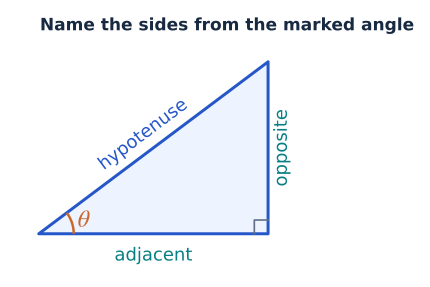
Choose the acute angle θ\theta first. The opposite side faces this angle. The adjacent side touches it and is not the hypotenuse. The side names can change when you choose the other acute angle.

Right triangle. Theta is at the left vertex. The adjacent side is horizontal, the opposite side vertical, and the hypotenuse slopes upwards.

Identify the angle before naming its opposite and adjacent sides.

Worked example

Three ratios from one triangle

A right triangle has opposite side 55, adjacent side 1212 and hypotenuse 1313, relative to an acute angle θ\theta. Find its three ratios.

  1. sin⁡θ=513,cos⁡θ=1213.\sin\theta=\frac{5}{13},\qquad\cos\theta=\frac{12}{13}.

    Sine and cosine use the hypotenuse as their denominator.

  2. tan⁡θ=512.\tan\theta=\frac{5}{12}.

    Tangent compares opposite with adjacent.

  3. The sine and cosine values lie between 00 and 11. The side lengths satisfy 52+122=1325^2+12^2=13^2.

    Use the geometry to check the answer.
Your turn

Relative to an acute angle α\alpha, a right triangle has opposite side 88 and hypotenuse 1717. Find the exact values of sin⁡α\sin\alpha, cos⁡α\cos\alpha and tan⁡α\tan\alpha.

Enter an exact number, for example 3/2 or 2-sqrt(3).

Enter an exact number, for example 3/2 or 2-sqrt(3).

Enter an exact number, for example 3/2 or 2-sqrt(3).

Section 2 of 6 · Core · about 6 min

Where do the special-angle values come from?

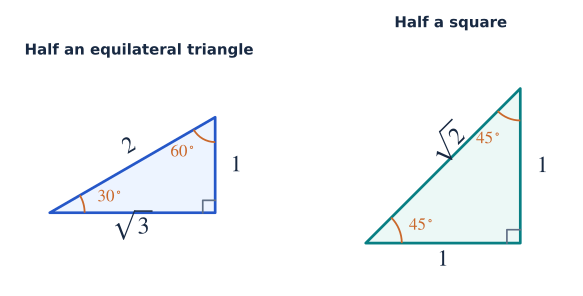
Bisect an equilateral triangle of side 22. Each right triangle has hypotenuse 22, shorter leg 11 and longer leg 22−12=3\sqrt{2^2-1^2}=\sqrt{3}. Its acute angles are 30∘30^\circ and 60∘60^\circ.

A right-isosceles triangle with legs 11 and 11 has hypotenuse 2\sqrt{2}. Each acute angle is 45∘45^\circ.

The thirty-sixty-ninety triangle has sides one, square root of three and two. The forty-five-forty-five-ninety triangle has legs one and hypotenuse square root of two.

These two triangles generate the exact-value table; the ratios do not depend on the size of the triangle.

Worked example

Build three entries instead of guessing

Find sin⁡60∘\sin60^\circ, cos⁡45∘\cos45^\circ and tan⁡30∘\tan30^\circ exactly.

  1. sin⁡60∘=32.\sin60^\circ=\frac{\sqrt{3}}{2}.

    The longer leg is opposite the larger acute angle.

  2. cos⁡45∘=12=22.\cos45^\circ=\frac{1}{\sqrt{2}}=\frac{\sqrt{2}}{2}.

    Multiply numerator and denominator by the same square root to rationalise.

  3. tan⁡30∘=13=33.\tan30^\circ=\frac{1}{\sqrt{3}}=\frac{\sqrt{3}}{3}.

    Use the shorter leg over the longer leg.

Anglesin⁡θ\sin\thetacos⁡θ\cos\thetatan⁡θ\tan\theta
30∘=π630^\circ=\frac{\pi}{6}12\frac{1}{2}32\frac{\sqrt{3}}{2}33\frac{\sqrt{3}}{3}
45∘=π445^\circ=\frac{\pi}{4}22\frac{\sqrt{2}}{2}22\frac{\sqrt{2}}{2}11
60∘=π360^\circ=\frac{\pi}{3}32\frac{\sqrt{3}}{2}12\frac{1}{2}3\sqrt{3}

Your turn

Evaluate 2sin⁡60∘+cos⁡45∘2\sin60^\circ+\cos45^\circ and sin⁡30∘cos⁡60∘\frac{\sin30^\circ}{\cos60^\circ} exactly.

Enter an exact number, for example 3/2 or 2-sqrt(3).

Enter an exact number, for example 3/2 or 2-sqrt(3).

Section 3 of 6 · Core · about 6 min

How do sine and cosine work beyond a right triangle?

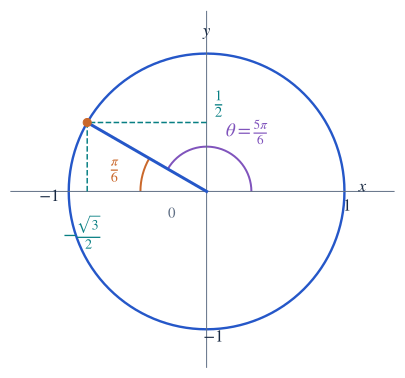
Draw a circle of radius 11 centred at the origin. Start on the positive horizontal axis and turn through θ\theta. Anticlockwise angles are positive. The terminal point has coordinates (cos⁡θ,sin⁡θ)(\cos\theta,\sin\theta).

Cosine is the horizontal coordinate and sine is the vertical coordinate. Their signs follow from the quadrant. Tangent is the vertical coordinate divided by the horizontal coordinate.

The terminal point at five pi over six is negative square root of three over two, one half. A reference angle of pi over six lies between the ray and the negative horizontal axis.

At θ=5π6\theta=\frac{5\pi}{6}, the reference angle is π6\frac\pi6. The terminal point is P=(cos⁡θ,sin⁡θ)=(−32,12)P=(\cos\theta,\sin\theta)=\left(-\frac{\sqrt3}{2},\frac12\right). In quadrant II the cosine is negative and the sine is positive.

At θ=5π6\theta=\frac{5\pi}{6}, cosine is negative and sine is positive. The reference angle is π6\frac{\pi}{6}.
Quadrantsin⁡θ\sin\thetacos⁡θ\cos\thetatan⁡θ\tan\theta
IPositivePositivePositive
IIPositiveNegativeNegative
IIINegativeNegativePositive
IVNegativePositiveNegative

The letters in CAST identify which ratios are positive: cosine in quadrant IV, all three in quadrant I, sine in quadrant II, and tangent in quadrant III. The coordinates explain why.

The reference angle α\alpha is the acute angle between the terminal ray and the horizontal axis. A reflected reference triangle has the same side lengths, so the reference angle gives the ratio’s magnitude. The quadrant supplies its sign.

For a non-axis angle already reduced to one turn:

QuadrantReference angle in radiansReference angle in degrees
Iα=θ\alpha=\thetaα=θ\alpha=\theta
IIα=π−θ\alpha=\pi-\thetaα=180∘−θ\alpha=180^\circ-\theta
IIIα=θ−π\alpha=\theta-\piα=θ−180∘\alpha=\theta-180^\circ
IVα=2π−θ\alpha=2\pi-\thetaα=360∘−θ\alpha=360^\circ-\theta

Worked example

Reference angle first, sign second

Find sin⁡150∘\sin150^\circ, cos⁡240∘\cos240^\circ and tan⁡315∘\tan315^\circ exactly.

  1. 150∘=180∘−30∘,sin⁡150∘=12.150^\circ=180^\circ-30^\circ,\qquad\sin150^\circ=\frac{1}{2}.

    Quadrant II has positive sine.

  2. 240∘=180∘+60∘,cos⁡240∘=−12.240^\circ=180^\circ+60^\circ,\qquad\cos240^\circ=-\frac{1}{2}.

    Quadrant III has negative cosine.

  3. 315∘=360∘−45∘,tan⁡315∘=−1.315^\circ=360^\circ-45^\circ,\qquad\tan315^\circ=-1.

    Quadrant IV has negative tangent.

Your turn

Find sin⁡225∘\sin225^\circ, cos⁡300∘\cos300^\circ and tan⁡120∘\tan120^\circ exactly.

Enter an exact number, for example 3/2 or 2-sqrt(3).

Enter an exact number, for example 3/2 or 2-sqrt(3).

Enter an exact number, for example 3/2 or 2-sqrt(3).

Axis angles need no acute reference triangle. The points at 00, π2\frac{\pi}{2}, π\pi and 3π2\frac{3\pi}{2} are (1,0)(1,0), (0,1)(0,1), (−1,0)(-1,0) and (0,−1)(0,-1). Read the coordinates directly.

Your turn

What is tan⁡π2\tan\frac{\pi}{2}?

Tangent value

Section 5 of 6 · Core · about 6 min

How do I find the other ratios from one ratio?

Use a reference triangle or coordinates on a circle. Pythagoras gives the missing magnitude; the stated quadrant gives its sign. A square root alone does not tell you which side of an axis the point lies on.

On the unit circle, Pythagoras gives cos⁡2θ+sin⁡2θ=1\cos^2\theta+\sin^2\theta=1. We will use this identity more fully in the identities lesson. Here it helps recover one coordinate from the other.

Worked example

A negative cosine in quadrant III

Given cos⁡θ=−725\cos\theta=-\frac{7}{25} and π<θ<3π2\pi<\theta<\frac{3\pi}{2}, find sin⁡θ\sin\theta and tan⁡θ\tan\theta.

  1. ∣sin⁡θ∣=1−(725)2=2425.|\sin\theta|=\sqrt{1-\left(\frac{7}{25}\right)^2}=\frac{24}{25}.

    Pythagoras gives the magnitude of the vertical coordinate.

  2. sin⁡θ=−2425.\sin\theta=-\frac{24}{25}.

    Quadrant III is below the horizontal axis.

  3. tan⁡θ=−2425−725=247.\tan\theta=\frac{-\frac{24}{25}}{-\frac{7}{25}}=\frac{24}{7}.

    Both coordinates are negative, so their quotient is positive.

Worked example

A tangent ratio gives two side magnitudes

Given tan⁡ϕ=−34\tan\phi=-\frac{3}{4} and π2<ϕ<π\frac{\pi}{2}<\phi<\pi, find sin⁡ϕ\sin\phi and cos⁡ϕ\cos\phi.

  1. Use horizontal coordinate −4-4 and vertical coordinate 33, in the given quadrant. The radius is (−4)2+32=5\sqrt{(-4)^2+3^2}=5.

    The coordinate signs, as well as their ratio, must match the angle.

  2. sin⁡ϕ=35,cos⁡ϕ=−45.\sin\phi=\frac{3}{5},\qquad\cos\phi=-\frac{4}{5}.

    Divide each coordinate by the positive radius.

Your turn

Given sin⁡α=−1213\sin\alpha=-\frac{12}{13} and 3π2<α<2π\frac{3\pi}{2}<\alpha<2\pi, find cos⁡α\cos\alpha and tan⁡α\tan\alpha.

Enter an exact number, for example 3/2 or 2-sqrt(3).

Enter an exact number, for example 3/2 or 2-sqrt(3).

Section 6 of 6 · Core · about 9 min

Which angle does an inverse function return?

Many angles can have the same sine, cosine or tangent. An inverse function must return one value, so each inverse uses a fixed principal range. For example, sin⁡−112=π6\sin^{-1}\frac{1}{2}=\frac{\pi}{6}, although sin⁡5π6=12\sin\frac{5\pi}{6}=\frac{1}{2} too.

InverseAllowed inputPrincipal output in radiansPrincipal output in degrees
sin⁡−1t\sin^{-1}t−1≤t≤1-1\le t\le1−π2≤θ≤π2-\frac{\pi}{2}\le\theta\le\frac{\pi}{2}−90∘≤θ≤90∘-90^\circ\le\theta\le90^\circ
cos⁡−1t\cos^{-1}t−1≤t≤1-1\le t\le10≤θ≤π0\le\theta\le\pi0∘≤θ≤180∘0^\circ\le\theta\le180^\circ
tan⁡−1t\tan^{-1}tEvery real input−π2<θ<π2-\frac{\pi}{2}<\theta<\frac{\pi}{2}−90∘<θ<90∘-90^\circ<\theta<90^\circ

Inverse sine and cosine accept inputs from negative one to one, inclusive. Their principal angle ranges are closed. Inverse tangent accepts every real input and approaches, but never reaches, positive or negative pi over two.

Principal angleAllowed inputsAngle range
sin⁡−1t\sin^{-1}t[−1,1][-1,1][−π2,π2]\left[-\frac\pi2,\frac\pi2\right]
cos⁡−1t\cos^{-1}t[−1,1][-1,1][0,π][0,\pi]
tan⁡−1t\tan^{-1}tR\mathbb R(−π2,π2)\left(-\frac\pi2,\frac\pi2\right)
Each inverse returns only angles in its principal range. The tangent-inverse endpoints are never reached.

Worked example

Check the principal range

Find sin⁡−1(−22)\sin^{-1}\left(-\frac{\sqrt{2}}{2}\right), cos⁡−1(−32)\cos^{-1}\left(-\frac{\sqrt{3}}{2}\right) and tan⁡−1(−1)\tan^{-1}(-1) in radians.

  1. sin⁡−1(−22)=−π4.\sin^{-1}\left(-\frac{\sqrt{2}}{2}\right)=-\frac{\pi}{4}.

    Inverse sine allows a negative angle in quadrant IV.

  2. cos⁡−1(−32)=5π6.\cos^{-1}\left(-\frac{\sqrt{3}}{2}\right)=\frac{5\pi}{6}.

    Inverse cosine returns the quadrant II angle between zero and a half-turn.

  3. tan⁡−1(−1)=−π4.\tan^{-1}(-1)=-\frac{\pi}{4}.

    The positive quadrant II angle is outside the principal tangent range.

Your turn

Find the principal values of cos⁡−1(−12)\cos^{-1}\left(-\frac{1}{2}\right), sin⁡−132\sin^{-1}\frac{\sqrt{3}}{2} and tan⁡−1(−3)\tan^{-1}(-\sqrt{3}), in radians.

Enter an exact number, for example 3/2 or 2-sqrt(3).

Enter an exact number, for example 3/2 or 2-sqrt(3).

Enter an exact number, for example 3/2 or 2-sqrt(3).

Worked example

A triangle inside an inverse composition

Evaluate cos⁡(sin⁡−1(−513))\cos\left(\sin^{-1}\left(-\frac{5}{13}\right)\right) exactly.

  1. Let u=sin⁡−1(−513)u=\sin^{-1}\left(-\frac{5}{13}\right). Then sin⁡u=−513\sin u=-\frac{5}{13} and −π2<u<0-\frac{\pi}{2}<u<0.

    The inverse range fixes the angle in quadrant IV.

  2. cos⁡u=1−(−513)2=1213.\cos u=\sqrt{1-\left(-\frac{5}{13}\right)^2}=\frac{12}{13}.

    Cosine is positive throughout this principal quadrant.

  3. cos⁡(sin⁡−1(−513))=1213.\cos\left(\sin^{-1}\left(-\frac{5}{13}\right)\right)=\frac{12}{13}.

    No rounded angle was needed.

Your turn

Evaluate tan⁡(cos⁡−1(−513))\tan\left(\cos^{-1}\left(-\frac{5}{13}\right)\right) exactly.

Enter an exact number, for example 3/2 or 2-sqrt(3).

Worked example

The order of composition matters

Evaluate sin⁡−1(sin⁡7π6)\sin^{-1}\left(\sin\frac{7\pi}{6}\right), cos⁡−1(cos⁡7π3)\cos^{-1}\left(\cos\frac{7\pi}{3}\right) and tan⁡−1(tan⁡3π4)\tan^{-1}\left(\tan\frac{3\pi}{4}\right).

  1. sin⁡7π6=−12,sin⁡−1(−12)=−π6.\sin\frac{7\pi}{6}=-\frac{1}{2},\qquad\sin^{-1}\left(-\frac{1}{2}\right)=-\frac{\pi}{6}.

    The original angle lies outside the inverse-sine range.

  2. cos⁡7π3=12,cos⁡−112=π3.\cos\frac{7\pi}{3}=\frac{1}{2},\qquad\cos^{-1}\frac{1}{2}=\frac{\pi}{3}.

    First evaluate the inner function, then use the principal inverse.

  3. tan⁡3π4=−1,tan⁡−1(−1)=−π4.\tan\frac{3\pi}{4}=-1,\qquad\tan^{-1}(-1)=-\frac{\pi}{4}.

    The inverse does not recover an angle outside its chosen range.

Your turn

Evaluate sin⁡−1(sin⁡5π4)\sin^{-1}\left(\sin\frac{5\pi}{4}\right) in radians.

Enter an exact number, for example 3/2 or 2-sqrt(3).

Worked examples

Practise the method

Core practice

Question 1 of 4

0 / 4 checked in this collection

Question list

Core practice

Fresh variants

Exam-style

Three exact signed ratios

3 marks

Find sin⁡(7π6)\sin(\frac{7 \pi}{6}), cos⁡(5π4)\cos(\frac{5 \pi}{4}), tan⁡(2π3)\tan(\frac{2 \pi}{3}) exactly.

Enter an exact number, for example 3/2 or 2-sqrt(3).

Enter an exact number, for example 3/2 or 2-sqrt(3).

Enter an exact number, for example 3/2 or 2-sqrt(3).

Full answer-format guide

Exact numbers: 3/2, sqrt(5), 2-sqrt(3), pi/6, 3*pi/2. Sets: {1,4}. Intervals: (3,5]; a round bracket excludes the endpoint. Infinity: inf; union: U; no solutions: empty. Separate coordinate pairs or triples with semicolons. Expressions: 2x^2+3x-1; equations: x^2=3x+1 or the polynomial equal to zero. Factors: x-1 ; x+2. Parameter fraction: numerator ; denominator. List integer answers individually.

Review the method

Progress stays in this browser. Create an account to save it or sign in.

Extra practice from this lesson

A triangle from two sides

An acute angle θ\theta in a right triangle has adjacent side 2424 and hypotenuse 2525. Find sin⁡θ\sin\theta and tan⁡θ\tan\theta.

Enter an exact number, for example 3/2 or 2-sqrt(3).

Enter an exact number, for example 3/2 or 2-sqrt(3).

Exact values in an expression

Evaluate 4cos⁡π3−2sin⁡π6+tan⁡π44\cos\frac{\pi}{3}-2\sin\frac{\pi}{6}+\tan\frac{\pi}{4}.

Enter an exact number, for example 3/2 or 2-sqrt(3).

Related radian angles

Find sin⁡5π3\sin\frac{5\pi}{3}, cos⁡7π6\cos\frac{7\pi}{6} and tan⁡3π4\tan\frac{3\pi}{4}.

Enter an exact number, for example 3/2 or 2-sqrt(3).

Enter an exact number, for example 3/2 or 2-sqrt(3).

Enter an exact number, for example 3/2 or 2-sqrt(3).

Negative angles and extra turns

Find sin⁡(−11π6)\sin\left(-\frac{11\pi}{6}\right), cos⁡19π3\cos\frac{19\pi}{3} and tan⁡(−5π4)\tan\left(-\frac{5\pi}{4}\right).

Enter an exact number, for example 3/2 or 2-sqrt(3).

Enter an exact number, for example 3/2 or 2-sqrt(3).

Enter an exact number, for example 3/2 or 2-sqrt(3).

Recover ratios in quadrant II

Given sin⁡α=1517\sin\alpha=\frac{15}{17} and π2<α<π\frac{\pi}{2}<\alpha<\pi, find cos⁡α\cos\alpha and tan⁡α\tan\alpha.

Enter an exact number, for example 3/2 or 2-sqrt(3).

Enter an exact number, for example 3/2 or 2-sqrt(3).

Read each inverse range

Find sin⁡−1(−12)\sin^{-1}\left(-\frac{1}{2}\right), cos⁡−1(−22)\cos^{-1}\left(-\frac{\sqrt{2}}{2}\right) and tan⁡−133\tan^{-1}\frac{\sqrt{3}}{3} in radians.

Enter an exact number, for example 3/2 or 2-sqrt(3).

Enter an exact number, for example 3/2 or 2-sqrt(3).

Enter an exact number, for example 3/2 or 2-sqrt(3).

Use the requested angle unit

Find sin⁡−1(0.6)\sin^{-1}(0.6) in radians to three decimal places. Find sin⁡−1(−0.4)\sin^{-1}(-0.4) in degrees to one decimal place.

Round as requested in the label, or enter your calculator value. Decimal or fraction input is accepted.

Round as requested in the label, or enter your calculator value. Decimal or fraction input is accepted.

Evaluate from the inside out

Evaluate sin⁡(cos⁡−1(−35))\sin\left(\cos^{-1}\left(-\frac{3}{5}\right)\right) and cos⁡−1(cos⁡5π3)\cos^{-1}\left(\cos\frac{5\pi}{3}\right) exactly.

Enter an exact number, for example 3/2 or 2-sqrt(3).

Enter an exact number, for example 3/2 or 2-sqrt(3).

Apply it · original exam-style problems

Show your working on paper and compare it with the worked solution and marking guidance.

Start after this lesson

Coordinates, signs and an inverse angle 6 marks

The terminal ray of θ\theta passes through (−8,15)(-8,15), where 0<θ<π0<\theta<\pi. Find the exact values of sin⁡θ\sin\theta, cos⁡θ\cos\theta and tan⁡θ\tan\theta. Then find θ\theta in degrees to one decimal place.

Hint

Find the distance from the origin. The principal inverse-cosine range matches the specified quadrant.

Worked solution
  1. r=(−8)2+152=17.r=\sqrt{(-8)^2+15^2}=17.
  2. sin⁡θ=1517,cos⁡θ=−817,tan⁡θ=−158.\sin\theta=\frac{15}{17},\quad\cos\theta=-\frac{8}{17},\quad\tan\theta=-\frac{15}{8}.
  3. θ=cos⁡−1(−817)=118.072486…∘≈118.1∘.\theta=\cos^{-1}\left(-\frac{8}{17}\right)=118.072486\ldots^\circ\approx118.1^\circ.

    The coordinate signs put the angle in quadrant II.

Marking guidance
  • Find the positive radius using Pythagoras: 1 mark.
  • Obtain the three correctly signed ratios: 3 marks.
  • Use an inverse with the correct quadrant and degree mode: 1 mark.
  • Give the angle to the requested accuracy: 1 mark.
An inverse is not a cancellation rule 5 marks

Let u=cos⁡−1(−1213)u=\cos^{-1}\left(-\frac{12}{13}\right). Find sin⁡u\sin u and tan⁡u\tan u exactly. Also evaluate sin⁡−1(sin⁡11π6)\sin^{-1}\left(\sin\frac{11\pi}{6}\right).

Hint

First locate the principal inverse-cosine angle. In the composition, compute the inner sine before the inverse.

Worked solution
  1. The principal value uu is in quadrant II. Therefore sin⁡u=1−144169=513\sin u=\sqrt{1-\frac{144}{169}}=\frac{5}{13}.

  2. tan⁡u=513−1213=−512.\tan u=\frac{\frac{5}{13}}{-\frac{12}{13}}=-\frac{5}{12}.
  3. sin⁡−1(sin⁡11π6)=sin⁡−1(−12)=−π6.\sin^{-1}\left(\sin\frac{11\pi}{6}\right)=\sin^{-1}\left(-\frac{1}{2}\right)=-\frac{\pi}{6}.
Marking guidance
  • Use the inverse-cosine principal range to justify the positive sine: 1 mark.
  • Find sine by Pythagoras: 1 mark.
  • Find the signed tangent ratio: 1 mark.
  • Evaluate the inner sine: 1 mark.
  • Select the inverse-sine principal value: 1 mark.
Three principal ranges in one problem 6 marks

Let a=sin⁡−1513a=\sin^{-1}\frac{5}{13}, b=cos⁡−1(−45)b=\cos^{-1}\left(-\frac{4}{5}\right) and c=tan⁡−1(−815)c=\tan^{-1}\left(-\frac{8}{15}\right). Find cos⁡a\cos a, sin⁡b\sin b and cos⁡c\cos c exactly, explaining the signs.

Hint

The three principal angles lie in quadrants I, II and IV respectively. Build a reference triangle for each.

Worked solution
  1. 0<a<π20<a<\frac{\pi}{2}, so cos⁡a=1−25169=1213\cos a=\sqrt{1-\frac{25}{169}}=\frac{12}{13}.

  2. π2<b<π\frac{\pi}{2}<b<\pi, so sin⁡b=1−1625=35\sin b=\sqrt{1-\frac{16}{25}}=\frac{3}{5}.

  3. −π2<c<0-\frac{\pi}{2}<c<0. Use horizontal length 1515, vertical magnitude 88 and radius 152+82=17\sqrt{15^2+8^2}=17, giving cos⁡c=1517\cos c=\frac{15}{17}.

Marking guidance
  • For each inverse, identify the principal quadrant and hence the required sign: 3 marks.
  • For each ratio, use Pythagoras and obtain its exact value: 3 marks.

Come back to what needs practice

Quick revision sheet (A4)

Your review plan starts after your first check.

Question bank and saved work