Maths4UBETA

Cones and pyramids

Choose between perpendicular height and slant height and track the outer faces.

Try the quick check →
Lesson 9 of 13

Section 1 of 3 · Core · about 8 min

How do I get the volume of a pyramid?

Compare it to a prism with the same base area and perpendicular height. As the pyramid narrows to the tip, its volume is one third as large.

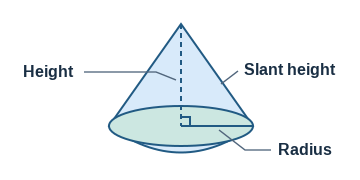
A cone with a dashed perpendicular height and a marked slant edge.

Volume uses the perpendicular height. The curved surface uses the slant height.

Worked example

Find the volume of a rectangular pyramid

A pyramid has a rectangular base 9 cm by 10 cm and perpendicular height 12 cm. Find its volume.

Rectangular pyramid base 9 cm by 10 cm. Dashed perpendicular height 12 cm.

  1. Multiply the base area by the perpendicular height and take one third.

  2. 9×10×123=360\frac{9\times 10\times 12}{3}=360.

  3. The result is 360360 cm³.

Your turn

A pyramid has a rectangular base 22 cm by 9 cm and perpendicular height 14 cm. Find its volume.

Rectangular pyramid base 22 cm by 9 cm. Dashed perpendicular height 14 cm.

Enter one number. Fractions and decimals are accepted.

Worked example

Find the volume of a rectangular pyramid

A pyramid has a rectangular base 14 cm by 8 cm and perpendicular height 6 cm. Find its volume.
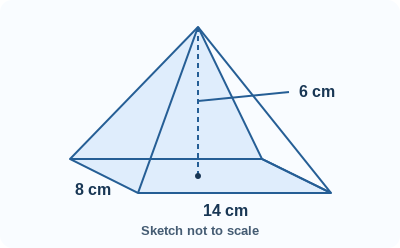
Rectangular pyramid base 14 cm by 8 cm. Dashed perpendicular height 6 cm.

Try it on paper first.

  1. Multiply the base area by the perpendicular height and take one third.

  2. 14×8×63=224\frac{14\times 8\times 6}{3}=224.

  3. The result is 224224 cm³.

Your turn

A pyramid has a rectangular base 27 cm by 7 cm and perpendicular height 8 cm. Find its volume.

Rectangular pyramid base 27 cm by 7 cm. Dashed perpendicular height 8 cm.

Enter one number. Fractions and decimals are accepted.

Section 2 of 3 · Core · about 8 min

Which height belongs in each cone formula?

Measure vertical height to the base centre at a right angle. Follow the slope from the apex to the circle to see the slant height.

Worked example

Find the total surface area of a cone

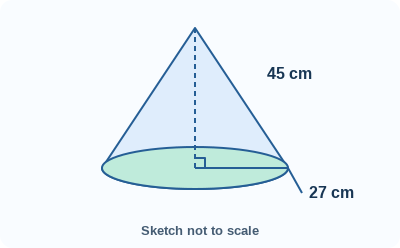
A solid cone has radius 27 cm and slant height 45 cm. Find its total surface area. Give your answer in terms of π\pi.

Cone radius 27 cm, slant height 45 cm.

  1. Use the slant height for the curved face. Add the circular base area.

  2. π×27×45+π×272=1944π\pi\times 27\times 45+\pi\times 27^2=1944\pi.

  3. The result is 1944π1944\pi cm².

Your turn

A cone has radius 66 cm, perpendicular height 88 cm and slant height 110 cm. Find its volume. Give your answer in terms of π\pi.

Cone radius 66 cm, slant height 110 cm. Dashed perpendicular height 88 cm.

Enter one number. Fractions and decimals are accepted.

Worked example

Find the volume of a cone

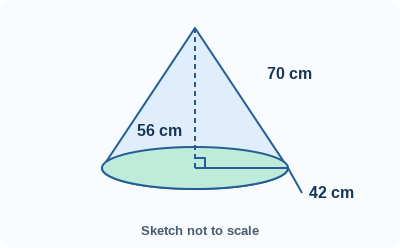
A cone has radius 42 cm, perpendicular height 56 cm and slant height 70 cm. Find its volume. Give your answer in terms of π\pi.

Cone radius 42 cm, slant height 70 cm. Dashed perpendicular height 56 cm.

Try it on paper first.

  1. Use the height from the centre of the base to the tip. Take a third of the matching cylinder's volume.

  2. π×422×563=32928π\frac{\pi\times 42^2\times 56}{3}=32928\pi.

  3. The result is 32928π32928\pi cm³.

Your turn

A solid cone has radius 81 cm and slant height 135 cm. Find its total surface area. Give your answer in terms of π\pi.

Cone radius 81 cm, slant height 135 cm.

Enter one number. Fractions and decimals are accepted.

Section 3 of 3 · Core · about 8 min

How can a net help with a square pyramid?

The four side faces unfold to triangles. The height of a triangle lies inside that flat face.

Worked example

Find surface area from a square-pyramid net

A square pyramid has base side 60 cm, face slant height 50 cm and perpendicular height 40 cm. Find its total surface area.

Square pyramid net. Each base edge is 60 cm. Face slant height 50 cm. The internal height 40 cm is not part of the net.

  1. Add one square base and the four triangular faces. Use the perpendicular height within each triangular face.

  2. 602+4×60×502=960060^2+4\times\frac{60\times 50}{2}=9600.

  3. The result is 96009600 cm².

Your turn

A square pyramid has base side 138 cm, face slant height 115 cm and perpendicular height 92 cm. Find its total surface area.

Square pyramid net. Each base edge is 138 cm. Face slant height 115 cm. The internal height 92 cm is not part of the net.

Enter one number. Fractions and decimals are accepted.

Worked example

Find surface area from a square-pyramid net

A square pyramid has base side 90 cm, face slant height 75 cm and perpendicular height 60 cm. Find its total surface area.

Square pyramid net. Each base edge is 90 cm. Face slant height 75 cm. The internal height 60 cm is not part of the net.

Try it on paper first.

  1. Add one square base and the four triangular faces. Use the perpendicular height within each triangular face.

  2. 902+4×90×752=2160090^2+4\times\frac{90\times 75}{2}=21600.

  3. The result is 2160021600 cm².

Your turn

A square pyramid has base side 168 cm, face slant height 140 cm and perpendicular height 112 cm. Find its total surface area.

Square pyramid net. Each base edge is 168 cm. Face slant height 140 cm. The internal height 112 cm is not part of the net.

Enter one number. Fractions and decimals are accepted.

Worked examples

Practise the method

Core practice

Question 1 of 5

0 / 5 checked in this collection

Question list

Core practice

Fresh variants

Exam-style

Find the volume of a rectangular pyramid

1 mark

A pyramid has a rectangular base 45 cm by 4 cm and perpendicular height 15 cm. Find its volume.

Rectangular pyramid base 45 cm by 4 cm. Dashed perpendicular height 15 cm.

Enter one number. Fractions and decimals are accepted.

Full answer-format guide

Exact numbers: 3/2, sqrt(5), 2-sqrt(3), pi/6, 3*pi/2. Sets: {1,4}. Intervals: (3,5]; a round bracket excludes the endpoint. Infinity: inf; union: U; no solutions: empty. Separate coordinate pairs or triples with semicolons. Expressions: 2x^2+3x-1; equations: x^2=3x+1 or the polynomial equal to zero. Factors: x-1 ; x+2. Parameter fraction: numerator ; denominator. List integer answers individually.

Review the method

Progress stays in this browser. Create an account to save it or sign in.

Extra practice from this lesson

A pyramid has a rectangular base 34 cm by 7 cm and perpendicular height 15 cm. Find its volume.

Rectangular pyramid base 34 cm by 7 cm. Dashed perpendicular height 15 cm.

Enter one number. Fractions and decimals are accepted.

A pyramid has a rectangular base 35 cm by 8 cm and perpendicular height 16 cm. Find its volume.

Rectangular pyramid base 35 cm by 8 cm. Dashed perpendicular height 16 cm.

Enter an exact value or round to 3 significant figures.

A cone has radius 108 cm, perpendicular height 144 cm and slant height 180 cm. Find its volume. Give your answer in terms of π\pi.

Cone radius 108 cm, slant height 180 cm. Dashed perpendicular height 144 cm.

Enter one number. Fractions and decimals are accepted.

A solid cone has radius 111 cm and slant height 185 cm. Find its total surface area. Give your answer in terms of π\pi.

Cone radius 111 cm, slant height 185 cm.

Enter one number. Fractions and decimals are accepted.

A square pyramid has base side 234 cm, face slant height 195 cm and perpendicular height 156 cm. Find its total surface area.

Square pyramid net. Each base edge is 234 cm. Face slant height 195 cm. The internal height 156 cm is not part of the net.

Enter one number. Fractions and decimals are accepted.

A square pyramid has base side 240 cm, face slant height 200 cm and perpendicular height 160 cm. Find its total surface area.

Square pyramid net. Each base edge is 240 cm. Face slant height 200 cm. The internal height 160 cm is not part of the net.

Enter one number. Fractions and decimals are accepted.

Apply it · original exam-style problems

Show your working on paper and compare it with the worked solution and marking guidance.

Come back to what needs practice

Quick revision sheet (A4)

Your review plan starts after your first check.