Maths4UBETA

Perimeter and area of straight-sided shapes

Decide whether to trace the boundary or cover the inside, then use perpendicular heights.

Try the quick check →
Lesson 3 of 13

Section 1 of 3 · Core · about 8 min

When should I add and when should I multiply?

A border has a length. A covering has an area. Trace the four sides for the first and count square units for the second.

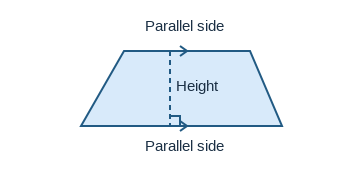
Trapezium with two parallel sides and dashed perpendicular height.

Mark the height at right angles. The sloping side is a different length.

Worked example

Find the perimeter of a rectangle

A rectangular exercise area is 14 m by 11 m. How long is its boundary?
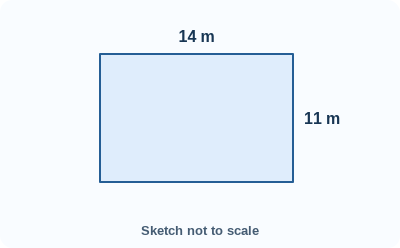
Rectangle 14 m by 11 m.

  1. Trace its four outer edges. Each of the two dimensions appears twice.

  2. 2(14+11)=502(14+11)=50.

  3. The result is 5050 m.

Your turn

A rectangle has length 27 m and width 13 m. Find its area.

Rectangle 27 m by 13 m.

Enter one number. Fractions and decimals are accepted.

Worked example

Find the area of a rectangle

A rectangle has length 19 m and width 5 m. Find its area.
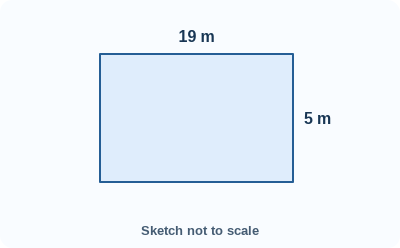
Rectangle 19 m by 5 m.

Try it on paper first.

  1. Count the rows of square units by multiplying the two dimensions.

  2. 19×5=9519\times 5=95.

  3. The result is 9595 m².

Your turn

A rectangular exercise area is 32 m by 7 m. How long is its boundary?

Rectangle 32 m by 7 m.

Enter one number. Fractions and decimals are accepted.

Section 2 of 3 · Core · about 8 min

Which height belongs in the area calculation?

Put your base at the bottom of the sketch. Draw the height at right angles to it, even when the line lies outside the shape.

Worked example

Use the perpendicular height of a parallelogram

A parallelogram has base 15 cm and perpendicular height 5 cm. Find its area.

Parallelogram base 15 cm and dashed perpendicular height 5 cm.

  1. Use the height measured at a right angle to the base.

  2. 15×5=7515\times 5=75.

  3. The result is 7575 cm².

Your turn

A triangle has base 28 cm and perpendicular height 3 cm. Find its area.

Triangle base 28 cm and dashed perpendicular height 3 cm.

Enter one number. Fractions and decimals are accepted.

Worked example

Use the perpendicular height of a triangle

A triangle has base 20 cm and perpendicular height 5 cm. Find its area.

Triangle base 20 cm and dashed perpendicular height 5 cm.

Try it on paper first.

  1. Use the height measured at a right angle to the base. Take half the product for a triangle.

  2. 12×20×5=50\tfrac12\times 20\times 5=50.

  3. The result is 5050 cm².

Your turn

A parallelogram has base 33 cm and perpendicular height 3 cm. Find its area.

Parallelogram base 33 cm and dashed perpendicular height 3 cm.

Enter one number. Fractions and decimals are accepted.

Section 3 of 3 · Core · about 8 min

How do I use the two parallel sides of a trapezium?

Imagine replacing the two parallel sides by a single average length. The average multiplied by the gap gives the area.

Worked example

Find the area of a trapezium

The parallel sides of a trapezium are 16 cm and 13 cm long. They are 6 cm apart. Find the area.

Trapezium parallel sides 13 cm and 16 cm. Perpendicular height 6 cm.

  1. Average the two parallel lengths. Multiply that average by their perpendicular separation.

  2. 16+132×6=87\frac{16+13}{2}\times 6=87.

  3. The result is 8787 cm².

Your turn

The parallel sides of a trapezium are 29 cm and 15 cm long. They are 4 cm apart. Find the area.

Trapezium parallel sides 15 cm and 29 cm. Perpendicular height 4 cm.

Enter one number. Fractions and decimals are accepted.

Worked example

Find the area of a trapezium

The parallel sides of a trapezium are 21 cm and 7 cm long. They are 6 cm apart. Find the area.

Trapezium parallel sides 7 cm and 21 cm. Perpendicular height 6 cm.

Try it on paper first.

  1. Average the two parallel lengths. Multiply that average by their perpendicular separation.

  2. 21+72×6=84\frac{21+7}{2}\times 6=84.

  3. The result is 8484 cm².

Your turn

The parallel sides of a trapezium are 34 cm and 9 cm long. They are 4 cm apart. Find the area.

Trapezium parallel sides 9 cm and 34 cm. Perpendicular height 4 cm.

Enter one number. Fractions and decimals are accepted.

Worked examples

Practise the method

Core practice

Question 1 of 5

0 / 5 checked in this collection

Question list

Core practice

Fresh variants

Exam-style

Find the perimeter of a rectangle

1 mark

A rectangular exercise area is 50 m by 14 m. How long is its boundary?
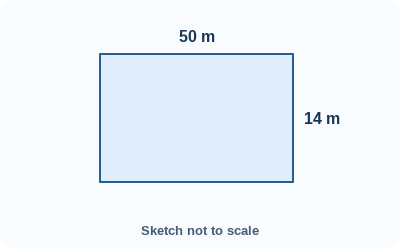
Rectangle 50 m by 14 m.

Enter one number. Fractions and decimals are accepted.

Full answer-format guide

Exact numbers: 3/2, sqrt(5), 2-sqrt(3), pi/6, 3*pi/2. Sets: {1,4}. Intervals: (3,5]; a round bracket excludes the endpoint. Infinity: inf; union: U; no solutions: empty. Separate coordinate pairs or triples with semicolons. Expressions: 2x^2+3x-1; equations: x^2=3x+1 or the polynomial equal to zero. Factors: x-1 ; x+2. Parameter fraction: numerator ; denominator. List integer answers individually.

Review the method

Progress stays in this browser. Create an account to save it or sign in.

Extra practice from this lesson

A rectangle has length 39 m and width 14 m. Find its area.

Rectangle 39 m by 14 m.

Enter one number. Fractions and decimals are accepted.

A rectangular exercise area is 40 m by 15 m. How long is its boundary?

Rectangle 40 m by 15 m.

Enter one number. Fractions and decimals are accepted.

A triangle has base 42 cm and perpendicular height 7 cm. Find its area.

Triangle base 42 cm and dashed perpendicular height 7 cm.

Enter one number. Fractions and decimals are accepted.

A parallelogram has base 43 cm and perpendicular height 3 cm. Find its area.

Parallelogram base 43 cm and dashed perpendicular height 3 cm.

Enter one number. Fractions and decimals are accepted.

The parallel sides of a trapezium are 45 cm and 9 cm long. They are 5 cm apart. Find the area.

Trapezium parallel sides 9 cm and 45 cm. Perpendicular height 5 cm.

Enter one number. Fractions and decimals are accepted.

The parallel sides of a trapezium are 46 cm and 10 cm long. They are 6 cm apart. Find the area.

Trapezium parallel sides 10 cm and 46 cm. Perpendicular height 6 cm.

Enter one number. Fractions and decimals are accepted.

Apply it · original exam-style problems

Show your working on paper and compare it with the worked solution and marking guidance.

Come back to what needs practice

Quick revision sheet (A4)

Your review plan starts after your first check.