Maths4UBETA

Cuboids, prisms and cylinders

Find volume from cross-sections and surface area by adding exposed faces.

Try the quick check →
Lesson 7 of 13

Section 1 of 3 · Core · about 8 min

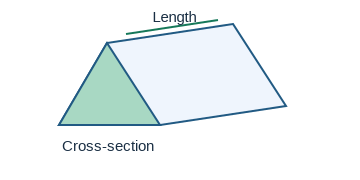
Which cross-section is repeated?

Imagine moving a flat end face along the solid. Every slice parallel to that end stays the same size.

Triangular prism with one triangular end highlighted.

The prism keeps the same cross-section throughout its length.

Worked example

Find the volume of a triangular prism

A prism has a triangular cross-section with base 12 cm and perpendicular height 9 cm. Its length is 3 cm. Find its volume.
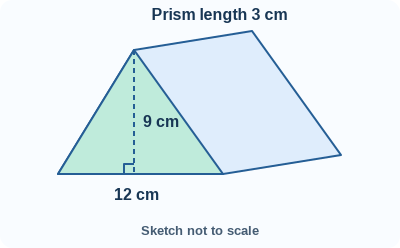
Triangular prism with base 12 cm, perpendicular height 9 cm and prism length 3 cm.

  1. Find the area of one triangular end. Multiply it by the constant length of the prism.

  2. 12×92×3=162\frac{12\times 9}{2}\times 3=162.

  3. The result is 162162 cm³.

Your turn

A prism has a triangular cross-section with base 25 cm and perpendicular height 8 cm. Its length is 6 cm. Find its volume.

Triangular prism with base 25 cm, perpendicular height 8 cm and prism length 6 cm.

Enter one number. Fractions and decimals are accepted.

Worked example

Find the volume of a triangular prism

A prism has a triangular cross-section with base 17 cm and perpendicular height 7 cm. Its length is 3 cm. Find its volume.

Triangular prism with base 17 cm, perpendicular height 7 cm and prism length 3 cm.

Try it on paper first.

  1. Find the area of one triangular end. Multiply it by the constant length of the prism.

  2. 17×72×3=3572\frac{17\times 7}{2}\times 3=\frac{357}{2}.

  3. The result is 3572\frac{357}{2} cm³.

Your turn

A prism has a triangular cross-section with base 30 cm and perpendicular height 6 cm. Its length is 6 cm. Find its volume.

Triangular prism with base 30 cm, perpendicular height 6 cm and prism length 6 cm.

Enter one number. Fractions and decimals are accepted.

Section 2 of 3 · Core · about 8 min

How can I count all the faces?

Draw a net or list each pair of opposite faces. In a cuboid the three different pairs use different combinations of side lengths.

Worked example

Find the surface area of a cuboid

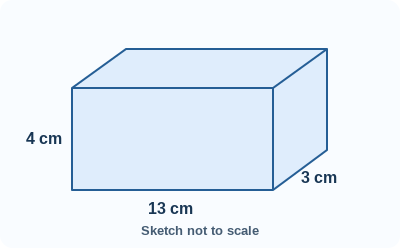
A sealed cuboid measures 13 cm by 3 cm by 4 cm. Find its total surface area.

Cuboid dimensions 13 cm by 3 cm by 4 cm.

  1. Find the area of one face from each pair of opposites. Double the sum.

  2. 2(39+52+12)=2062(39+52+12)=206.

  3. The result is 206206 cm².

Your turn

A sealed cuboid measures 26 cm by 9 cm by 2 cm. Find its total surface area.

Cuboid dimensions 26 cm by 9 cm by 2 cm.

Enter one number. Fractions and decimals are accepted.

Worked example

Find the surface area of a cuboid

A sealed cuboid measures 18 cm by 8 cm by 4 cm. Find its total surface area.

Cuboid dimensions 18 cm by 8 cm by 4 cm.

Try it on paper first.

  1. Find the area of one face from each pair of opposites. Double the sum.

  2. 2(144+72+32)=4962(144+72+32)=496.

  3. The result is 496496 cm².

Your turn

A sealed cuboid measures 31 cm by 7 cm by 2 cm. Find its total surface area.

Cuboid dimensions 31 cm by 7 cm by 2 cm.

Enter one number. Fractions and decimals are accepted.

Section 3 of 3 · Core · about 8 min

How can I find the curved surface of a cylinder?

Unroll the curved wall. One side of the rectangle is the full circumference of the circular end. The other side is the cylinder's height.

A cylinder net is a rectangle with a circular end above and below it.

The rectangle wraps around the circular ends. Its width becomes the circumference, and its height stays the height of the cylinder.

Worked example

Find the volume of a cylinder

A closed cylinder has radius 14 cm and vertical height 5 cm. Find its volume. Give your answer in terms of π\pi.

Cylinder radius 14 cm and perpendicular height 5 cm.

  1. Multiply the area of one circular cross-section by the height.

  2. π×142×5=980π\pi\times 14^2\times 5=980\pi.

  3. The result is 980π980\pi cm³.

Your turn

A closed cylinder has radius 27 cm and vertical height 3 cm. Find its total surface area. Give your answer in terms of π\pi.

Cylinder radius 27 cm and perpendicular height 3 cm.

Enter one number. Fractions and decimals are accepted.

Worked example

Find the total surface area of a cylinder

A closed cylinder has radius 19 cm and vertical height 5 cm. Find its total surface area. Give your answer in terms of π\pi.

Cylinder radius 19 cm and perpendicular height 5 cm.

Try it on paper first.

  1. Unroll the curved wall into a rectangle. Add the two circular end caps.

  2. 2π×19×5+2π×192=912π2\pi\times 19\times 5+2\pi\times 19^2=912\pi.

  3. The result is 912π912\pi cm².

Your turn

A closed cylinder has radius 32 cm and vertical height 3 cm. Find its volume. Give your answer in terms of π\pi.

Cylinder radius 32 cm and perpendicular height 3 cm.

Enter one number. Fractions and decimals are accepted.

Worked examples

Practise the method

Core practice

Question 1 of 5

0 / 5 checked in this collection

Question list

Core practice

Fresh variants

Exam-style

Find the volume of a triangular prism

1 mark

A prism has a triangular cross-section with base 48 cm and perpendicular height 3 cm. Its length is 4 cm. Find its volume.

Triangular prism with base 48 cm, perpendicular height 3 cm and prism length 4 cm.

Enter one number. Fractions and decimals are accepted.

Full answer-format guide

Exact numbers: 3/2, sqrt(5), 2-sqrt(3), pi/6, 3*pi/2. Sets: {1,4}. Intervals: (3,5]; a round bracket excludes the endpoint. Infinity: inf; union: U; no solutions: empty. Separate coordinate pairs or triples with semicolons. Expressions: 2x^2+3x-1; equations: x^2=3x+1 or the polynomial equal to zero. Factors: x-1 ; x+2. Parameter fraction: numerator ; denominator. List integer answers individually.

Review the method

Progress stays in this browser. Create an account to save it or sign in.

Extra practice from this lesson

A prism has a triangular cross-section with base 37 cm and perpendicular height 6 cm. Its length is 3 cm. Find its volume.

Triangular prism with base 37 cm, perpendicular height 6 cm and prism length 3 cm.

Enter one number. Fractions and decimals are accepted.

A prism has a triangular cross-section with base 38 cm and perpendicular height 7 cm. Its length is 4 cm. Find its volume.

Triangular prism with base 38 cm, perpendicular height 7 cm and prism length 4 cm.

Enter one number. Fractions and decimals are accepted.

A sealed cuboid measures 40 cm by 9 cm by 6 cm. Find its total surface area.

Cuboid dimensions 40 cm by 9 cm by 6 cm.

Enter one number. Fractions and decimals are accepted.

A sealed cuboid measures 41 cm by 3 cm by 2 cm. Find its total surface area.

Cuboid dimensions 41 cm by 3 cm by 2 cm.

Enter one number. Fractions and decimals are accepted.

A closed cylinder has radius 43 cm and vertical height 4 cm. Find its total surface area. Give your answer in terms of π\pi.

Cylinder radius 43 cm and perpendicular height 4 cm.

Enter one number. Fractions and decimals are accepted.

A closed cylinder has radius 44 cm and vertical height 5 cm. Find its volume. Give your answer in terms of π\pi.

Cylinder radius 44 cm and perpendicular height 5 cm.

Enter one number. Fractions and decimals are accepted.

Apply it · original exam-style problems

Show your working on paper and compare it with the worked solution and marking guidance.

Come back to what needs practice

Quick revision sheet (A4)

Your review plan starts after your first check.