Maths4UBETA

Major and minor arcs and sectors (Extended)

Work with any central angle, either of two sectors and reverse calculations.

Try the quick check →
Lesson 6 of 13

Section 1 of 3 · Core · about 8 min

How do I use an angle that does not divide 360° exactly?

The fraction of the full turn is still the angle divided by 360°. Leave the fraction exact until the final step.

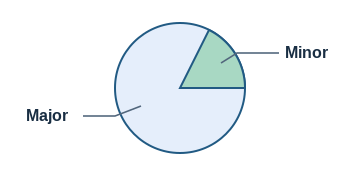
Two radii split a circle into a small shaded sector and a larger sector.

The angles at the centre add to one full turn. Choose the angle inside the requested region.

Worked example

Use the marked angle for the minor sector

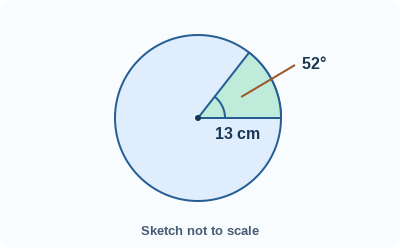
Two radii of a circle of radius 13 cm enclose a minor angle of 52∘52^\circ. Find the area of the minor sector. Give your answer in terms of π\pi.

Radius 13 cm and central angle 52°. The minor sector is shaded green.

  1. Use the given minor angle. Multiply the whole-circle measurement by its fraction of a full turn.

  2. 52360×169π=219790π\frac{52}{360}\times 169\pi=\frac{2197}{90}\pi.

  3. The result is 219790π\frac{2197}{90}\pi cm².

Your turn

Two radii of a circle of radius 26 cm enclose a minor angle of 65∘65^\circ. Find the arc length of the minor sector. Give your answer in terms of π\pi.

Radius 26 cm and central angle 65°. The minor sector is shaded green.

Enter one number. Fractions and decimals are accepted.

Worked example

Use the marked angle for the minor sector

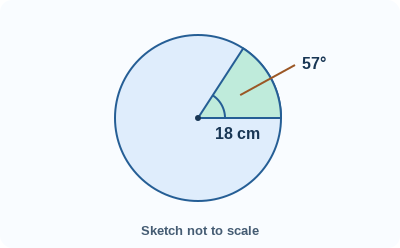
Two radii of a circle of radius 18 cm enclose a minor angle of 57∘57^\circ. Find the arc length of the minor sector. Give your answer in terms of π\pi.

Radius 18 cm and central angle 57°. The minor sector is shaded green.

Try it on paper first.

  1. Use the given minor angle. Multiply the whole-circle measurement by its fraction of a full turn.

  2. 57360×36π=5710π\frac{57}{360}\times 36\pi=\frac{57}{10}\pi.

  3. The result is 5710π\frac{57}{10}\pi cm.

Your turn

Two radii of a circle of radius 31 cm enclose a minor angle of 70∘70^\circ. Find the area of the minor sector. Give your answer in terms of π\pi.

Radius 31 cm and central angle 70°. The minor sector is shaded green.

Enter one number. Fractions and decimals are accepted.

Section 2 of 3 · Core · about 8 min

Which angle describes the larger sector?

The radii make two angles around the centre. Shade the sector you want. Subtract the smaller angle from a full turn when you need the larger one.

Worked example

Use the reflex angle for the major sector

Two radii of a circle of radius 14 cm enclose a minor angle of 53∘53^\circ. Find the arc length of the major sector. Give your answer in terms of π\pi.

Radius 14 cm and central angle 53°. The major sector is shaded green.

  1. The major angle is 360° minus 53°. Multiply the whole-circle measurement by its fraction of a full turn.

  2. 307360×28π=214990π\frac{307}{360}\times 28\pi=\frac{2149}{90}\pi.

  3. The result is 214990π\frac{2149}{90}\pi cm.

Your turn

Two radii of a circle of radius 27 cm enclose a minor angle of 66∘66^\circ. Find the area of the major sector. Give your answer in terms of π\pi.

Radius 27 cm and central angle 66°. The major sector is shaded green.

Enter one number. Fractions and decimals are accepted.

Worked example

Use the reflex angle for the major sector

Two radii of a circle of radius 19 cm enclose a minor angle of 58∘58^\circ. Find the area of the major sector. Give your answer in terms of π\pi.

Radius 19 cm and central angle 58°. The major sector is shaded green.

Try it on paper first.

  1. The major angle is 360° minus 58°. Multiply the whole-circle measurement by its fraction of a full turn.

  2. 302360×361π=54511180π\frac{302}{360}\times 361\pi=\frac{54511}{180}\pi.

  3. The result is 54511180π\frac{54511}{180}\pi cm².

Your turn

Two radii of a circle of radius 32 cm enclose a minor angle of 71∘71^\circ. Find the arc length of the major sector. Give your answer in terms of π\pi.

Radius 32 cm and central angle 71°. The major sector is shaded green.

Enter one number. Fractions and decimals are accepted.

Section 3 of 3 · Core · about 8 min

Can I work back from an arc length?

Divide the arc length by the full circumference. The result is the fraction of the turn, so multiply by 360° to get the angle.

Worked example

Find the angle from an arc length

A minor arc is 92π\frac{9}{2}\pi cm long on a circle of radius 15 cm. Find its central angle in degrees.

  1. Compare the arc length with the full circumference, then multiply the fraction by 360°.

  2. 360×92π30π=54360\times\frac{\frac{9}{2}\pi}{30\pi}=54.

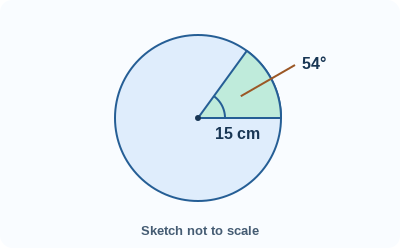
  3. Radius 15 cm and central angle 54°. The minor sector is shaded green.

  4. The result is 5454 degrees.

Your turn

A minor arc is 46945π\frac{469}{45}\pi cm long on a circle of radius 28 cm. Find its central angle in degrees.

Enter the angle in degrees.

Worked example

Find the angle from an arc length

A minor arc is 599π\frac{59}{9}\pi cm long on a circle of radius 20 cm. Find its central angle in degrees.

Try it on paper first.

  1. Compare the arc length with the full circumference, then multiply the fraction by 360°.

  2. 360×599π40π=59360\times\frac{\frac{59}{9}\pi}{40\pi}=59.

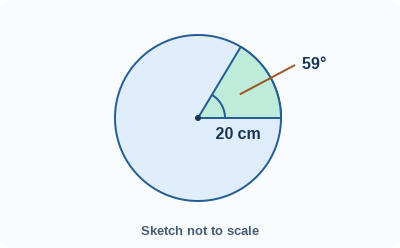
  3. Radius 20 cm and central angle 59°. The minor sector is shaded green.

  4. The result is 5959 degrees.

Your turn

A minor arc is 665π\frac{66}{5}\pi cm long on a circle of radius 33 cm. Find its central angle in degrees.

Enter the angle in degrees.

Worked examples

Practise the method

Core practice

Question 1 of 5

0 / 5 checked in this collection

Question list

Core practice

Fresh variants

Exam-style

Use the marked angle for the minor sector

1 mark

Two radii of a circle of radius 49 cm enclose a minor angle of 49∘49^\circ. Find the area of the minor sector. Give your answer in terms of π\pi.

Radius 49 cm and central angle 49°. The minor sector is shaded green.

Enter one number. Fractions and decimals are accepted.

Full answer-format guide

Exact numbers: 3/2, sqrt(5), 2-sqrt(3), pi/6, 3*pi/2. Sets: {1,4}. Intervals: (3,5]; a round bracket excludes the endpoint. Infinity: inf; union: U; no solutions: empty. Separate coordinate pairs or triples with semicolons. Expressions: 2x^2+3x-1; equations: x^2=3x+1 or the polynomial equal to zero. Factors: x-1 ; x+2. Parameter fraction: numerator ; denominator. List integer answers individually.

Review the method

Progress stays in this browser. Create an account to save it or sign in.

Extra practice from this lesson

Two radii of a circle of radius 38 cm enclose a minor angle of 77∘77^\circ. Find the arc length of the minor sector. Give your answer in terms of π\pi.

Radius 38 cm and central angle 77°. The minor sector is shaded green.

Enter one number. Fractions and decimals are accepted.

Two radii of a circle of radius 39 cm enclose a minor angle of 78∘78^\circ. Find the area of the minor sector. Give your answer in terms of π\pi.

Radius 39 cm and central angle 78°. The minor sector is shaded green.

Enter one number. Fractions and decimals are accepted.

Two radii of a circle of radius 41 cm enclose a minor angle of 80∘80^\circ. Find the area of the major sector. Give your answer in terms of π\pi.

Radius 41 cm and central angle 80°. The major sector is shaded green.

Enter one number. Fractions and decimals are accepted.

Two radii of a circle of radius 42 cm enclose a minor angle of 81∘81^\circ. Find the arc length of the major sector. Give your answer in terms of π\pi.

Radius 42 cm and central angle 81°. The major sector is shaded green.

Enter one number. Fractions and decimals are accepted.

A minor arc is 91345π\frac{913}{45}\pi cm long on a circle of radius 44 cm. Find its central angle in degrees.

Enter the angle in degrees.

A minor arc is 21π21\pi cm long on a circle of radius 45 cm. Find its central angle in degrees.

Enter the angle in degrees.

Apply it · original exam-style problems

Show your working on paper and compare it with the worked solution and marking guidance.

Come back to what needs practice

Quick revision sheet (A4)

Your review plan starts after your first check.