Maths4UBETA

Compound solids and exposed surfaces

Add or subtract volumes and count the faces you can reach from outside a solid.

Try the quick check →
Lesson 12 of 13

Section 1 of 3 · Core · about 8 min

Where can I split a joined solid?

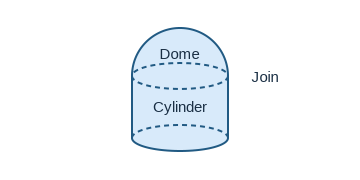
Mark the join between the parts. Label each part with a familiar name, then find the volume of each.

A curved hemisphere joins the top of a cylinder along a dashed seam.

The seam is useful when splitting the volume. A pair of surfaces hidden at the seam does not count in external area.

Worked example

Add the volumes of a cylinder and hemisphere

A solid is made from a cylinder of radius 10 cm and height 11 cm and a hemisphere of the same radius. Find its volume. Give your answer in terms of π\pi.

Cylinder height 11 cm and hemisphere have common radius 10 cm. The dashed seam is internal.

  1. Split the solid at the join. Add the cylinder volume and half the volume of a sphere.

  2. 102π×11+23π×103=53003π10^2\pi\times 11+\frac23\pi\times 10^3=\frac{5300}{3}\pi.

  3. The result is 53003π\frac{5300}{3}\pi cm³.

Your turn

A solid is made from a cylinder of radius 23 cm and height 13 cm and a hemisphere of the same radius. Find its volume. Give your answer in terms of π\pi.

Cylinder height 13 cm and hemisphere have common radius 23 cm. The dashed seam is internal.

Enter one number. Fractions and decimals are accepted.

Worked example

Add the volumes of a cylinder and hemisphere

A solid is made from a cylinder of radius 15 cm and height 5 cm and a hemisphere of the same radius. Find its volume. Give your answer in terms of π\pi.

Cylinder height 5 cm and hemisphere have common radius 15 cm. The dashed seam is internal.

Try it on paper first.

  1. Split the solid at the join. Add the cylinder volume and half the volume of a sphere.

  2. 152π×5+23π×153=3375π15^2\pi\times 5+\frac23\pi\times 15^3=3375\pi.

  3. The result is 3375π3375\pi cm³.

Your turn

A solid is made from a cylinder of radius 28 cm and height 7 cm and a hemisphere of the same radius. Find its volume. Give your answer in terms of π\pi.

Cylinder height 7 cm and hemisphere have common radius 28 cm. The dashed seam is internal.

Enter one number. Fractions and decimals are accepted.

Section 2 of 3 · Core · about 8 min

Which faces can I touch from outside?

Imagine painting the finished solid. Paint reaches the sides and ends that are exposed. It cannot reach a join between two parts.

Worked example

Count exposed surfaces of a joined solid

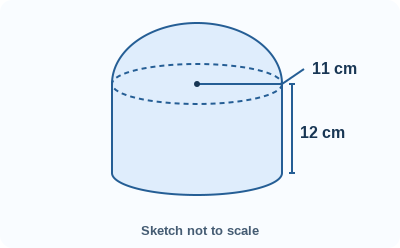
A hemisphere sits on and exactly covers a cylinder's top. Both have radius 11 cm. The cylinder is 12 cm tall. Find the total external surface area, including the base. Give your answer in terms of π\pi.

Cylinder height 12 cm and hemisphere have common radius 11 cm. The dashed seam is internal.

  1. Count the curved cylinder wall, the curved hemisphere and the bottom circular face. The two faces at the join are inside.

  2. 2π×11×12+2π×112+π×112=627π2\pi\times 11\times 12+2\pi\times 11^2+\pi\times 11^2=627\pi.

  3. The result is 627π627\pi cm².

Your turn

A hemisphere sits on and exactly covers a cylinder's top. Both have radius 24 cm. The cylinder is 14 cm tall. Find the total external surface area, including the base. Give your answer in terms of π\pi.

Cylinder height 14 cm and hemisphere have common radius 24 cm. The dashed seam is internal.

Enter one number. Fractions and decimals are accepted.

Worked example

Count exposed surfaces of a joined solid

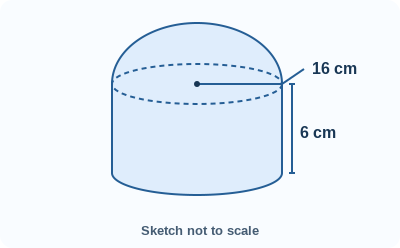
A hemisphere sits on and exactly covers a cylinder's top. Both have radius 16 cm. The cylinder is 6 cm tall. Find the total external surface area, including the base. Give your answer in terms of π\pi.

Cylinder height 6 cm and hemisphere have common radius 16 cm. The dashed seam is internal.

Try it on paper first.

  1. Count the curved cylinder wall, the curved hemisphere and the bottom circular face. The two faces at the join are inside.

  2. 2π×16×6+2π×162+π×162=960π2\pi\times 16\times 6+2\pi\times 16^2+\pi\times 16^2=960\pi.

  3. The result is 960π960\pi cm².

Your turn

A hemisphere sits on and exactly covers a cylinder's top. Both have radius 29 cm. The cylinder is 8 cm tall. Find the total external surface area, including the base. Give your answer in terms of π\pi.

Cylinder height 8 cm and hemisphere have common radius 29 cm. The dashed seam is internal.

Enter one number. Fractions and decimals are accepted.

Section 3 of 3 · Core · about 8 min

What changes when a hole goes right through?

Treat the hole as a smaller solid. Its length is the distance from the first opening to the second.

Worked example

Remove a cylindrical hole from a solid cylinder

A cylinder has radius 12 cm and height 13 cm. A hole of radius 3 cm is drilled straight through from top to bottom. Find the volume remaining. Give your answer in terms of π\pi.

Cylinder outer radius 12 cm and height 13 cm. Through-hole radius 3 cm.

  1. Subtract the volume of the full-height cylindrical hole from the original cylinder.

  2. π(122−32)×13=1755π\pi(12^2-3^2)\times 13=1755\pi.

  3. The result is 1755π1755\pi cm³.

Your turn

A cylinder has radius 25 cm and height 15 cm. A hole of radius 1 cm is drilled straight through from top to bottom. Find the volume remaining. Give your answer in terms of π\pi.

Cylinder outer radius 25 cm and height 15 cm. Through-hole radius 1 cm.

Enter one number. Fractions and decimals are accepted.

Worked example

Remove a cylindrical hole from a solid cylinder

A cylinder has radius 17 cm and height 7 cm. A hole of radius 2 cm is drilled straight through from top to bottom. Find the volume remaining. Give your answer in terms of π\pi.

Cylinder outer radius 17 cm and height 7 cm. Through-hole radius 2 cm.

Try it on paper first.

  1. Subtract the volume of the full-height cylindrical hole from the original cylinder.

  2. π(172−22)×7=1995π\pi(17^2-2^2)\times 7=1995\pi.

  3. The result is 1995π1995\pi cm³.

Your turn

A cylinder has radius 30 cm and height 9 cm. A hole of radius 3 cm is drilled straight through from top to bottom. Find the volume remaining. Give your answer in terms of π\pi.

Cylinder outer radius 30 cm and height 9 cm. Through-hole radius 3 cm.

Enter one number. Fractions and decimals are accepted.

Worked examples

Practise the method

Core practice

Question 1 of 5

0 / 5 checked in this collection

Question list

Core practice

Fresh variants

Exam-style

Add the volumes of a cylinder and hemisphere

1 mark

A solid is made from a cylinder of radius 46 cm and height 14 cm and a hemisphere of the same radius. Find its volume. Give your answer in terms of π\pi.

Cylinder height 14 cm and hemisphere have common radius 46 cm. The dashed seam is internal.

Enter one number. Fractions and decimals are accepted.

Full answer-format guide

Exact numbers: 3/2, sqrt(5), 2-sqrt(3), pi/6, 3*pi/2. Sets: {1,4}. Intervals: (3,5]; a round bracket excludes the endpoint. Infinity: inf; union: U; no solutions: empty. Separate coordinate pairs or triples with semicolons. Expressions: 2x^2+3x-1; equations: x^2=3x+1 or the polynomial equal to zero. Factors: x-1 ; x+2. Parameter fraction: numerator ; denominator. List integer answers individually.

Review the method

Progress stays in this browser. Create an account to save it or sign in.

Extra practice from this lesson

A solid is made from a cylinder of radius 35 cm and height 14 cm and a hemisphere of the same radius. Find its volume. Give your answer in terms of π\pi.

Cylinder height 14 cm and hemisphere have common radius 35 cm. The dashed seam is internal.

Enter one number. Fractions and decimals are accepted.

A solid is made from a cylinder of radius 36 cm and height 15 cm and a hemisphere of the same radius. Find its volume. Give your answer in terms of π\pi.

Cylinder height 15 cm and hemisphere have common radius 36 cm. The dashed seam is internal.

Enter one number. Fractions and decimals are accepted.

A hemisphere sits on and exactly covers a cylinder's top. Both have radius 38 cm. The cylinder is 6 cm tall. Find the total external surface area, including the base. Give your answer in terms of π\pi.

Cylinder height 6 cm and hemisphere have common radius 38 cm. The dashed seam is internal.

Enter one number. Fractions and decimals are accepted.

A hemisphere sits on and exactly covers a cylinder's top. Both have radius 39 cm. The cylinder is 7 cm tall. Find the total external surface area, including the base. Give your answer in terms of π\pi.

Cylinder height 7 cm and hemisphere have common radius 39 cm. The dashed seam is internal.

Enter one number. Fractions and decimals are accepted.

A cylinder has radius 41 cm and height 9 cm. A hole of radius 2 cm is drilled straight through from top to bottom. Find the volume remaining. Give your answer in terms of π\pi.

Cylinder outer radius 41 cm and height 9 cm. Through-hole radius 2 cm.

Enter one number. Fractions and decimals are accepted.

A cylinder has radius 42 cm and height 10 cm. A hole of radius 3 cm is drilled straight through from top to bottom. Find the volume remaining. Give your answer in terms of π\pi.

Cylinder outer radius 42 cm and height 10 cm. Through-hole radius 3 cm.

Enter one number. Fractions and decimals are accepted.

Apply it · original exam-style problems

Show your working on paper and compare it with the worked solution and marking guidance.

Come back to what needs practice

Quick revision sheet (A4)

Your review plan starts after your first check.